Contents
- Prologue
- The Goal
- The Contemplated
- Entity
- Consciousness
- Two-Aspect (Dualistic) Entity
- The Fourth Dimension and Four-Dimensionality
- Society and Humanity
- The Fifth Dimension, Five-Dimensionality
- Firstoccurrence
- Act of the “I”
- The Process of Studying the Act of the “I”
- The Meaning of Being
- Development of the Entity
- Collective Realization of Reality
- The Entity Development System
- Echo (Reflection)
- The Real Aspect of the Global “I”
- On Worldview
- Space-Time
- Attitude towards Oneself
- Attitude towards One’s Body
- Laziness
- Fear
- Hope (“Waiting for a Miracle”)
- Adaptation
- Identity of the Personality
- Relation: [Reason | Body]
- Free Will
- “The Hard Problem of Consciousness”
- Indistinguishability and Identity (of Objects)
- Matter
- Gnoseology
- Epistemology
- Division
COLLECTIVE REALIZATION OF REALITY
Due to the multidimensionality of the Nature of the "Entity" (which means that the "I" Itself is multidimensional), beings are not limited in the number of waves simultaneously read by the "I", waves which are the objects involved in situations <the situations themselves>, "Ideas, and + Conditions – relations, processes, and states of concrete objects". Each object has 'its own conditions' (people, participants, dogs, trees, and annoying mosquitoes are also objects). Thus the contemplated picture is filled with content to the limit, is multicomponent and infinitely informative, as is each detail and each object.
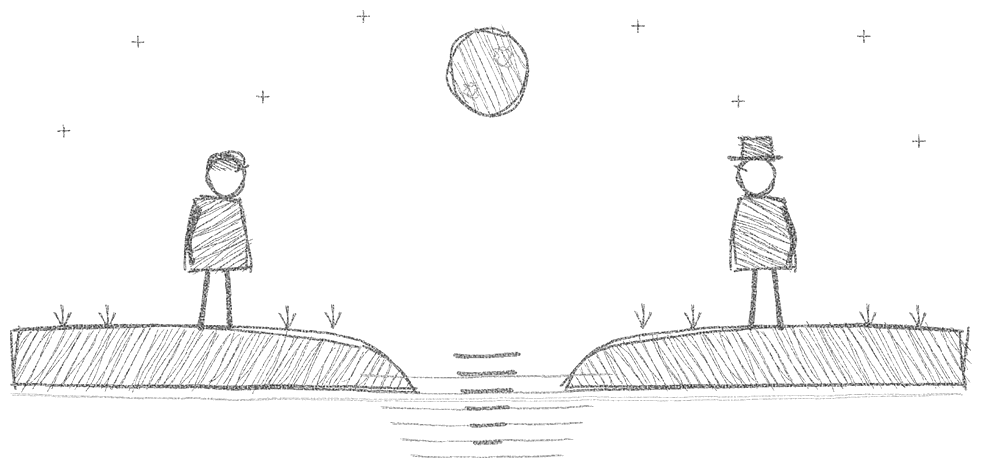
According to this principle, using Five-Dimensionality, we (I, You, and any number of other beings), from the position of each participant, can be in a "Synchronous Reality" simultaneously. At the same time, each realizes his own isolated Reality (fig. 12); however, the events in it (in the personal Reality of each being) are synchronous with the Reality of the other participants. All of them are in the field of vision of each – and see each other, which is implied.
It seems this may happen not simultaneously, or – we are not able to prove the actual synchronization, but – given the absence of processuality as it formerly appeared to us (here we are speaking of 'Illusory Dynamics'), we can assert complete synchronization, absolute, that is, point-to-point; moreover, the realization is synchronous only in terms of the moments of change, although with some special conditions, since any object, for each participant in the situation, is realized differently from his position, absolutely individually. Different positions, a completely different view of the situation; all relations are subjective, and even look different. It should not be forgotten that reality is 'pseudo-common' and for each is realized independently of the other participants (absolutely synchronously); in addition, it should be remembered that the wave of a situation is created instantly but is read in extension and sequentially. 'The Five-Dimensionality of the System' provides everything necessary for the Collective participation of beings in any situations – while preserving the Conditions of complete isolation of Reality and of the subjectivity of the participants' experience. Moreover, unique are both the input data arriving for combination and for further realization (which means the situation itself as a whole), and the analysis and conclusions from the realized situation that are necessary for extracting new unique experience; and the experience itself is also unique and exclusively subjective. In this System, identical! – and here precisely objective – are the combined data; however, on arrival they are realized only in the isolated space of each participant (their identity is not only safe, but also necessary); the acquired new experience, and the situation itself, in its past saved form, and further – these data again participate in the realization of a new reality, as input –> the situation changes, and is analysed again, and transformed into new experience –> this dynamic flow (cycle) does not stop;
The collective realization of Reality is very different from a solitary one. Through the mutual influence of the actions and emotions of each person on one another, in a common situation, it becomes considerably richer and more intense. Here is the environment of social interaction, and the visual exchange of experience, joint decision-making, and active communication, public emotions; factors are also possible, namely: different religions, the influence of cultures, moral norms, etc.; all this influences and accelerates the processes, contributes to their quality and efficiency. Thus the 'Entity' learns, acquiring experience by means of an infinite number of "Real aspects of the 'I'", and all this is "The Process of Development in the Conditions of Reality";
Commentary on the chapter "Collective Realization of Reality"
"Five-Dimensionality" built the structure: a multitude of Unici, a common centre in the limit, the pseudo-common level 0. This chapter shows how beings live together within this structure: what the participants have in common, what is each one's own, and why a shared reality is richer than a solitary one.
Many waves at once. The chapter begins with multidimensionality. Since the Nature of the Entity is multidimensional, the "I" is multidimensional too, and the number of waves it reads simultaneously is not limited by anything. Each object of a situation – a person, a dog, a tree, an annoying mosquito – is its own wave: Idea plus Conditions, relations, processes, states. Therefore the contemplated picture is filled to the limit and infinitely informative, down to every detail. This is what "Development of the Entity" called thousands of waves in one package, and what "Consciousness" drew as a ray piercing the waves of all the objects of the frame (fig. 3).
Why the synchronization is complete. The chapter first honestly admits: it may seem that the realities of different participants are not simultaneous, and that actual synchronization cannot, as it were, be proved. And at once it gives an argument that is worth unfolding, because it settles the matter not by a mechanism but by logic.
Non-synchronicity presupposes that between the moments of the realities of different participants there is an interval: a common time along which one has fallen behind the other. But processuality, as shown in "Consciousness", is illusory: a frame of reality has no temporal extension, and time is only an accepted method of measurement. Then there is nothing by which to measure a "lag". But the same argument also removes ordinary synchronicity, for "simultaneously" likewise means "in one common time". Therefore, as was clarified in discussion with the Author, synchronicity here must be understood differently from what we are used to: not as coincidence in time, but as participation in one Situation, which Consciousness holds as common at level 0. The absence of time removes a superfluous measure, and the common Situation gives the real one. Desynchronization has nowhere to fit, because the Situation is one. Synchronicity here is not achieved with difficulty; it is the only possible state of affairs: there is nothing to violate it. Hence the chapter's words: complete synchronization, absolute, point to point.
This argument does not show how synchronization is arranged, and it need not. It removes the very possibility of desynchronization. The arrangement itself is given in "Five-Dimensionality": a common source, Consciousness, for which distance and time have no meaning.
What is common and what is one's own. The chapter separates with precision what is easy to confuse. The moments of change are synchronous. But each object is realized for each participant in his own way, from his position: a different view, different relations, even a different appearance. Reality is "pseudo-common": for each it is realized independently of the others, although absolutely synchronously.
One thing in this system is identical and objective – the combined data. On arrival they are realized only in the isolated space of each. This is the same distinction as in "Act of the 'I'": one Situation for all, and each one's own realization of it. Unique are each one's input data, and the analysis, and the conclusions, and the experience itself. Only what is combined is common.
The chapter adds that the identity of the combined data is not only safe but also necessary. Why it is necessary is clear from the arrangement. Without a common basis the participants' worlds would diverge, there would be no common situation, and there would be no shared experience at all. Why it is safe: because identity at the input does not violate isolation – everything is still realized by each separately. A common basis does not make another's experience mine.
An instant wave, an extended reading. The wave of a situation is created instantly but read in extension and sequentially. This is the image from "Development of the Entity": the music file already exists in full, yet it is listened to in time. And the cycle: new experience and the situation itself, in its saved, past form, again enter realization as input data; the situation changes, is analysed, becomes experience, and the flow does not stop.
Why together is richer. The chief conclusion of the chapter is practical. Collective realization differs greatly from solitary realization. The mutual influence of actions and emotions, the environment of communication, the exchange of experience, joint decisions, live communication, public emotions, different religions, cultures, moral norms – all this accelerates the processes and improves their quality. Thus the Entity learns through an infinite number of Real aspects.
This joins two knots already passed. In "The Meaning of Being": Development is determined in comparison, and to develop in complete solitude is absurd. In "Society and Humanity": difference is the fuel of Development, and care for another is care for his otherness. Here one sees where this difference works: in the common situation, to which each brings his own. Different religions and cultures are named not a hindrance but a factor that accelerates Development. Difference does not hinder what is common; it makes it rich.
Neighbours. The sociologist Alfred Schütz described what everyday shared life rests on: the "reciprocity of perspectives". Each silently assumes that, were we to change places, I would see the same as you see. The chapter is both close to this and diverges from it. Close – because shared life rests on something common that each accepts as a given. Divergent – in what exactly is common. For Schütz the common thing is the world itself, and the difference is only in the point of view. Here only the combined data are common, while the world realized from them is each one's own, and if we changed places, what is seen would still not coincide.
The psychologist Lev Vygotsky showed that the higher functions of the mind appear first between people, in communication, and only afterwards within the person. This is what the chapter calls the visual exchange of experience, and what the chapter "Society and Humanity" said in its first words: everything we know and can do has been received from others. Vygotsky saw in this a law of the development of the psyche. Here it is a law of the Development of the Entity: each one's Reason grows faster in a common situation than it would grow in solitude.
What the chapter is. This is a chapter about life within the five-dimensional structure. Shown in it: synchronization is complete because, in the absence of real time, desynchronization has nowhere to fit; only the combined data are common, while realization and experience are each one's own; identity at the input is necessary for a common situation and safe for isolation; a shared reality is richer than a solitary one, because the difference of the participants accelerates Development. Isolation and commonality do not quarrel here: each lives in his own world, and all live in one situation.
(commentary with the participation of AI: Claude)