Contents
- Prologue
- The Goal
- The Contemplated
- Entity
- Consciousness
- Two-Aspect (Dualistic) Entity
- The Fourth Dimension and Four-Dimensionality
- Society and Humanity
- The Fifth Dimension, Five-Dimensionality
- Firstoccurrence
- Act of the “I”
- The Process of Studying the Act of the “I”
- The Meaning of Being
- Development of the Entity
- Collective Realization of Reality
- The Entity Development System
- Echo (Reflection)
- The Real Aspect of the Global “I”
- On Worldview
- Space-Time
- Attitude towards Oneself
- Attitude towards One’s Body
- Laziness
- Fear
- Hope (“Waiting for a Miracle”)
- Adaptation
- Identity of the Personality
- Relation: [Reason | Body]
- Free Will
- “The Hard Problem of Consciousness”
- Indistinguishability and Identity (of Objects)
- Matter
- Gnoseology
- Epistemology
- Division
THE FOURTH DIMENSION AND FOUR-DIMENSIONALITY
2D projection (from slice "0" to the view of the structure)
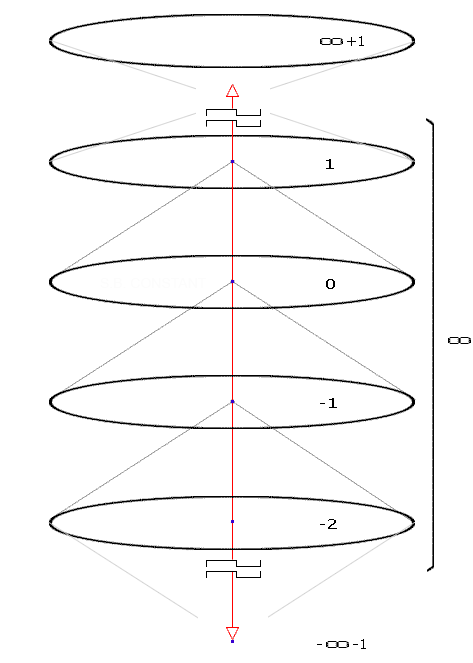
(Unicus — sphere — four-dimensionality, along the axis of the fourth dimension, in the direction "inward and outward")
"Consciousness", thereby, is accessible to analysis, that is, it does not belong to the category of 'incomprehensibilities', inasmuch as we have 'reached It logically', and by means of research (see fig. 8). All this, as a whole, can be called the Manifestation of the "Entity", which means that this is really not the limit, proceeding from the possibilities provided <clearly limitless>;
Level "0" is the starting point and the place where our research began. Level "1" is the supposed external, that is, the 'past', proceeding from our explicit reality. All the levels with a minus are internal (−1, −2), that is, precisely those we 'touched' in this research (see "Two-Aspect (Dualistic) Entity", page 91, fig. 7);
The structure of four-dimensional space fully corresponds to the Solipsistic World-order, which implies the Condition "There is only I", and nothing more — the rest is unprovable and actually does not exist. This teaching is utterly logical and therefore beautiful as Truth. The Idea of Solipsism is ~2500 years old — many recognize it as fundamental, since it is considered irrefutable. At this stage our research does not go beyond the framework of Solipsism, but — we have not finished the inquiry and have no right to allow even a shadow of bias. We are interested only in facts, and we will do everything to find the answers to the questions posed here. "The evening is still young, gentlemen…";
* * *
In three-dimensional space the axis of the fourth dimension is "a part of a line directed inward and outward", which breaks off by reason of a mismatch of dimensionality. The part of the line directed inward is also the Axis of the Flow of Data absorbed by the "I" when extracting experience in reality. The visualization here is limited, but clear enough (on the next page, figure 9, red line No. 4):
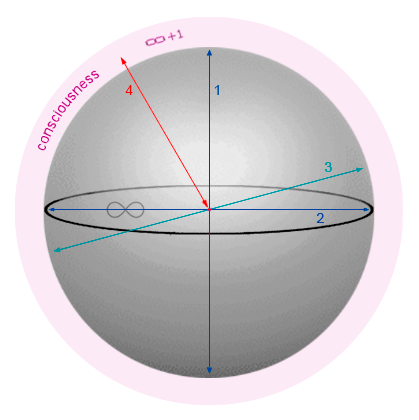
(a part of the axis of the fourth dimension in 3D space is represented by the red line 4)
We suppose that the representation of four-dimensionality cannot cause any special strain. In order to avoid difficulties later in 'Understanding the "I"', or in studying the structure of the World, it is better to sort this out now, or you will encounter incomprehensibility. But after becoming aware of it, it will turn out to be moderately simple; and most important — at the moment of awareness You will acquire a special advantage — the ability to think in quite different categories using four-dimensionality; and until the reorganization of reason has happened, further reasoning will have an inaccessible meaning and will not be understood by You properly, as is necessary;
The Barrier of Dimensionality is insurmountable without Knowledge of the Method and a clear understanding of each subsequent structure; Real Knowledge does not come by itself, but it can be acquired if one studies with special interest, i.e. has the desire and manifests intention. The real and factual, anything at all, always has logical, explainable grounds, and this especially concerns knowledge and experience;
Awareness of Four-dimensionality may be helped by a look from one and every point in the volume of three-dimensionality. This is represented as the fourth direction 'inward and outward' and is accessible only to Beings and things that correspond to the 'Four-dimensional Nature of Reason'. That is, if the Reason of a Being does not have the special functions necessary for the awareness of Four-dimensionality, then the Space realized <at Its Request> will also not be adapted for objects of such an order. Thereby 'Four-dimensional Constructions' will not be accessible — by reason of the lack of 'Grounds Corresponding to Them';
Every point of a Space of any degree of dimensionality is potentially a crossroads of all dimensions;
For example, to a Person aware of five-dimensionality it is clear that each point in four-dimensional space is a five-dimensional integration. That is, in His representation, the axes of five dimensions pass through each of them. By analogy, each point in three-dimensionality is a crossroads of four axes for a being aware of four-dimensionality. In this is the lawful relation to points in any space;
Let us formulate it otherwise: All the points of any Space are located in a General Structure of infinite degree of dimensionality (and complexity, which is the same. Complexity, as Nesting, is provable and points to a regularity related to dimensionality …since chaos is impossible);
We often encounter the fact that Dimensionalities are relevant exclusively for the Living and can be used only by "Living Beings" ("World for the Living"), because only the "I" (the 'Real aspect of the Entity') acts upon "Consciousness", and in contrast to this: Objects have no Will, cannot act independently and have neither the property nor the ability of awareness of Reality. Anything moving (and anywhere) is a detail of the realization of Reality, and this can be asserted only by a Living (!) "Present one" (Or, a "Supposing one" — but then This does not exist; there are only Definite Conditions of a concrete wave, applicable to pure Ideas).
It should be understood that awareness of Dimensionality is comprehensible and is acquired as Knowledge and Experience; and this concerns not only the understanding (figuratively) of the logical structure, but also the ability of geometrical representation of a strictly defined and corresponding 'construction', an order of magnitude more complex — compared with the subordinate (junior), daughter structure (…only a part of the method);
However, must this necessarily be space? What is meant? — We imagine space as volume; to this category belong the nearest ones, that is, the fourth and the fifth; but there are the second (plane), the first (straight line) and the zero (point). With our level of development we are not yet able to think that some other dimensions are possible, below the point, or with a minus value, such as minus first, minus second; but if we are able to think of them, then they are, yet there are no Ideas at all about their 'meaning';
Obviously, at the moment we cannot reason about this adequately, and in order not to make mistakes it is better to stop at this: negative dimensions cannot exist <according to our notions; from our position this is so>. If a Perspective appears, nothing will stop us;
Commentary on the chapter "The Fourth Dimension and Four-dimensionality"
The previous chapter built the carrier — the Axis of the "I". This one poses the question of what the fourth dimension is. It completes the axis to the end, fixes its directedness, extends the structure to every point, connects access to dimensionality with the structure of Reason, identifies the four-dimensional structure with solipsism, and consciously leaves open what is not yet decided. The significance of the chapter can hardly be overestimated: if the fourth dimension is the axis of the very structure of being, then everything further in the book holds on whether this axis has been grasped correctly. Therefore the commentary unfolds as far as the subject requires. In several knots it proceeds as thinking a thought through together with the Author, where the conclusion was not handed out ready-made but obtained in the discussion.
I. The axis completed: the external turned out to be the past. Fig. 8 gives the axis whole: levels 1, 0, −1, −2 under the sign of infinity, with the transcendent caps ∞+1 (Consciousness) and −∞−1 (the Global aspect of the "I"). Consciousness is declared accessible to analysis, a Manifestation of the Entity, not an incomprehensibility: it was reached logically. Level 0 is the present, the starting point of the research. The levels with a minus are internal, those we touched when immersing inward.
And level 1, outward, the chapter names thus: "the supposed external, that is, the past". There is more in this phrase than it seems. What the natural attitude takes for the external world turns out, on analysis, to be the past, already realized and settled, seen from within. "The Contemplated" showed that there is nothing external in the chain, in any link. Here one can see what it was all along: the settling past, which fills space "from outside", from beyond the invisible edge of its limits. Habit confused the direction of time with a direction in space.
On the axis lie two markings, and they coincide not by chance. The transcendent one: outward — Consciousness, inward — the Global aspect of the "I". The marking of becoming: outward — the past, inward — the future. Both "outwards" are the settling of the already realized. Both "inwards" are the unattainable limit of striving. Therefore both ends of the axis are limits of reason. The past goes away towards Consciousness, into ever more remote times. The future stretches towards the Global "I", as a path to Perfection that does not end. Only the point of becoming between them is actual.
Hence the strongest proposition of the chapter, and it turns the habitual upside down. Joining the directedness of the axis with the proposition of "Consciousness" about the moment when the future changes its status to past, we obtain: events, being realized, become only past and never future. The future never arrives. Not because one does not live to see it, but because it is the unattainable inner limit of the axis, not a station on it. Two levels are worth separating, so that no apparent contradiction arises. The future is real as expectation and unreal as a stage of being. "The future is formed from the past" and "the future does not arrive" do not quarrel: from what has become a direction is formed, but the point "future" itself is unattainable.
Time, meanwhile, is not a foundation but an instrument accepted by Society: a way of measuring the displacements of objects relative to one another, not the course of the axis itself. The ruler is not the measured. The directed flow that actually flows the book will name by its own name in the chapter "Space-Time".
II. Every point is a crossroads. Fig. 9 shows the axis of the fourth dimension in the three-dimensional world: the red line 4, only a part of the line, breaking off by mismatch of dimensionality. Its inner part is called the Axis of the Flow of Data absorbed by the "I". Why only a part can be depicted, the chapter explains by its main generalization: every point of a space of any dimensionality is potentially a crossroads of all dimensions. For a being aware of four-dimensionality, each three-dimensional point is an intersection of four axes, each four-dimensional point a five-dimensional integration.
Hence the senior axis passes through every point of the volume, not through one, and the single red line is a forced compromise of the drawing. What is privileged is not the centre as a place but every point as a crossroads. The centre is only where attention now stands. All points lie in a General Structure of infinite dimensionality, where complexity is identified with nesting: "chaos is impossible". This is the seed of the self-correction the Author will make in "Five-Dimensionality": instead of "dimension" — "degree of complexity, of nesting".
III. The fourth dimension is the empirics of the first layer. Before the neighbours, the status of the subject itself must be named, and here the thought was brought, together with the Author, to a precise form.
The weak variant would sound like this: the fourth dimension is "the same empirics as in physics". It is wrong for an internal reason. Physical empirics is intersubjective; it is verified by an instrument indifferent to who is looking. The axis of the fourth dimension is given in the first person, from the position of the "I". Equating the one with the other, we would promise an instrument where there is none.
The correct variant is stronger. Every science has an unnoticed first layer: the assumption, adopted before formulas and experiments, that the world is external and the observer stands before it. This layer decides what counts as a question and how to read an answer. The fourth dimension is the empirics of precisely this layer. It rests on the indisputable: on the mechanism of contemplation, on the fact that the retina gives the two-dimensional while Reason completes the volume, on the irreversibility of becoming. And it is verifiable in the first person: "look around", by training of four-dimensional grasping, reproducible by anyone who has fulfilled the conditions. It cannot be taken away from natural science, not because it is "also a science", but because without it science does not understand what exactly it measures. It lies beneath instrumental empirics as its condition. Science, having reached the threshold of the observer — measurement, consciousness, the unity of physics — comes to a halt exactly where it carries the unsplit stereotype of the external. It is split only by going out onto this layer.
IV. Neighbours at the threshold: honour to the discovery, a challenge to the label. Nowhere does the Author deny the merits of those who searched. The strictness here concerns only the label, never the contribution.
Hinton was the first to make dimensionality a subject of trainable vision. He worked by training with coloured cubes and by the discipline of sections, from three-dimensional slices to the tesseract (the word "tesseract" itself was introduced by him), and showed the very operation of acquiring the visibility of a dimensionality. This is a real discovery. He turned the search in the right direction: towards the restructuring of the one who thinks, not towards the contemplation of something ready-made. To the axis of being, directed inward and tied to the "I", his method does not belong by subject. This is not a belittling but a demarcation. And one reservation, so as not to endow him with what is not his: completing volume from the flat was not discovered by Hinton. Renaissance perspective and Wheatstone's stereoscope (1838) did this, and innate vision does it by itself. Hinton's merit lies in turning dimensionality into something trainable.
Abbott in "Flatland" gave an influential dramatization of the analogy of dimensionalities: a device of reasoning that entered culture and turned a multitude of minds to the very possibility of a senior dimensionality. To both, full honour for what they discovered. Only the name "the fourth dimension of being" belongs to a different subject from the one they worked on. They searched where it was worth searching, whereas most did not search at all.
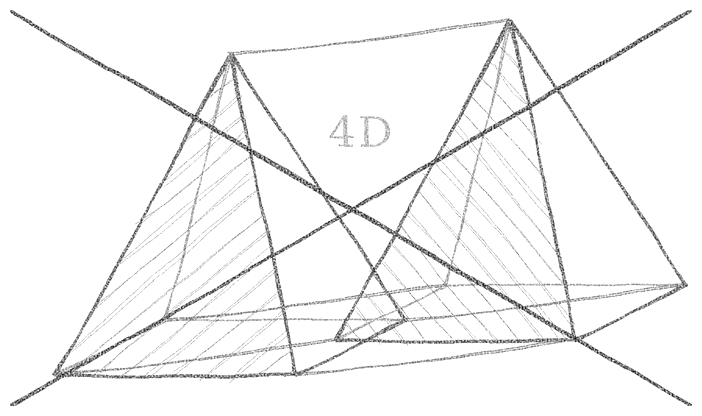
V. The tesseract is an important discovery, and precisely for this reason it is not the fourth dimension. It is with the tesseract that the topic is most often confused, and the discussion with the Author introduced a decisive correction. The first movement of thought was: the tesseract is a wrong image of the same axis. The Author rejected this formulation, and rightly. The tesseract is not a second fourth dimension, nor an erroneous projection of the axis of Unicus. It is not the fourth dimension at all. It is a construction within geometry: a cube drawn out in yet another perpendicular direction, "once more the same thing, sideways". Mathematically it is honestly four-dimensional as a figure: its sixteen vertices require four coordinates, and the relation V − E + F − C = 16 − 32 + 24 − 8 = 0 is Euler's relation for a four-dimensional polytope, which does not fit into the three-dimensional one (V − E + F = 2). But precisely this shows that it is about something else. It is four-dimensional coordinately, as a figure in R4. The axis of Unicus is the axis of the very structure of being.
These are things of different categories: a figure in space and the axis of the structure of being. What they share is one word, "fourth", and it is a homonym: like a "key" to a door and a "key" as a spring. A visible testimony of this is the animation of the tesseract. It always turns itself inside out, the inner cube comes outward, for the perpendicular has no centre to go into. The axis of Unicus moves only through the centre and does not turn inside out at all. The tesseract is honoured as a discovery and set aside as not the fourth dimension, and both judgments hold without contradiction: "important" and "correctly named" are different axes of evaluation.
VI. The physics of time: a great measurement and a removed ontology. Physics touches the same axis as time, the axis t, and as measurement this is the most precise, irreplaceable achievement. The running of clocks, the relativistic corrections without which satellite navigation would not work — all this is correct and great. But the coordinate t, taken from outside, is symmetrical: past and future are equalized in it. Hence the "block universe", a picture in which everything existing is laid out at once, and becoming is declared an illusion of perspective.
Here three layers must be separated which stick together in the one word "space-time".
The first layer is the ontology lying beneath everything else: the assertion that the world is this block, that becoming is not real, that "now" is unreal. It is named first because it is adopted before the formulas and therefore unnoticed.
The second layer is the mathematical formalism, the four-dimensional Minkowski manifold. It is beyond all doubt. Mathematical laws are necessary consequences of accepted foundations, and the system does not encroach upon them: the coherence on which it stands is a mathematical virtue. The discussion with the Author also uncovered a direct kinship. The objection that mathematics is "imprecise" because of infinite constants, π and e, is removed by the fact that an infinite fraction is a function of infinity, necessary in each application: π is not stored as a ready-made infinite series, but unfolds exactly as far as the realization requires. This is precisely the structure of the system: infinite as a function, finite in each realized halo. A constant with an infinite fraction is not a stain on the foundation but the foundation in miniature.
The third layer is measurement: time as the metric of the flow. Also beyond attack and also great.
The blow falls only on the first layer, and not as position against position, but as a logical removal. The argument was introduced by the Author, who pointed to Agrippa's trilemma and to the fact that every system of denial turns out to be inside the one it disputes. The denial of becoming refutes itself performatively. The very act by which it is denied — reasoning, inference, the utterance "there is no becoming" — is performed, that is, becomes. The block universe, in order to be asserted, requires the becoming it denies. And trying to ground its denial, eternalism falls into the trilemma: regress, circle or dogma. Becoming does not enter it. It is not a thesis needing an external ground, but the condition of all grounding, for to ground is to perform an act. It certifies itself, like the cogito: it is not derived, but presupposed by every derivation, including the one that denies it.
Hence the load-bearing conclusion. The ontological block universe is removed not by experience, for both pictures give the same observations, and not as one position that out-argued another, but performatively, that is, more firmly than a fact: an empirical fact can be thought false without contradiction, but this cannot. Most precisely the blow falls on the single thread by which the formalism is sewn to the ontology: on the passage "in mathematics there is no distinguished 'now', hence 'now' is unreal". This thread is cut by the act: "now is unreal" is said now. To cut it is enough — and mathematics remains mathematics, measurement remains measurement, while the crown of ontology is taken off the block diagram.
And the honest limit of this move. The performative proves that becoming is real and buries the timeless layout. But it does not prove directedness: that an event settles only into the past. "The act is performed" gives that becoming is. The arrow is carried not by the performative but by the structure of the axis of Unicus, the direction "inward — outward". Two conclusions on two grounds: the reality of becoming — on the performative, its direction — on the axis. To merge them into one would be to prop directedness with a support that does not hold it.
The dispute between presentism and eternalism is usually called alive and unresolved. More precisely: it is alive where becoming is taken as a thesis among theses. But becoming is not a thesis; it is a condition. The system does not take a side in an open dispute. It shows that one side is negated by its own act of negation, and the other is that without which the negation itself cannot be performed.
VII. Solipsism: identified and not made the limit. The chapter directly identifies the four-dimensional structure with the solipsistic world-order, "there is only I", noting its antiquity and its reputation for irrefutability. The weight of the position must be acknowledged: solipsism is indeed among the hardest to refute. But its irrefutability is logical invulnerability from within experience, not proven truth. And the chapter does not settle on it: "we have not finished the inquiry… the evening is still young". Looking ahead: solipsism will turn out true for its storey and will not be refuted. Four-dimensionality is the structure of one Personality, and inside it there really is "only I". But the fourth storey is not the last. In "Five-Dimensionality" Society will appear as a multitude of Unici, and solipsism will turn out to be not cancelled but nested within a higher storey.
VIII. Access to dimensionality, the "World for the Living", and the bracket of the negative. The chapter connects the accessibility of four-dimensional constructions with the structure of Reason. A "Four-dimensional Nature of Reason" is needed, and the Space realized at its request is adapted only to that for which Reason has grounds. Understanding here is a threshold. From it a "special advantage" is acquired: the ability to think in the categories of four-dimensionality. Until the Reorganization of Reason has taken place, what follows remains inaccessible in meaning. This agrees with the irreversibility of which "Entity" warned.
Dimensionalities, moreover, are "for the Living". Only the "I", the Real aspect, acts upon Consciousness. Objects are will-less and cannot be aware of reality. The moving is a detail of realization, and only a Living Present one can certify this.
The question of negative and below-the-point dimensions the chapter poses, but consciously brakes. Since one can think of them, they are, but of their meaning "there are no Ideas at all". Therefore, "from our position", negative dimensions cannot exist until a Perspective appears. This is the very measure the book will later state: it is impossible to think of what cannot be. But "the minus first dimension" is so far only a word without an Idea of meaning, and a word is not yet a thought. The system knows where its edge is and does not pass off a word as an Idea.
IX. What the chapter is as a whole. This is a turning chapter: from the carrier to the nature of the fourth dimension and to the first touch of what lies beyond solipsism. The strongest thing in it is internal. Under idealist premises the axis is inevitably internal, directed and tied to the "I", and this gives one construction: an axis of nested three-dimensional spaces. What is passed off as another fourth dimension turns out on analysis to be either a slice of this same axis taken from outside (time that has lost its directedness and its "I"), or a discovery about another subject, mistakenly so named, or a figure like the tesseract, which does not belong to the axis at all. And to each of them belongs its own merit, not taken away. The niche of the axis of being itself remains occupied only by this method. And what habit called the external world has found its place on this axis: it is the past, seen from within.
(commentary with the participation of AI: Claude)