Contents
- Prologue
- The Goal
- The Contemplated
- Entity
- Consciousness
- Two-Aspect (Dualistic) Entity
- The Fourth Dimension and Four-Dimensionality
- Society and Humanity
- The Fifth Dimension, Five-Dimensionality
- Firstoccurrence
- Act of the “I”
- The Process of Studying the Act of the “I”
- The Meaning of Being
- Development of the Entity
- Collective Realization of Reality
- The Entity Development System
- Echo (Reflection)
- The Real Aspect of the Global “I”
- On Worldview
- Space-Time
- Attitude towards Oneself
- Attitude towards One’s Body
- Laziness
- Fear
- Hope (“Waiting for a Miracle”)
- Adaptation
- Identity of the Personality
- Relation: [Reason | Body]
- Free Will
- “The Hard Problem of Consciousness”
- Indistinguishability and Identity (of Objects)
- Matter
- Gnoseology
- Epistemology
- Division
TWO-ASPECT (DUALISTIC) ENTITY
It is utterly clear and obvious to us how the scheme of the mechanism of contemplation leads to complete isolation and blocks the 'Idea of an external reality of objects independent of "Consciousness"'. At the same time we also understand that what is meant is the impossibility of the existence of the physical World — such as we imagined it before; but otherwise nothing changes, except the extremely important (!) emotional psychic relations. The contemplated remains the same. By itself, the Knowledge of the Structure of the World cannot manifest activity by its own Will and magically influence the boiling of water in a kettle; it will not melt ice, will not make the faded beautiful, etc. — it is not a spell. We are, however, sure that this knowledge can be used, but only at will and thanks to certain practices, which are not discussed here, because This Is the practice itself, and all the others are for the most part secondary. One who is able to become aware of the Essence will forever change his attitude to Himself, which means an equal attitude to the World as a whole, to Humanity, Society, and to everything living and non-living, including all situations. This unusual Knowledge will help to become aware of Happiness, to love Oneself, the World, God, and Everything Absolutely — without any limitations and exceptions;
* * *
Photons act on the cell of the eye -> The cell initiates signals which go to the brain -> The signals are processed, and then -> "I" see what seems to me external. "I" understand that this phenomenon is provided by systemic features and is only a sensory representation of the results of signal processing — that is, of waves originating at the 'Sources of My own history, and changed by experience into My appearance'. We knew before that, according to our physics, some of the signals are electrical — we agreed to call them so — but What are they in reality? — we do not know;
So, in the course of this research we conclude that we are, and have been, in an 'isolated bubble of closed space', which seems common to us but, when comprehended, turns out to be individual;
Let us recall that we began reasoning with the aim of studying the mechanism by which we 'see right now';
Let us draw an analogy of the result, that is — we are in a separate room, and in these conditions we say that we are in isolation, and, pointing the index finger towards our eyes, we say that we see everything happening in this room, but precisely inside 'Consciousness'; thereby, as it were once more, again, we immerse ourselves inside Ourselves. We have already gone through this practice before and understand that not everyone will manage to imagine it, although many already know that, once understood, it will turn out to be too simple. We hope You will master it;
Constructing reality, we immerse ourselves inside the "I" –> dynamically forming our "radiant future", taking into account the fading past, which as it were remains outside. In this process it seems to us that we are contemplating the external <surrounding us> World. It resembles a ride on the rear platform of the last carriage, looking at the railway track running away into the distance. In fact, we contemplate while extracting new experience, as events receding into the past — independently choosing the facts and knowledge necessary and effective for rational development, even if the judgment and their qualification are purely subjective. Usually, soon, the "new experience" turns out to be former and already outdated, requiring correction, being supplemented with newly extracted valuable facts, either on the basis of previous knowledge, or of some special conditions — thus new experience is formed and stored in memory (together with the situation, which <probably> may be useful for careful analysis). This is repeated, again and again;
Thereby it can be stated that any experience is used as a part of the data, as a basis for the extraction of new experience. Another important part of the data are: a). the Ideas of "things" in their ideal form; and b). the Conditions influencing both the dynamics and change of all objects in the content of a concrete current situation, and that may also influence the change of meaning of the situation itself;
The potential of a situation is its attractiveness, which in turn reflects the degree of saturation with experience and the interest of the "I" (the Need of the Entity) in participating, and the intention to manifest activity in striving to extract new experience, until complete exhaustion. But complete extraction of experience from a situation is absolutely impossible (it too is in principle infinite, informationally); however, the "Entity" strives for development, absorbing the maximum of experience from what is available — but very much depends on the skill of extracting experience effectively. A Situation filled with events is quite possible, from which it is not possible to extract any effective and rational experience at all, except visual — although for a writer or an artist it may turn out to be invaluable — which means the "Entity" needs it;
Interest has enormous significance, that is, information that interests the "Entity", as content contained in the data stream, is a catalyst and energy for the manifestation of intention, the realization of reality and the formation of future events. This is incredibly important for those who are learning to manage reality (…the practices are not few);
It is necessary to draw your special attention to the fact that changes of static data at the Global level, preserved as consequences of the activity of the "Real aspect of the 'I'" (if someone has moved a stone, it will remain moved), are not yet reliable proof of the "Collective Synchronous Realization" of reality; but so far we have not found any pronounced prerequisites explaining any principles by which this would be possible; therefore, until now, we investigate the 'Nature' of only one (from the position of each) "Real aspect of the 'I'";
"Man is a social being". We suppose that people are not phantoms; precisely for this reason we feel an enormous interest and a natural need to discover and investigate the mechanism of the Joint Realization of Collective Reality. Besides, we want to find out (even if theoretically) whether other civilizations and Global factors exist? Can they be dangerous?, or dependent on the intention, and also on the results of the activity, of other "Real aspects of the 'I'";
figurative sphere — the diameter is equal to infinity

(representation as a section of the current space along the equator)
Let us imagine and consider this as a diagram on the two-dimensional plane of paper. In figure 2 we practised a section of infinite three-dimensional space along the equator — this is a flat circle one conventional point thick (fig. 5). Let us suppose our current space, in the centre of which you and I are now located, reasoning about the structure of the World (through the cognition of the mechanism of contemplation), pointing to the transition inside Oneself, where the "I in the body" participates in the situation, extracting the given experience in the contemplated frame ("I" see);
through the centre –> inward
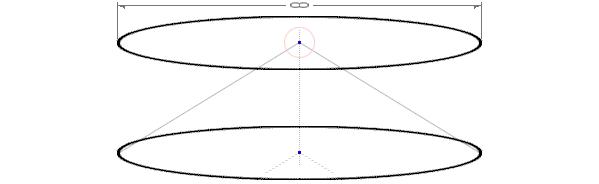
(immersion inside Oneself by one level inward)
After immersion inside Ourselves we are again in the very same conditions; we point to the inner "I" and to Its inner contemplation. This immerses us one more — the next — level inside Our Very Selves (see fig. 6). We have drawn this diagram on a plane, but concentrating, we understand that this is a sphere with a central dot in the centre, and this dot goes inside Itself, that is, inside each of us, and turns out to be one more space with a central dot inside (or compare with the "point of infinity"); Think deeply about this amazing phenomenon — this dot (the "I") is infinite inside Itself — that is, 'My? I' strangely slips away when one tries to touch (It). Each space, meanwhile, seems to inherit the Centre (the "I" appears bottomless, that is, an Abyss — in some, but definite, sense). We are able to perform this procedure as many times as we like. The result will be the same. It should be noted — the data use the stream of photons as transport -> flying inside the "I"; however, the contemplated 'fills' the realized space precisely from outside, from the past. The future is formed from the past (!) …
This tells us that the data enter memory through a certain "Axis of the 'I'", through Consciousness and Reason (we called this the process of signal processing), are interpreted and qualified, being transformed into sensory images, and –> fill space …from beyond the invisible edge of its limits. All this literally arises, appearing as the contemplated, as if in a gigantic, magical 3D theatre:
∞… –> through the centre –> inward –> through the centre –> inward –> … –∞
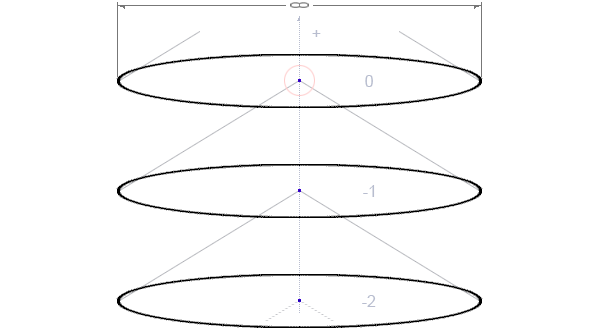
(immersion inside Oneself by two levels inward)
Taking into account that "Consciousness" is transcendent and realizes any spaces, it should be explained that multidimensionality cannot be a structural or a software problem, since the increase of dimensionality has even a very banal regularity. It is another matter that we will encounter the problem of representation, and without visualization we will not be able to fully investigate (the next, above) higher dimensionalities;
And nevertheless, we will turn out to be capable of something. Then our eyes will truly open, and this will happen soon, or very soon, but within the framework of this research;
We propose to recall, or — pay attention to, this widely known feature (regularity):
Mother spaces contain an infinite number of subordinate spaces, inferior by one in the number of dimensions.
Zero-dimensionality — the Abstract Dot;
One-dimensionality — a Straight line, joined in one direction from an infinite number of zero-dimensional dots;
Two-dimensionality — a Plane, composed of an infinite number of parallel straight lines;
Three-dimensionality — Volume, composed of an infinite number of superimposed <one on another> planes;
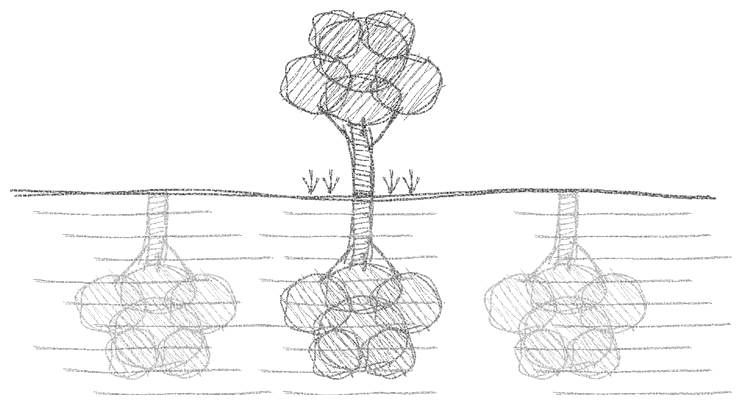
Four-dimensionality* (Unicus) — is composed of an infinite number of nested three-dimensional spaces, successively inheriting the central dot (outside –> inward). Unicus [Lat.] — unique, personal; *Four-dimensionality is the main fundamental property of the four-dimensional construction of space;
Five-dimensionality (Generalis) — is composed of an infinite number of four-dimensionalities, with axes directed inward. Generalis [Lat.] — general. To become aware of five-dimensionality, an understanding of four-dimensionality is necessary;
By this method we can easily suppose any dimensionality, and in theory it will be correct; but we cannot represent the method and the practical geometry, because for this knowledge a logical ground is necessary, that is — a cause leading to understanding is needed. The fifth dimension (and five-dimensionality) is not easy to imagine; we will try to explain it first, and then try to depict it on a two-dimensional plane, but first let us look at Unicus. From the examples we analysed above, and thanks to the representation, we understand that the axis of the fourth dimension is infinite and directed inward and outward. Besides this, it is necessary to understand that "Consciousness" has no limitations as regards the realization of any dimensionalities. Both "Consciousness" and the "Global aspect of the Entity", as "Causes", are transcendent and are expressed in this way:
∞+1 and –∞–1
Where ∞+1 is the transcendent outside and is "Consciousness", while –∞–1 is the transcendent inside, that is, the "Global aspect of the 'I'", realized with fundamental relativity to <Its> complete opposite (as a method and ground of being) — the very important "Real aspect of the Global 'I'". For the understanding of four-dimensionality this is quite enough; however, we will have to return to it, otherwise we will encounter the natural barrier of reason when investigating the "Collective Synchronous Realization". It should be grasped that we are considering the general structure, but from the position of each being it does not differ in any way;
Are you wondering, What is the difference between the "Global aspect of the Entity" (that is, the "Global aspect of the 'I'", which is one and the same) and the "Real aspect of the Global 'I'"? It is not yet time to speak of this, but for clarification it should be said that: the "Global aspect of the Entity" is the "One 'I'", that is, All the "I's" — of each being in their infinite number — which are defined in this relation as "Not I", in relation to That which Is in reality and participates in situations as the "Real aspect of the Global 'I'" — as the necessary Balance of opposites (we understand the relativity as equal). This relativity is fundamental, equivalent, interdependent, and is ensured by the fact of "Systemic necessity";
Commentary on the chapter "Two-Aspect (Dualistic) Entity"
After "The Contemplated" and "Consciousness" it is clear what we see and where we are. This chapter turns to the one who sees, and builds his structure by a single repeated action. The path goes from the consequences of the discovery just made to the axis of the "I", from the axis to the ladder of dimensionalities, from the ladder to the two transcendent Causes. The two-aspect nature that gave the chapter its name appears only at the end, and deliberately not in full.
Knowledge that does not work magic. The chapter begins with a sober reservation. Isolation is proved, the idea of an external world is blocked, and yet the contemplated remains the same. Knowledge of the structure of the World will not by itself boil water in a kettle, melt ice, or make the faded beautiful. It is not a spell. What changes is something else: the attitude. One who has become aware of the essence forever changes his attitude to Himself, and hence to the World, to people, to everything living and non-living, to all situations.
This reservation is more important than it seems. It sets a fence against reading the system as magic, and the same fence will appear later in the Law of Realization of Grounds: what is realized is the necessary ground, not the desired one. And it shows where the action of knowledge lies: in the attitude. As in "Consciousness" the originality of the Ship of Theseus is held not by matter but by attitude, so here the World changes not in its planks but in how the one who knows relates to it. That is why the Author says that this knowledge is the practice itself, and other practices are secondary. The result is named simply: to become aware of Happiness, to love Oneself, the World, God and everything without exception.
The rear platform of the last carriage. The chapter sums up the path travelled with an image. We are in an isolated bubble which seems common and, when comprehended, turns out to be individual. Constructing reality, we immerse ourselves inside the "I", and it seems to us that we are looking at the external world. In fact it is like a ride on the rear platform of the last carriage: we see the track running away into the distance, that is, events receding into the past, and we choose from them what is needed for development.
Hence the circulation of experience. New experience soon becomes former and serves as the basis for the next. Any experience is a part of the data for extracting new experience. The two other parts of the data are the Ideas of things in their ideal form and the Conditions influencing the change of objects and the meaning of the situation itself. This is the same pair as in "Consciousness": Idea plus Wave of state.
The potential of a situation, and Interest. The chapter introduces a notion that will become the engine of the system. The potential of a situation is its attractiveness: its saturation with experience and the Interest of the "I", the Need of the Entity, to participate in it. It is impossible to extract the experience of a situation completely: informationally it is infinite. Much depends on the skill of extraction. It happens that from a situation saturated with events nothing can be extracted except the visual, but for a writer or an artist even this is invaluable, which means the Entity needs it.
Interest — information that interests the Entity — the chapter calls the catalyst and energy of intention, of the realization of reality and of the formation of future events. Looking ahead: "The Process of Studying the Act of the 'I'" will define energy as a difference that unfolds information into images, and "Firstoccurrence" will find in Interest the very movement of the Seeking "I". The seed of this lies here.
An honest boundary. The chapter stops at a place one could easily rush past. Changes at the global level are preserved as consequences of the activity of the "I": a moved stone remains moved. But this is not yet proof of the Collective Synchronous Realization. There is as yet no principle by which it is possible, and therefore only one Real aspect of the "I", from the position of each, is investigated. The motive is named openly: man is a social being, and we suppose that people are not phantoms. The motive is acknowledged, the proof deferred. This promissory note will be paid in "Five-Dimensionality".
One action: through the centre, inward. Further, the chapter builds the structure of the "I" by a single operation. A section of infinite space along the equator — a flat circle with the "I" in the centre (fig. 5). We point to the inner "I" and its contemplation, and this immerses us one level deeper: the central dot turns out to be the entrance into a new space with its own centre (fig. 6). We repeat, and the spaces are strung onto a vertical, the "Axis of the 'I'", with levels 0, −1, −2 (p.91, fig. 7). The whole construction grows out of a single technique, not out of a set of assumptions.
And here the chapter notices something amazing: the "I" strangely slips away when one tries to touch it. Each space inherits the centre, and the "I" turns out to be bottomless, an Abyss in a certain sense. This observation has a famous neighbour. Hume, looking into himself in search of the "I", found only particular perceptions and confessed that he could never catch himself without a perception. From this he concluded that there is no "I", only a bundle of perceptions. The chapter sees the same slipping away and draws the opposite conclusion. The "I" slips away not because it is not, but because it is not an object. Looking ahead: in the "Act of the 'I'" the book will show that the "I" is an Act, not a thing among things. An Act cannot be touched like an object: every touch is already its performance. Hence also the rule the book will later state: one cannot say "my I", because the "I" is that whose everything is, not that which belongs to someone. Hume looked for the "I" among the contents and did not find it. The chapter finds it as the centre from which the contents are seen and which itself does not stand among them.
The ladder of dimensionalities. The chapter cites the regularity: a mother space contains an infinite number of subordinate ones, of dimensionality smaller by one. Dot, line, plane, volume. The zero-dimensional dot of this ladder is a rung of geometry. It should not be confused with the Abstract passive Dot in the chapter "Act of the 'I'": that is a limit of reason, to which the notion of dimensionality is not yet applicable. The name is one (Dot), but the subjects are different.
For dimensionalities up to the third, this is a mathematical fact. On the fourth rung the chapter does something other than school geometry. The geometrical fourth dimension continues the same move: infinitely many volumes along a new perpendicular axis. Here, by contrast, four-dimensionality, Unicus, is an infinity of three-dimensional spaces nested in one another and inheriting the central dot, from outside inward. The fourth parameter is not a shift sideways but a depth of nesting.
The main thing in this decision is what the chapter does not say directly, but what follows irremovably from its premises. A perpendicular axis is a direction outward, into a new external dimension. But there is nothing external in the system: "The Contemplated" and "Consciousness" established this. The perpendicular has nowhere to lead. There remains the only unlocked direction: inward, through the centre. Four-dimensionality as nesting is here not "more natural" than the orthogonal, but inevitable. The competing construction requires an external, and there is no external. "By this method", the Author says, any dimensionality is conceivable, and this does not contradict inevitability: "any dimensionality" refers to the number of storeys, "inevitably inward" to the direction of the axis. Five-dimensionality, Generalis, is named here: an infinite number of four-dimensionalities with axes directed inward. It will be disclosed in its own chapter.
From this one can see why the tesseract, a cube drawn out in a perpendicular direction, has nothing to do with the axis of Unicus. What they have in common is one word, "fourth", and here it is a homonym: like a "key" to a door and a "key" as a spring. The book will speak of this in detail in the next chapter.
Two transcendent Causes. The axis is infinite in both directions, and the chapter caps it with two Causes: ∞+1 — the transcendent outside, Consciousness; −∞−1 — the transcendent inside, the Global aspect of the "I". These expressions are not an arithmetic of infinities but a sign of what lies on the other side of open infinity, beyond the limit of reason. Read as operations on numbers, they would mislead a mathematician. Read as an indication of a limit, they do their work.
Two-sided transcendence does not make Consciousness dualistic. Dualistic is the Entity, in two aspects. Consciousness is a static basis without dimensionality of its own, realizing any. The realized dimensionality, meanwhile, is always concrete and finite, however large. Infinity is a function, while what is realized is a concrete Halo of the Contemplated, like the number π, infinite as a function and finite in each application.
Looking ahead: on the same axis past and future will lie as well. Outward goes the past, into ever more remote times, towards Consciousness. Inward — the future, towards the Global aspect, unattainable, as the centre of the "I" is unattainable. Only the point of becoming between two unattainabilities is actual. Therefore an event never becomes future, only past. The chapter already says the main thing: The future is formed from the past <…but will never arrive>.
Two arcs of one relation. The chapter holds that the data fly inward, into the "I", while the contemplated fills space from outside, from the past, "as if in a gigantic, magical 3D theatre". This is not confusion but two arcs of one relation. Transport inward is how the Real aspect is drawn into becoming. Filling from outside is how the already realized is presented. They must not be mixed, and need not be torn apart.
The two-aspect nature — named and deferred. Only at the end does the chapter give what is put in its title. The Entity is twofold. The Global aspect of the Entity is the One "I", all the "I's" of each being in their infinite number, which in this relation are defined as "Not I". Opposite them stands the One who is in reality and participates in situations: the Real aspect of the Global "I". The relativity between them is fundamental, equivalent, interdependent and ensured by systemic necessity, the Balance of Opposites. The chapter itself stops: "it is not yet time to speak of this". The full layout, the Three Hypostases, will unfold in "The Process of Studying the Act of the 'I'". Here the two-aspect nature is introduced and left open.
What the chapter is. This is a chapter-construction. It sets up the carrier — the Axis of the "I", gives the names — Unicus, Generalis, marks the two transcendent Causes and names the two-aspect nature of the Entity. The strongest thing in it is what follows inevitably: under the accepted premises, four-dimensionality can only be nesting inward, for the perpendicular would require an external, which does not exist. The subtlest is the "I" slipping away when touched, not because it is not, but because it is not an object. And the first page of the chapter gives the key to the whole book: knowledge does not work magic, it changes the attitude, and in this is its power.
(commentary with the participation of AI: Claude)