Contents
- Prologue
- The Goal
- The Contemplated
- Entity
- Consciousness
- Two-Aspect (Dualistic) Entity
- The Fourth Dimension and Four-Dimensionality
- Society and Humanity
- The Fifth Dimension, Five-Dimensionality
- Firstoccurrence
- Act of the “I”
- The Process of Studying the Act of the “I”
- The Meaning of Being
- Development of the Entity
- Collective Realization of Reality
- The Entity Development System
- Echo (Reflection)
- The Real Aspect of the Global “I”
- On Worldview
- Space-Time
- Attitude towards Oneself
- Attitude towards One’s Body
- Laziness
- Fear
- Hope (“Waiting for a Miracle”)
- Adaptation
- Identity of the Personality
- Relation: [Reason | Body]
- Free Will
- “The Hard Problem of Consciousness”
- Indistinguishability and Identity (of Objects)
- Matter
- Gnoseology
- Epistemology
- Division
CONSCIOUSNESS
We are accustomed to judge of This rather peculiarly, and have always taken "Consciousness" to be what was considered the internal functional activity of the brain — sensory, psychic, but chemical by their physical nature, processes occurring in it. Many inquisitive people suspect that this is not quite as was believed, and not very easy to understand because of its unusualness. But the Truth, which is already known, will not change from our attitude to It, and will not bend to individual oddities of character;
Fundamental laws do not care whether we know of them or not. But to us it is not indifferent. We want to explore the World, to cognize Ourselves, to study the sciences, to develop in order to know! To look openly, to breathe freely, and to live worthily of a Human — one who has thrown off the rusty shackles of senile survivals and stereotypes. Otherwise for a long time we will not be able to understand — What are We really capable of?
For the realization of volumetric ("3D") objects a corresponding space (i.e. place) is necessary, otherwise this cannot be realized …even in a virtual World; Let us suppose that we recognize that "Consciousness" provides for the "I" the realization of three-dimensional space and of the objects located in its volume. Why exactly does "Consciousness" provide the realization of space? And why is this done "for the I", and not just so — without a cause?
Let us first answer the second question: We have not yet tried to prove the presence of other people in the "Isolated region of Consciousness", and it is hardly very simple, because space is realized individually (— complete isolation). We will investigate this a little later, but at this stage we can only assert that Objects and space are realized only for a concrete "I";
As to the first question, concerning the source of realization, it should be taken into account that the "I" is active and cannot be passive, that is, in relation to "Consciousness" the "I" has opposite properties; otherwise this would contradict the balance of the necessary relativity of the being of the "I".
Consequently, "Consciousness" is static. As primary we recognize only the "I" and "Consciousness"; this means that the active "I" initiates the realization of objects and space by means of "Consciousness", that is, it uses "Its" functional capabilities. By its intention the "I" brings "Consciousness" to "Active Realization". All this is too simple; however, having become confused, we encounter difficulties that we ourselves have invented, but without any grounds. Everyone knows that many people elevate the realization of reality to supernatural creation (sorcery, magic), but everything has an explanation, logic and ground — Everything happens by reason of development, i.e. of natural rational change — through the acquisition of experience by the active "I", or through the application of experience already available, but with the same goal — Development;
The same becomes known in connection with the practice of life — the "I" is active, uses any available instruments and is interested in development — it shows interest in "things" and situations. This is not an unfounded assertion — investigating the "I", we take into account obvious facts, that is, our own properties and characteristics. In cognizing Oneself it is necessary to identify the "I" under investigation = with Oneself. We know that to carry out the Act of Self-Evidence the "I" uses reason, but Reason becomes accessible when the "I" acts upon "Consciousness", and is the Product of this relativity;
There are also very important facts and conclusions connected with the development of reason and with its functions, but now this is not timely; later we will certainly return to it;
Any Being has relativity, which may be spatial — when the 'interdependent arrangement of objects relative to one another' is meant and used — but relativity may also be inherent, ensuring the 'Harmony of the World' in the observance of the Balance of Opposites, that is, what we usually call the Internal Energy Balance. Likewise in the properties of compounds of elements, and in the Essence of important astrophysical Laws — the violation of this Balance is 'strictly inadmissible';
* * *
It is probably sometimes useful and necessary to look ahead, to grasp the 'still unfamiliar', for the subsequent realization of an already more 'Prepared and Grounded Reality'. When the topic is extremely complex, for better understanding one should use all the contributing methods and possibilities, especially if this concerns worldview convictions and/or implies contradictions with persistent stereotypes;
For due preparation let us cite the usual relations: Cold/Hot, Near/Far, +/-, Heavy/Light, Reasonable/Unreasonable, and, concerning our reasoning, the important fundamental relation [ "I" | "Consciousness" ].
For a full and deep awareness of the actual, that is, of the "Full Being of the 'I'", we recommend that You study, become aware of, and take into account the following most important relation:
[ "Abstract Being of the Global 'I'", and | "Being of the Global 'I' in the Conditions of Reality" ];
Although it is not yet timely, it is necessary to keep in mind:
1. We represent the "I" abstractly, i.e. the "One 'I'", literally the General, which is each separate "Real aspect of the Entity" in reality — that is, it is present as the "Global aspect of the 'I'" — nowhere specifically, everywhere at once (He Is). As abstract, the "One 'I'" is absolutely static and therefore inherent in the wave nature; however, the "Global aspect of the Entity" = the "One 'I'", or = the "Global aspect of the 'I'", necessarily has a balance — a Systemic opposite, namely the "Real aspect of the Global 'I'" — the unique, the Only in the World, Fundamental, Systemically necessary Living Being, having access to the entire volume of experience and data. The "Global aspect of the Entity in Reality" — He! Has possibilities limited by nothing — a potential equal to the sum of the potentials of all living beings in the World. Incomprehensible. Eternal. Equivalent to the whole World;
2. We also represent the "I" in reality — as the ordinary one familiar to us, the "'I' in the body", active, independent, manifesting will and intention, comprehending experience, that is, a living being in a body inherent in the nature of particles, and being in the conditions of reality. The "I" itself Is the "Spark of Life", that is, an infinitely small part of the Soul <of the "One 'I'"> — of the "Global aspect of the Entity". But each "Real aspect of the Entity", from the position of the "Real aspect of the Global 'I'", is defined as "Not I" (— which, however, is quite natural);
The two-aspect nature of the "I" is confirmed by Wave-Particle Dualism, and indicates Its connection with any dimensions. What is important is that the Nature of particles is Reality, while in the absence of <living> dynamics it is a Static Wave (all this is very important, and further on we will return to it more than once);
* * *
Taking into account the fact of the contemplation of mental images which are not located in the "Space of Explicit realization", it can be asserted that the current "Explicit Space" is not the only one. Objects contemplated mentally, as if 'once more inside' <for example, extracted from memory>, are also three-dimensional and are also located in space, but in some other one. However, in any case, we realize ourselves and become aware of Ourselves in the "frame of explicit current reality", and precisely in such conditions in which the application of Reason is possible — thinking, observation, analysis of the situation; let us include in the list meditative states, astral space, the state of sleep, hypnotic sleep, etc.
All this confirms our conclusion that it is precisely 'Consciousness' that realizes a potentially unlimited number of necessary spaces — for the concrete needs of the "I", in this case for the realization of three-dimensional objects; but we do not doubt our ability to extract experience using dimensions of a higher order (— of any degree of dimensionality, if this turns out to be accessible). However, now we assert only the most obvious fact:
Space is not "Consciousness";
An important (for us) postulate; it will be useful not only in this research, but also in the life of one who likes life. Formulations and brief theses having a special meaning move us towards the answers to the questions posed here;
Taking into account that we can close our eyes — refusing to contemplate the situation — or deliberately fall asleep, of our own will — ceasing the realization of reality, the question arises: Can the "I" be Self-sufficient?
A positive answer to this question, under the ideal conditions of being established by us, would indicate the complete non-relatedness of the "I", which contradicts absolutely everything, that is, it is illogical and impossible, for a whole series of natural reasons. However, if "Any ideas, feelings, thoughts, memory data, and anything contemplated can exist exclusively in 'Consciousness', in the form which we consider actual and valid, then non-relatedness implies the 'One "I"', and not in some Void of the World, but precisely as 'There is only "I"', including everything conceivable and inconceivable, together with the Void, if we allow that it is possible at all". This means that "Consciousness" is located inside the "I", but has a direct relativity to the "I". Also, individually, that is — from the position of each living being in the World — this is so, taking into account all the facts about which we reasoned before;
Can it be proved that this is not so? (by refuting Solipsism)
We have found out before, we know, and have said many times, that we see everything contemplated only in "Consciousness" ("I" see in Consciousness), and from the current position "Consciousness", as the Cause (the Handler?), is around, and precisely outside. When "Consciousness" is around, this means that the "I" is in the centre of the current space ("within the frame"), extracts experience acting in its own body in the conditions of reality, represents Itself in this form;
Consciousness inside means what we point to when we reason about the mechanism of contemplation [from the photon, through the signal, etc.] and call it "the handler inside Oneself", and then about the "I", but again inside, which contemplates "This same thing", already as the result of processing — and again "Consciousness" has turned out to be inside; it is precisely on this that we have focused attention and are reasoning. You will say: –It looks like a trick. –The reaction is understandable, but let us keep our attention. We explain (even if early) that the cyclicity 'inward' is due to four-dimensionality, while the ambiguity arises because of the Dualism of the 'I';
It is resolved, however, quite simply: reasoning, we say that we are immersing inside the "I", but at the same time we are always inside "Consciousness". This is traced very simply — any situation can be realized only in a corresponding space, in "Consciousness" and by means of "It". The "I" acts as the active trigger and initiator, in the conditions of reality = in space;
Consciousness is always outside (a priori, and in any case);
However, we would like to find a simpler representation, in the hope of offering You more transparent examples and citing them as proof in consequence of other, more understandable conclusions. Therefore, for now we only assert the following — anything at all is, and can exist, only relatively. This has a special meaning. Let us recall the Harmony of the World (the internal Balance);
In connection with the established absolute impossibility of the non-related being of the "I", an important conclusion follows:
The "I" exists in mutual relativity with "Consciousness";
According to the Fact of Being and the Act of Self-Evidence, the "I" is the Active aspect. From the position of any person, this is the Fact of the Being of the "I" and of "My vital Activity" in this relation. "Consciousness", on the other hand, always appears static, and provides the "I" with the possibility of manifesting Activity. This harmonious relation is the fundamental basis — the mutual relativity of the "I" / and "Consciousness" (also in accordance with inherent relativity, this is the balance: Static / and Dynamic), which represents the One two-aspect Entity: [ "Real aspect" / and "Global aspect of the Entity" ]. This reliably proves that "Consciousness" is outside of everything Existing, and the "I" manifests "Its Activity" being inside the Static "Consciousness". When we try to reason about this in relation of the "Global aspect of the Entity" to "Consciousness", Its position is abstract and is everywhere, but "Consciousness" is in any case outside;
We ask you to take into account also that we are investigating, although we think and are accustomed to conditions which literally do not correspond to what we are reasoning about here; therefore at times we have to, to tell the truth, contort ourselves, considering the static in sequential dynamics, which in fact may be dynamic and static at once — and among such "things" we count the Two-Aspect "I".
When we attribute everything static to the nature of Consciousness, it should be taken into account that Consciousness realizes Spaces which are static by definition, while the content located in them is contemplated as dynamic. On the other hand — any content is only contemplated as dynamic, showing the static state of the object at each point of the wave of its dynamic state, successively one after another (a paradoxical fact). This is not factual dynamics, but in practice (and in experience!) it is contemplated and taken into account precisely so, and not otherwise. Doubtful also is the <as if> visible three-dimensionality, which in fact consists of two-dimensional images, while three-dimensionality, in their correlation, is only understood and held in awareness, but not seen; otherwise we would see one more side of a cube (in addition), and could see what is "behind a high fence".
Unusual knowledge can be obtained only in the most unusual way;
For effective research it will be useful to keep in mind and take into account everything we already know — a view of the picture under study as a whole will be required, as well as from different positions. "Consciousness" is only intuitively and mentally understood as Space. To be more precise, "Consciousness" is primary, that is, as if "above space", transcendent (∞+1), and is meant as the fundamental "hardware" part, while Space, and any objects, are only a software realization of a "place for images" — no less ephemeral and virtual than we take an image on a monitor or a volumetric hologram (of coloured sparks) to be;
"Space" (volume) is realized only as static relative to everything that is contemplated 'located' inside it. Any objects located in Space are temporary (extremely unstable), dynamic, both inside and outside. It must always be kept in mind that space is realized as inaccessible to sensory perception, that is — we neither feel it nor see it, but we are aware of its presence by reason of the relativity of the objects located in it. Let us especially note also the fact that any <all> objects exist relative to space, and even a single object in space (air, for example) can exist unhindered, that is, without the need to have relativity to other objects (it arises when there is more than one object);
Geometrically, space is easiest to imagine in the form of a sphere, since the radius in all directions is 'equally equal to infinity'. The absence of limits of space is not subject to doubt, since space is realized by means of "Consciousness" as a wave function. Taking into account the fundamental and immediate contact with reality, Space, as we understand, possesses a unique and amazing property not inherent in objects, namely: it has no properties, no dimensions, and is potentially infinite. Being the basis of the realization of objects in the conditions of reality, space is fundamental;
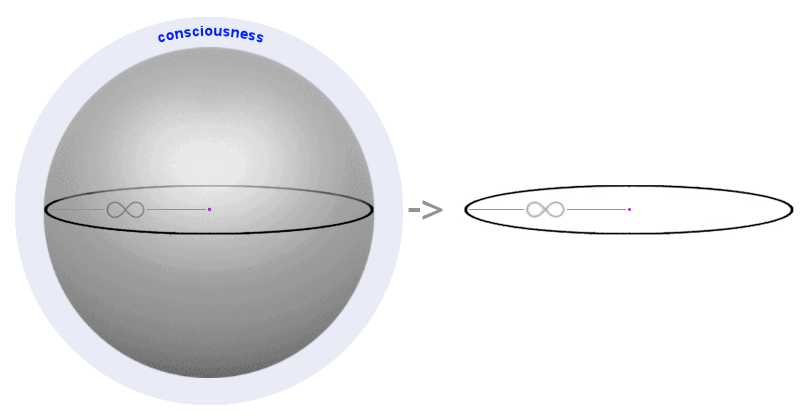
(the Dot in the centre of space is the "I")
The Systemic Function of Space is realized partially, as necessary, when we are present and turn our attention. The boundary of Space will recede as one approaches it, that is, Space is infinite, but — precisely preliminarily. For example, if one flies to the "Nearest star", one will have to realize the "preliminarily existing", and fly at the speed of light for several years, or for billions of years;
With such a structure (arrangement), sizes cannot be an obstacle and have no special significance, nor has time; therefore anything is realized equally simply and instantly — a glass, trees and a cluster of galaxies. However, for study and for the extraction of experience, the dynamics of these objects and a situation are necessary — a process in time and space;
With constant attention —> in the direction of a concrete point of concentration, the function of the realization of Space is interpreted and represented as an endless cycle, with expansion in all directions and recession from the centre — at the speed of light, as is proper in these conditions;
* * *
No, of course we are not in a matrix, and this is not a computer program. There is no point in creating this at the risk of making a mistake — everything works perfectly as it is. Yes, for better understanding we sometimes use the terms and words "software, processor, etc.", meaning by them the structure and functionality of a living being — scientifically proved at the level of physical processes, which we have been observing and successfully studying for hundreds of years.
This is not vain labour, but the greatest — with a single reservation — we were studying the "Contemplated", not the external, but only the structure of the images of "things" visible to us, a kind of "Parade of the illumination of elementary particles". With such a structure it is not at all surprising that objects, when greatly magnified, consist of particles not touching one another <ephemeral, by the way>; that is why everything is so complex, literally — like the whole volume of physics, because it (physics) studies precisely this "enchanting phenomenon";
* * *
There can be no question of an external physical reality — we have reliably established this and repeated it more than once; but for convenience of application in our research, an understanding of very many principles (seemingly obvious) is necessary;
We propose to formulate from what is already known:
The Real Status of an object is its visible Status, corresponding to the current state — "an object with superimposed experience", and according to the existing conditions;
Here, by the notion of "Status" is meant the ephemerally contemplated, but concrete state of the Idea of an object, in relation to other objects in a connected situation, and according to strictly defined conditions. If the change of state of an object is expressed by a wave function, then the point of attention (concentration) will always correspond to a concrete moment of realization, and further — the point seems to move along the wave of change of the object. In reality we see a static state at a concrete point, and each next moment another one, at the next point, and then the next, and so on … The object, meanwhile, is contemplated as dynamic in all respects, both inside and outside.
It is necessary to clarify the following about the contemplated moment — the actually seen state represents precisely the final condition, that is, the state in which the object has already been completely transformed and will be available in experience in the new state. We understand It as two-component: Idea + Wave of state; Looking at a fresh apple on the table, its Idea is meant — this is the Apple Itself, + the Condition of change of state of the concrete object, taking all factors into account. Let us say we put an Apple on the table at home and went away on a journey for half a year. When we return and, remembering the apple, look at the table, we will see a rotten (half-decomposed), but already dry apple. That is, the Idea + the Condition that in an environment with room air temperature the apple will turn into what we saw after returning. In the given example, the conditions will be your experience in which apples spoil. Even though You did not see how the apple changed in the process, the point on the wave of its state will not cause an error, proceeding from the interconnection of many, many factors in this situation, including physics, chemistry, biology, etc. If there is a Hamster in the house, in a cage, and it suddenly escapes, then the Entity will take it into account as a condition, and then the Apple will most likely be eaten. Into the probability which we call "most likely" will be laid the behaviour of the Hamster, its quick wits, its ability and possibility to climb onto the table, …and so on;
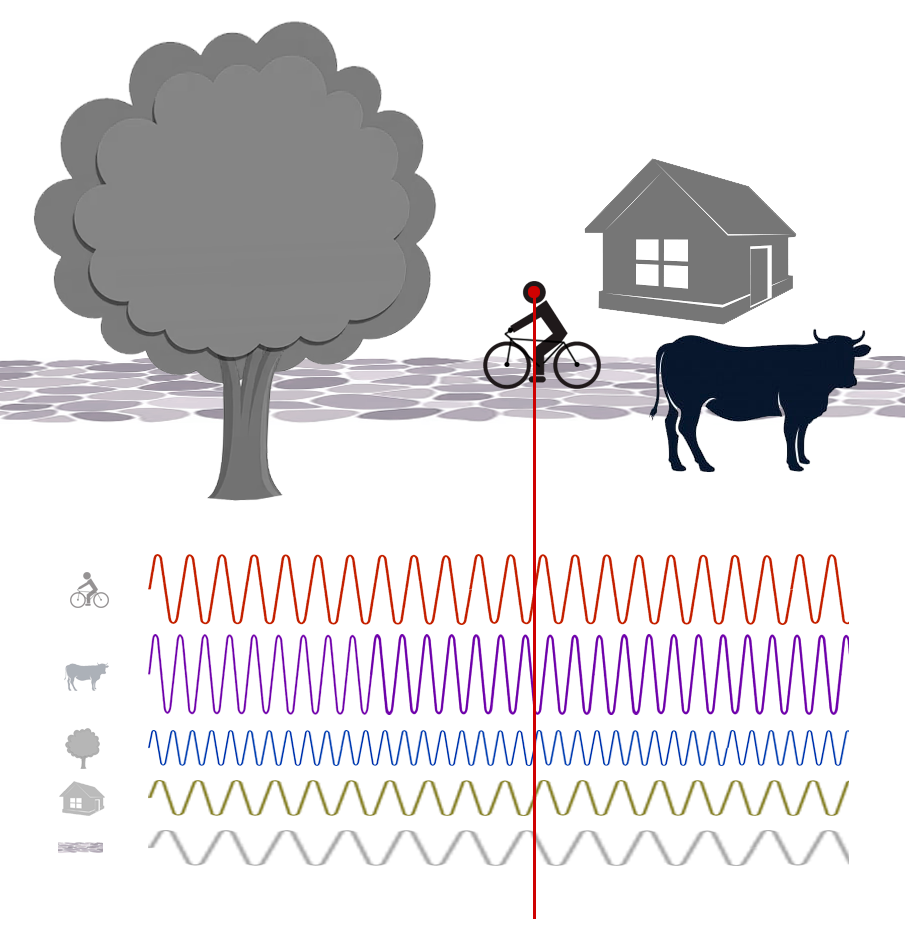
Let us imagine the wave of each object of the supposed "frame of reality", i.e. in one range of events and data on states, pierced by a ray of the system function, perpendicularly "touching" one point of each wave, the one corresponding to the moment — exposing the contemplated in the form of the sensory result of processing, in the internal volume of the virtual 3D sphere of contemplated reality (see fig. 3). This is the final state of the process of transformation: between the existing state of the objects (in the situation) previously available in memory, and the state of the already transformed objects, by means of the superimposition of experience, which is stored as new experience. The point of attention has no relation to time, but represents a point "on a conventional scale" of the dynamic state of the object, as the process of transformation of its past state into the future (if this is clearer). This does not prevent us from using time as a method of measuring relations, magnitudes, parameters and states (and this is what happens); then the point of the real moment on the "time scale" corresponds to some concrete point of state on the "scale of the state of the object", but these are not at all the same — they are different scales considered at one moment, correlated, but precisely conventionally. That is — by a deliberately created, definite condition:
Time is a method, accepted in a concrete 'Society', of measuring relations in the conditions of reality;
It is necessary to explain that, in order to understand some (many) Laws, Truths, "things", we are forced to consider them by breaking them into sequential chains, although these elements are phenomena not of a physical nature; and since we have no suitable instruments of cognition other than those we use, then, anticipating 'criticism outside attempts at understanding', we will continue without apology.
The moment of reality seems to roll along the waves of experience and events, directly dependent on the intention of the "I". If temporal reality is an abstract boundary between past and future, it is also the moment of transition, when "future time" changes its status to "past";
The temporal extension of the "frame of reality" cannot be measured; it does not exist. Consequently, anything dynamic, contemplated, is unique and cannot be repeated under any circumstances. An object now, and "the same object" a billionth of a second later, differ from each other almost like different objects. Everything is simple — object "A" was before, but under the influence of experience and conditions <of its change> it was transformed into object "B". Here (with a smile) the "Ship of Theseus" comes to mind. A very strange "problem". Does it exist at all? Or is it also a Myth?
* * *
We propose to digress for a minute to the "problem" of replacing all the parts of a whole (sequentially or simultaneously, which does not matter). A certain monument is meant here; however, one can consider an analogous act of replacing all the details of any 'complex things', with the question: Will "the Thing Itself" and the Essence of the attitude to it be preserved? Will the replacement of all parts not affect the attitude, by reason of the loss of the Status of the Original, and of that true uniqueness and belonging which the 'thing' possessed in the first place?
Any object, as we have found out, at each of the moments differs from its former form, mass and composition. This is confirmed by physics, chemistry, logic, metaphysics;
Consequently, before the replacement of the parts of the "Ship of Theseus", the parts already differed from the original. The ship can be recognized as original only when it belongs to Theseus, or when Theseus himself is on it. At that, the Essence of the replacement is not important — he (Theseus) could replace any details, and at any time; this did not violate the belonging of the ship. Theseus is no more, as there is no more his ship. If only we recognize the ship and honour it as a monument, then nothing can change this attitude; and nevertheless the latter does not solve the problem, but it is unambiguously solved by the fact that a 'thing' cannot be static in the conditions of reality, and its details too change at every moment. That is why the replacement of those parts which have become unfit in no way violates 'the Essence of the Ship Itself', just as of other 'repaired things'; otherwise, we assert, originals do not actually exist, but our attitude is the only proof of the originality of 'things';
* * *
Once again let us turn attention to realization. When the mechanism of contemplation is investigated, we break it into parts (studying it stage by stage). At the same time, we perceive and are aware of the processes as occurring not stage by stage (that is, in the current mode), and the realization of reality as a flow — dynamically, as if flooding events [from outside –> inward], filling space. Here it is necessary to clarify that one can assert the filling only of the visible volume; that is, that "there is something around the corner" cannot be proved, unless we use conditions still unknown to us. We have to take into account the periods (stages) which we consider in reasoning, and their seemingly great extension compared with the transition of the point of attention (point of concentration) along the wave of change of an object or situation, 'from one point to another' — in this sense there is no "real dynamics" at all, and the expression "real dynamics" is absurd to the point of impossibility, as are "real objects and situations". That is, the processes under investigation, 'occurring in reality', can be understood as 'illusory' and 'pseudo-real', …if one scrupulously sorts out the "Structure of the System" — this will come in handy;
Let us continue the research, applying the method of division as before (we have no other way out), otherwise it is impossible to sort this out; the final result is extremely important to us;
Obviously, the "current object mass" dynamically fills the <surrounding> space — arriving from outside –> inward. Taking into account the transition inward when photons cross the boundary of the body (see fig. 1), and looking meanwhile at the initially former picture, we understand that we contemplate inside ourselves, having left the "past" outside — and having fallen inward, together with our body;
Transform the stage-by-stage reasoning into a flow, and it will turn out that, being in an active state, we fly inside Ourselves, participating in events — constantly trying to extract experience; and to this corresponds the phrase: "To live, one must learn";
Why "trying"? Because experience should be divided into passive — that which it was not possible to extract, which turned out to be missed in the matter of development — and effective — i.e. quite new, extracted by means of experience already available, necessary for further development and useful;
While investigating, we must constantly remember the current flow (as a condition), more precisely: our flight inside Ourselves and immersion into the "I". This is very important. There is a valuable sense in connecting this interesting fact with the 'winged phrase' at Delphi: "know thyself". The complex can be too simple;
* * *
We will also consider the current notion of reality, perceived as a simple sequence of -wide- time frames. For example, if we speak about the past, then to this category belong long events, or certain extended states, which we draw in the same way as we imagine a "frame of reality", and then we return this picture for analysis — we do this again and again. People also often worry about something and project, returning a frame that irritates the psyche, when they "voluntarily practise suffering it through". By the way, they thereby obtain a specific experience, which will subsequently without fail be transformed into something unpleasant;
Reality in such falsifications represents a whole 'period of the necessary degree of clarity'. The clearest and most detailed "fresh past" is available in memory for a shorter time than low-detail events in their general representation. With time the past will no longer be able to return as it was remembered at the moment of the realization of the long-gone reality, since the attitude to the events that happened will change cardinally. But we are always learning the business of acquiring experience, and periodic analysis of similar <or same-type> events, with special persistence, will entail the acquisition of new experience, possibly more valuable than when analysing the 'explicit original' — when we encountered the given situation "in the conditions of reality";
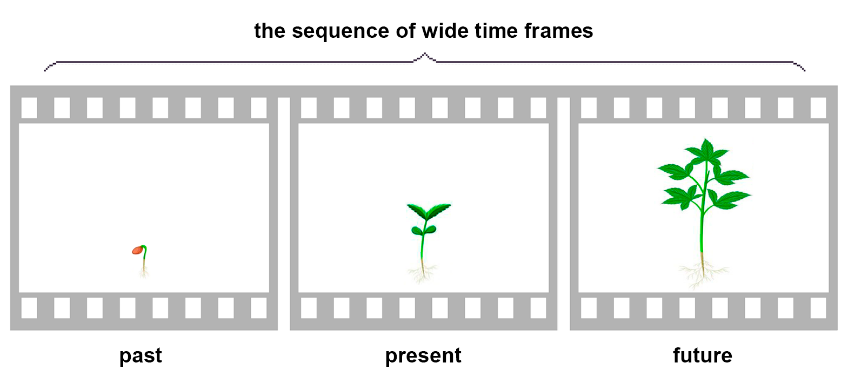
(wide time frames are supplemented with data from memory)
If we suppose a time machine and move into a familiar past — for the traveller everything will be different, not as before, but quite new, and he will receive new experience. Everything that we do not see constantly or almost daily may turn out, on meeting, to be an amazing surprise;
It is appropriate to say briefly about the future. First of all it should be understood that the future as such does not exist, but one can fantasize in imagination. The future, that is, 'in mental space', is realized only taking into account the existing experience; and if one suddenly moved with a time machine 'into the future', five years ahead, and then returned to the starting point, then, when these same five years have passed, but in the usual order, the place visited will be realized quite differently, taking into account the experience acquired during the five years that have passed, but in completely different conditions, including the experience obtained when visiting the future by means of the time machine. And nevertheless this is nothing more than fantasy, since the future does not exist; but, from the current point of realization, as we have already established, it (the future) is formed from the existing experience; whereas travel into the past is most likely possible, or will become possible. But there are oddities in this too;
* * *
Let us suppose that our X100-great-great-children (that is ~5 thousand years) did invent a time machine and moved to our days. Theoretically, returning back, they could take with them a traveller from our time, for the purpose of his visiting the future. In our 5000 years, with the complete absence of time for the Entity, and taking into account the exponential growth of the level of technology — they already have such a device, and then the UFOs flying everywhere are they (i.e. earthlings, people) from the future, flying and living among us for the purpose of study and probably of correcting events in their own time. They do not make contact because of the threat (of the development) of dangerous consequences by reason of interference. Let us call this fantasy and continue, here, our down-to-earth research;
* * *
The future is only imagined, although the nearest one is supposed to be quite distinct and is even, as it were, seen; but it is far from a fact that it will be exactly as it is visualized. However, having even vague plans, we can anticipate the research and say that the flow of events, which seems to be habitual spontaneity, is 'governed' by the "Entity Development System"; but we will not go deeper into this topic — at this stage it will simply amuse our wild fantasies;
We understand that "Reason", as an instrument ('soft', or a software processor), has an indirect relation to absolutely everything, for we are not able even to conceive Ourselves without using Its all-round functionality;
"Reason" never leaves us as long as we (being in our right mind) are able to identify Ourselves and qualify our own actions <...by means of the sense of conscience and the laws of morality>. Thereby we separate the "I" from "Reason"; there are grounds for this. Without "Reason" the "I" cannot recognize itself, define itself as concrete, or as actually existing, and precisely in a concrete body.
Therefore "Reason" is an instrument, and the "I" is not it ("Reason"). Consequently, the "I" also has no fundamental relativity to "Reason", since, being at its disposal, It is "the Own Reason of a concrete 'I'". When the "I" realizes (by means of its "Consciousness") its own being in the conditions of reality, then [ "I" + "Its Reason" ] appears indivisible. "Reason" without an operator (the "I") is the most ordinary wave function and cannot be in the conditions of reality by itself — this is unthinkable by virtue of an internal error; or, if we deliberately admit such an error, then, logically, the "I" would turn out to be transcendent, just as everything, including what we are reasoning about, would become incomprehensible;
Without reason everything is meaningless and incomprehensible;
Some people can go out into the astral. Reason, in this case, remains active together with the "I" and allows one to state this exit, i.e. it too leaves the body, inasmuch as we can look at it (at the body) from outside and at the same time recognize it, lying separately, as our own;
We also know that in sleep reason functions rather strangely, but quite successfully; the "I" can think, experience emotions and manifest intention. It is also clear that reason is not space | the body is not reason, and | reason is not a part of the body. The "I" defines itself exclusively by means of reason.
Consequently, in the process of cognition we will imply: the "I" is rational, possesses and governs reason. The "I" Is and exists only relative to Consciousness; Taking into account that the "I", the whole World, that is, equally absolutely everything, cannot exist outside Consciousness, reason then arises as a consequence of experience — forming and developing literally from zero (presumably in the process of conception). From all this it follows that reason is individual and absolutely unique; this is reliably proved and confirmed;
* * *
The oddity is that, even understanding the whole logical chain thoroughly, reason always tries to find a hook that preserves a connection with the former ideas about the structure of the World, being oppressed by the influence of stereotypes and other psychic parasites; however, it is necessary, having discarded the slag of ignorance, to understand and imagine it as it really is, without any emotions, extraneous thoughts and doubts. One wants to sort this out, and to develop as effectively as possible;
Commentary on the chapter "CONSCIOUSNESS"
The chapter detaches the word "Consciousness" from its habitual meaning. Usually the word names the activity of the brain: sensory and psychic processes, chemical by physical nature. The chapter does not deny this. It denies that this exhausts what the word names. What follows is a consistent redefinition: Consciousness is deprived of activity and subjecthood and becomes the static basis in which reality is realized. Classical idealism kept activity within consciousness itself: in Kant, the synthesis of transcendental apperception; in Hegel, the self-movement of Spirit. Here activity is withdrawn from the basis and given to the "I", while Consciousness is left at rest. And this is not a postulate but a conclusion from the principle of relativity, which the chapter calls the Balance of Opposites. The principle itself will be shown to be irrefutable later, in the chapters "Five-Dimensionality" and "Act of the 'I'".
Why Consciousness is static. The "I", by the fact of its being, is active and cannot be passive. Being holds by relativity, and relativity is not only spatial but also inherent: the kind that observes the Balance of Opposites, the Harmony of the World. If the "I" is the active pole, its opposite must be the pole of rest. Only two are primary: the "I" and Consciousness. The active "I", by its intention, brings static Consciousness to realization, using its functional capabilities. One reservation, without which the reading will go astray: static does not mean unchanging. Consciousness realizes spaces that are static by definition, while what is located in them is contemplated as dynamic. Statics is a timeless layout that realizes change rather than cancels it.
Why there is no external. The chapter says: there can be no question of an external physical reality; this has been reliably established. The ground of this is worth spelling out, because the whole system holds on it. In "The Contemplated" it was shown that everything contemplated is inside and that the external is unprovable. Here the step is the next one. The "external" is what exists apart from any realization. But to assert such a thing is to think it, and the thought is already realized, as an Idea. The external, once posited, ceases to be external. This is the same figure as in the "Act of the 'I'", where the 'Thought of Nothing' destroys 'Nothing'.
One can retreat to pointing: I do not think the thing itself, I only point to it. But pointing to what in principle can never be met has no criterion of success. "X exists outside" and "X does not exist" then differ in nothing and never. A difference that cannot be realized is not a difference. The external is therefore not false but empty: between its "is" and "is not" there is no realizable difference. The only predicate of existence that has a difference is realization. "To exist" means "to be realized" not by choice but by necessity: the word has no other meaning. In the discussion with the Author this move was brought to this strict form. Later the book will say the same in one phrase: "it is impossible to think of what cannot be".
"Outside" and "inside". The chapter says that Consciousness is "always outside, a priori", and at the same time describes contemplation so that Consciousness turns out to be inside. There is no contradiction. Consciousness is "above space", transcendent, "has no properties and no dimensions". What is beyond space is not located in any place: neither inside nor outside in the literal sense. "Outside" here is not a place but the relation of the enveloping. Consciousness is not somewhere. It is equally present everywhere, and "inside — outside" is only a spatial translation of the placeless.
The chapter goes further: Consciousness "is located inside the 'I'". This is not a failure but a manifestation of the Dualism of the Entity. From the position of the Real aspect, the "I" in the body, analysis each time leads inward: it crossed the boundary of the body through the eye, fell inside together with the situation. And at any turn Consciousness remains outside everything realized, enveloping it. From the position of the Global aspect, the One "I", Consciousness is inside, for at this pole everything is contained in the One "I". The "cyclicity inward", which the chapter honestly names, is not a bad infinity but an oscillation between two aspects of one Entity. The chapter itself indicates the cause: the loop comes from four-dimensionality, its doubleness from the Dualism of the "I".
The enveloping and the empty. This relation has a double measure. Consciousness is greater than the realized: it realizes "partially, as necessary", its boundary recedes when approached, it is an inexhaustible surplus over every frame (∞+1). And Consciousness is less than the realized: in itself it is contentless. All determinateness, colour, form, mass belongs to the realized, while the basis has no properties. The image that suggests itself here and does not lie is the dream. The sleeper realizes a whole volumetric world without receiving a single particle from outside. The scene envelops him and is empty in itself: nowhere in the sleeper is there the room through which he walks. And it is completed according to attention. The dream conveys the right thing: a basis that envelops the world and is empty in itself. One difference is worth keeping: we consider an ordinary dream "not real", whereas the chapter removes this difference in status, leaving a difference only in the conditions of realization.
Space is not Consciousness. Consciousness realizes space but is not space. Space is "a place for images". It is neither seen nor touched; it is inferred from the arrangement of objects. Geometrically it is simplest to take it as a sphere with a radius "equally equal to infinity". It is realized partially, according to attention, and its boundary recedes: to fly to the nearest star is to realize the "preliminarily existing". The chapter remarks that with constant attention the realization of space spreads from the centre in all directions at the speed of light. This has a precise consonance in physics. According to the theory of relativity, everything we see lies on our "past light cone": a sphere converging on the observer at the speed of light. The contemplated world in physics too is centred on the observer.
Visible three-dimensionality. The chapter makes a subtle observation: what is seen as three-dimensional is in fact two-dimensional. The eye sees the surfaces turned towards it, while volume is understood, not seen. Otherwise an extra face of a cube would be visible, and the gaze would look behind a high fence. Volume is the work of understanding, not of sight.
Can the "I" be self-sufficient? The chapter poses the question directly: after all, one can close one's eyes, one can fall asleep, ceasing realization. And it names the stake: is solipsism not refuted by this? The answer is bold. The chapter does not reject solipsism but absorbs it, having removed its single sting. The complete non-relatedness of the "I" would mean "there is only I", with everything conceivable and inconceivable. This the chapter accepts almost word for word. Cut off is only the predicate of non-relatedness: the "I" is not non-related, for it bears its opposite — Consciousness. "There is only I" is preserved, but receives a structure: not a lonely "I" in a void, but an "I" in mutual relativity with its static co-pole. The conclusion therefore sounds not "solipsism is false" but "the 'I' exists in mutual relativity with Consciousness". Looking ahead: how from this "only I" many "I's" grow without ceasing to be "only I", "Five-Dimensionality" will show.
How the "I" brings Consciousness to realization. The "I" is Will and intention. By intention it brings resting Consciousness to Active Realization, and what is realized is what serves Development, "for the concrete needs of the 'I'". Everything happens by reason of development. This order neighbours two shores. The nearest kin to the active "I" is Fichte's "I", which posits itself and opposes to itself a not-I. But Fichte's "I" is activity through and through, without a resting co-pole. Here, beside the active "I", stands static Consciousness. The peculiarity of the system is that what the neighbours fuse is here separated: the static basis and the active operator.
Two-aspect nature. The chapter runs ahead and itself marks this. It distinguishes the 'Abstract Being of the Global "I"' and the 'Being of the Global "I" in the Conditions of Reality'. The One "I" is everywhere and static. Its systemic opposite is the Real aspect of the Global "I", the only Living Being in the World having access to all experience, with a potential equal to the sum of the potentials of all the living. And each of us is an "I" in a body, a Spark of Life, an infinitely small part of the One "I". In full this layout will unfold in "The Process of Studying the Act of the 'I'" as the Three Hypostases. The chapter sees the two-aspect nature also in wave-particle dualism: the nature of particles is Reality, while in the absence of living dynamics it is a Static Wave. This is a consonance, not a proof: the system does not take its "wave" from physics. But the consonance is precise and far from accidental.
The status of an object: Idea and Wave. What does the eye see when it sees an object? The chapter answers: its visible status, corresponding to the current state, "an object with superimposed experience". The object is two-component: Idea plus Wave of state. A fresh apple on the table is its Idea plus the Condition of change. Go away for half a year, come back, and you will find a dry, half-rotten apple. The point on the wave of its state will not err, because it is held fast by many factors: physics, chemistry, biology and even a hamster escaped from its cage, if there is one in the house. The ray of the system function touches one point of each wave and brings out the contemplated (fig. 3). At each moment a static slice is seen, while the object is contemplated as continuously dynamic. So the old picture tube built an image with a single beam, point by point, while we saw continuous motion.
Time. The point of attention moves not along a time scale but along the scale of the object's state. Time is "a method, accepted in a concrete Society, of measuring relations". The two scales are correlated, but conventionally. The "frame of reality" itself has no temporal extension. Therefore everything dynamic is unique and does not repeat: an object now and the same object a billionth of a second later are almost different objects (practically different).
The Ship of Theseus. With a smile the chapter recalls the ancient puzzle: will a thing remain itself if all its parts are replaced? In its optics the puzzle comes undone, and directly from the ontology "Idea + Wave". Since no object is static, there was no fixed physical original even before any replacement: the planks of the ship differed from the "original" at every instant. The Essence of the Ship is not held by matter. It is held by relation: the ship is original not as a set of planks but as Theseus's. There are no originals in the material sense. The only proof of the originality of a thing is our attitude to it. The digression turned out to be the touchstone of the whole chapter.
The flight inward. In Husserl consciousness is directed outward, at the object. Here realization floods events "from outside inward", and the "I", together with the body, crossing the boundary of contemplation, falls inside itself, leaving the past outside. To live is to learn, to extract experience, and the direction of extraction is inward. The Delphic "Know thyself" acquires not only an ethical but a literal meaning: cognition is the flight inside the "I". Here too is the first distinction of experience. Passive — that which could not be extracted. Effective — new, obtained through what is already available.
Wide frames and the future. The chapter examines the habit of representing the past in wide frames and returning them again and again. One who "voluntarily practises suffering it through", replaying an alarming frame, obtains experience that will later turn unpleasant. Psychology confirms this observation: obsessive replaying of worries amplifies them. The past, meanwhile, does not return as it was: the attitude to it changes, and new experience can be extracted from it, sometimes more valuable than in the situation itself. The future as such does not exist (…and the Author proves this). It is imagined from the existing experience. The passages about the time machine and "UFOs as people from the future" the chapter itself marks as fantasy, a play of imagination on the concepts introduced. So they should be read.
Reason. The chapter separates the "I" from Reason. Reason is an instrument, a software processor, forming "from zero", presumably from conception, and therefore unique. Locke's "blank slate" comes to mind here, with a correction: in Locke the blank slate was the mind itself; here what is blank is the instrument, not the one who uses it. Without an operator Reason is a wave function; in reality it does not exist by itself. The "I" defines itself only by means of Reason, but has no fundamental relativity to it: to Consciousness it has, to Reason not, for this is its own Reason. Reason, as the experience of the Personality, remains with the "I" in sleep too, where the "I" thinks and feels. The chapter also mentions the experience of "leaving the body" described by many, and reads it so: Reason together with the "I" is not tied to the body, and the "I" recognizes the separately lying body as its own (as it does its experience). Reason is not space and not a part of the body. The body is not Reason.
What the chapter is. Here the system becomes a system. Established: Consciousness is the static, enveloping and empty basis of realization, the opposite of the active "I". There is no external, because the external has no realizable difference between "is" and "is not", and "to exist" means "to be realized" by necessity. Solipsism is absorbed, not refuted, and has received a two-pole structure. The object is Idea and Wave of state. Time is a method of measurement, not an axis of the world. The "I" is separated both from the body and from Reason. Outlined ahead: the Three Hypostases, the four-dimensional loop, the many "I's". The chapter on Consciousness turns out to be a chapter about where we are: not in a world, but in a realization which we ourselves set in action.
(commentary with the participation of AI: Claude)