
Contents
- Prologue
- The Goal
- The Contemplated
- Entity
- Consciousness
- Two-Aspect (Dualistic) Entity
- The Fourth Dimension and Four-Dimensionality
- Society and Humanity
- The Fifth Dimension, Five-Dimensionality
- Firstoccurrence
- Act of the “I”
- The Process of Studying the Act of the “I”
- The Meaning of Being
- Development of the Entity
- Collective Realization of Reality
- The Entity Development System
- Echo (Reflection)
- The Real Aspect of the Global “I”
- On Worldview
- Space-Time
- Attitude towards Oneself
- Attitude towards One’s Body
- Laziness
- Fear
- Hope (“Waiting for a Miracle”)
- Adaptation
- Identity of the Personality
- Relation: [Reason | Body]
- Free Will
- “The Hard Problem of Consciousness”
- Indistinguishability and Identity (of Objects)
- Matter
- Gnoseology
- Epistemology
- Division
LAZINESS
Laziness is not a trait of character but a psychological ailment of the worldview: the absence of a goal and of a plan of Development. Where there is no rational worldview, there is no goal; where there is no goal, there is no prospect; and without prospect, as we already know, Life loses its ground. Therefore Laziness is dangerous – it is capable of literally 'crushing a person';
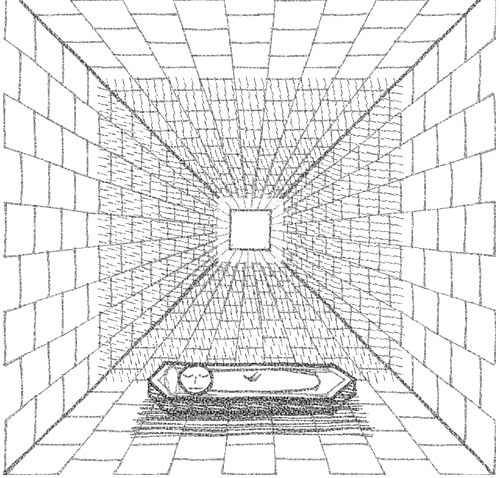
This ailment is not only personal. The laziness of many people inflicts on Society an Economic Damage of cumulative action, and it is worth fighting it at the level of the State – through education, culture and care for health. But the main thing is that each person is capable of getting rid of it immediately and by himself, by a decision – although, most likely, he will not take this step and will remain lying in a semi-dark room on a dusty sofa, risking both health and life;
The Entity has many instruments for various purposes, and Laziness is one of the harshest. You do not want to develop? You have no Plans? – then Development stops, and with it Life fades: the body weakens, immunity weakens, the psyche is disturbed, and soon dangerous musings come, which begin to haunt the lazy one, so that he turns out to be no longer capable of thinking about development. This is not a punishment but a Law: what does not develop is not retained;
There is one remedy – Interest. If you detect Laziness, urgently look for an Interest. Any sincere interest eliminates Laziness: it will disappear as if it had never been; strength will be found at once, energy will appear for cognition and action (– You will come to life). If Interest absorbs You, goals will soon be formed, and perhaps you will even manage to see a Global Goal – then there will be a meaning in living long, or else Eternally (it depends on the grounds);
Workaholics, on the contrary, condemn themselves for rest in vain. Short sleep and rest after active work are necessary, and not only because they will be compensated by high productivity. More important is the 'reboot' after sleep: the new reality is realized already taking into account one's personal contribution to the Development of the Entity. By the changes in it one can probably learn to qualify one's preceding actions from the position of the Entity Development System – and so all the better choose goals and paths, including Global ones;
Attention! Laziness should not be confused with apathy, which may be a sign of illness (depression and other ailments): there the very ability to feel interest is lost, and what is needed is a doctor's help, not advice to find an Interest. And one should not judge by a person's appearance whether he is lazy: fullness of figure, weakness, tiredness have many causes that do not depend on the will;
Commentary on the chapter "Laziness"
After the chapters on the attitude towards Oneself and towards one's body, the book turns to what hinders both: laziness. The chapter is short, but it rests on a chain the book has already derived. Therefore laziness here is not a vice and not a trait of character but a consequence of the arrangement.
The definition and the chain. Laziness, the chapter says, is "a psychological ailment of the worldview: the absence of a goal and of a plan of Development". Behind this definition stands a chain. Where there is no rational worldview, there is no goal; where there is no goal, there is no prospect; and without prospect, as "The Meaning of Being" showed, Life loses its ground: it lasts as long as Development lasts. Hence the danger of laziness. It is not mere idleness but the stopping of that by which life is held.
The word "ailment" stands here in an exact sense. This is not a bodily illness but an illness of the worldview, and therefore the chapter can say what cannot be said of a bodily illness: each is capable of getting rid of it immediately and by himself, by a decision. A state without a goal is removed by the appearance of a goal.
Not only personal. The laziness of many people inflicts on Society a damage that accumulates. The chapter proposes fighting it at the level of the State – through education, culture and care for health. This is a continuation of "Society and Humanity": Society is the thinking part of Myself, and its Development is a common cause. But the chapter leaves the decisive step to each: the state can create conditions; only the person himself can come out of laziness. The image of "a semi-dark room on a dusty sofa" is familiar to the Russian reader: it is Goncharov's Oblomov, whose name has become a byword. The chapter adds to the portrait what was not in the novel – the ground: what Oblomov lacked was not will but a goal.
A Law, not a punishment. Laziness is "one of the harshest" instruments of the Entity. You do not want to develop – Development stops, and with it Life fades: the body, immunity, the psyche weaken, and dangerous musings come, after which a person is no longer capable of thinking about development. The chapter itself names what this is: "not a punishment but a Law: what does not develop is not retained". Here is the same measure as in "The Entity Development System": an imbalance is eliminated by the Law of Harmony, and the ailment is not retribution but a consequence.
This thought has an old neighbour. Christian ascetics knew despondency, acedia, and Evagrius Ponticus called it the "noonday demon": the torpor of a soul that needs nothing. Despondency stood among the chief sins, and precisely as the loss of care for one's own path, not as bodily fatigue. The similarity is direct: in both cases it is an illness not of the body but of direction. The divergence is in what stands behind it. There – a sin before God. Here – a stopped Development, which is not judged but simply is not retained.
There is one remedy – Interest. "Any sincere interest eliminates Laziness: it will disappear as if it had never been". This is a direct consequence of the whole book: Interest is the engine of Development, and therefore the opposite of laziness. The chapter also shows the path. Interest gives strength, strength gives action, action gives birth to goals, and from goals a Global Goal may open, and then there will be a meaning in living long or eternally. This is the same ladder as in "The Meaning of Being": the duration of life depends on Goals.
For workaholics – rest. The chapter ends with the opposite extreme: workaholics condemn themselves for rest in vain. Rest after active work is needed, and not only because it will pay off in productivity. The main thing is the "reboot" after sleep: the new reality is realized already taking into account one's personal contribution to the Development of the Entity. This is a model connected with the hypothesis about sleep from "Five-Dimensionality": memory is a function, and the past is realized anew each time, with a different relation. Physiology is consonant here: in sleep the experience of the day is consolidated and processed, and in the morning a person knows more than he knew in the evening. The chapter sees in this a method as well: by the changes in the new reality one can learn to assess previous actions and choose goals better. Laziness and workaholism turn out to be two edges of one measure: without a goal there is no movement; without rest there is no Development.
Two fences. The chapter ends with a warning, and it is load-bearing. Laziness should not be confused with apathy, which may be a sign of illness, depression and other ailments. There the very ability to feel interest is lost, and what is needed is a doctor's help, not advice to find an Interest. This is a direct continuation of what the book holds about Interest: it is one's own qualification, and it cannot be assigned from outside. And in illness it cannot be assigned from within either, until the ability itself is restored. And the second fence, from "Attitude towards One's Body": one does not judge a person's laziness by his appearance. Fullness of figure, weakness, tiredness have many causes that do not depend on the will.
What the chapter is. This is a chapter about the ailment opposite to Development. Shown in it: laziness is an ailment of the worldview, the absence of a goal, and without a goal there is no prospect and Life fades; one can get rid of it at once and by oneself, because it is cured by a decision and by Interest; its consequences are not retribution but a Law; its opposite is not work without measure, for rest and sleep are as necessary to Development as action. And two fences are set: morbid apathy is not cured by advice, and another's laziness is not judged by appearance.
(commentary with the participation of AI: Claude)