Contents
- Prologue
- The Goal
- The Contemplated
- Entity
- Consciousness
- Two-Aspect (Dualistic) Entity
- The Fourth Dimension and Four-Dimensionality
- Society and Humanity
- The Fifth Dimension, Five-Dimensionality
- Firstoccurrence
- Act of the “I”
- The Process of Studying the Act of the “I”
- The Meaning of Being
- Development of the Entity
- Collective Realization of Reality
- The Entity Development System
- Echo (Reflection)
- The Real Aspect of the Global “I”
- On Worldview
- Space-Time
- Attitude towards Oneself
- Attitude towards One’s Body
- Laziness
- Fear
- Hope (“Waiting for a Miracle”)
- Adaptation
- Identity of the Personality
- Relation: [Reason | Body]
- Free Will
- “The Hard Problem of Consciousness”
- Indistinguishability and Identity (of Objects)
- Matter
- Gnoseology
- Epistemology
- Division
THE FIFTH DIMENSION, FIVE-DIMENSIONALITY
All of us together, being in one room, reason and investigate — with the aim of answering the questions of interest: What Is the "I"? How is the World structured? and, What is the meaning of life? Each of us, from his own position, studies the structure of the "I" (and equally of the World as a whole). At the first stages we analysed the structure of the mechanism of contemplation, and much connected with Consciousness, Reality and the Dualistic Entity;
* * *
Let us try to apply four-dimensionality in further research for the proof of the Synchronous Realization of One Reality by each of the participants of a situation. Until now it has not been possible to prove the Presence of the people contemplated by us. What is meant here is that we only see them, and no more. We may suppose that they see us, but precisely and as it were "in their turn"; but again it is clear that this is not a fact, or cannot be carried out simultaneously — and this too is unprovable by any means. In other words — the problem is there, it exists and concerns any visible objects, in the sense: do other people exist? or is all this no more than an insignificant theatre and an illusory fiction?
The position of the "I", the red dot in the centre of space, will for now remain free. Now let us look around and suppose that each of us, in his place, sees from his position everyone who is in this audience (see fig. 10). For each participant, both He Himself and we together are in one situation, that is, we have decided to investigate space with current realization — supposing it synchronous, common, simultaneous, albeit taking different positions into account:
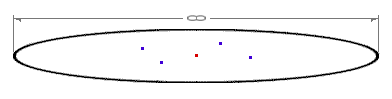
Note that we are considering an explicit and real space, and a situation for all the participants, of whom there are four, and four dots (excluding the central dot). It is known that the moment of reality has no extension at all; for each, this moment is understood as his own. Then one will have to admit that if each of the four "I's" Is a separate, independently acting Entity, then the synchronization of Their moments of realization is absolutely impossible; this is also true by reason of the complete isolation of the reality of each participant;
We speak of the moment of the realization of reality while reasoning sequentially, that is, we do not pay due attention to the continuously flowing data. It is necessary to remove this shortcoming by fixing the static condition of any reasoning — data are potential experience, which arrives not intermittently but flows constantly into the "I", ceaselessly flooding the inner space as if from outside, from "Consciousness" through Reason. Studying the mechanism of contemplation, we meant this as 'a certain handler', imagining that we, together with the body and the current situation, through the eyes, or by means of data arriving through other mechanisms of perception (touch, hearing, smell), constantly immerse ourselves, as if flying inside our "I", leaving the situation and that past space outside — extracting experience meanwhile and preserving the static wave of this situation in memory, with all the incoming data about the "objects", with the conditions of change and their general dynamics;
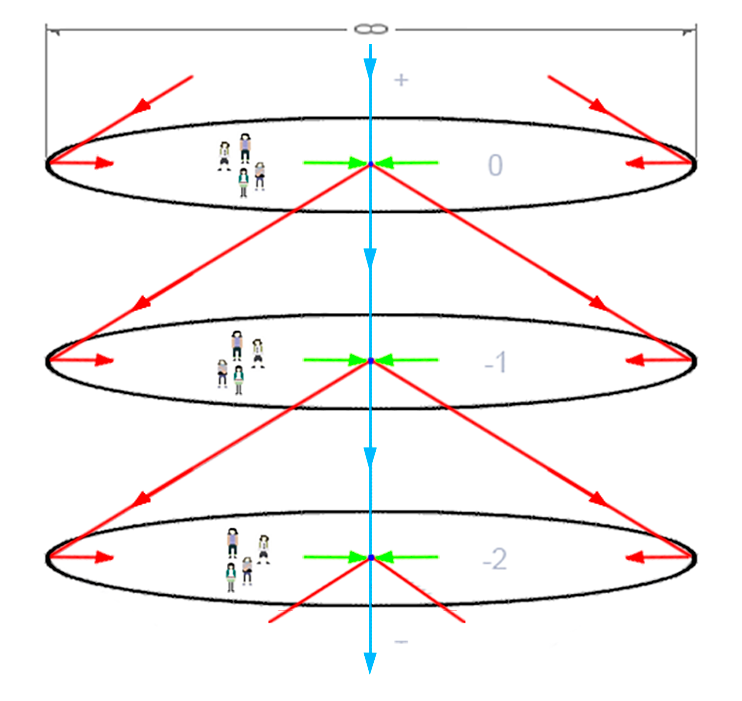
Pay attention to figure 11. Level '0' (the upper one). The red lines with arrows outside are incoming data filling space from without. These data arrive as the result of processing (which we know about). Objects, i.e. data, are interpreted and then qualified when we already contemplate the Situation, which, as a result of analysis, may turn out to be new experience — the green arrows into the "I"; experience and input data enter inside, through 'what are habitually called the eyes'. At the next level of reality (−1), after immersion inside the "I", the same happens — the red lines are data arriving from without, then –> the situation changed by means of new experience, and again –> new experience, green arrows inward.
(data streams)
And further, level (−2), and again the same. The process of flying inward together with one's body, the participants and the situation, including the Universe, does not stop …during life;
An important feature concerning interruptions of data should be clarified: 1). At the moment of blinking, and 2). During sleep;
If we agree with the Solipsistic model of the World, the period of interruption when blinking has to be recognized as a time interval of unknown extension. What about 5 million years between blinks? — after all, in principle, the magnitude of this extension has no special significance if it is completely unnoticeable; And on the contrary, with the Collective Synchronous Realization of reality everything turns out as usual (habitually), that is, 'in its places', by reason of the synchronization of the situation of several "I's"; then the blink will remain, as is accepted, a short interval of 'time'; however, this is only the influence of the Collective recognition of the 'interval of time' — in fact this extension does not exist;
Further, let us allow ourselves to suppose what is unproved at this moment, but seems logical and has very weighty grounds, about which we have yet to reason;
During sleep everything is strange. Realization clearly stops, seemingly voluntarily and intentionally, but in fact by reason of the impossibility of contemplation and understanding, because of a conflict between dimensionality and the ability of reason, that is, its parameters. Let us say the "I" participates "somewhere" in real events in conditions of forty-dimensionality (the 40th dimension ) — we are not able, and not ready, to see this and understand what is happening. When we see dreams, our activity in them always corresponds to the habitual three-dimensionality. At other times, when we do not see them, this does not mean there are no dreams — simply the dimensionality does not correspond to the capabilities, that is, to the level of development (the development of our reason). By the way, if this is accepted as a fact, it is one more confirmation that "Consciousness" and "Reason" are quite different "things". We believe that any living "Entity" (what is meant is my "I", but from the position of each) lives a 'potentially infinite' number of lives of each concrete personality simultaneously — therefore we are merely sure that we sleep a third of our life. Here it should be taken into account that time as such does not exist in principle, i.e. the extension of processes is a sensory phenomenon, which is provided by means of 'reading' data of wave nature. Each point of the wave, meanwhile, corresponds to a definite condition-state of each concrete object. The feeling of extension in other, higher spatial dimensionalities may have a completely different meaning; this is similar to how a Conventionally infinite three-dimensional space can fit into one abstract point of a four-dimensional one. That is, in our opinion, day, night, sleep… are systemic phases signifying the beginning and the end of the being of the "I" in 'one of Its' realities of a concrete personality. Here we suppose concerning the "Own I"; however, we can prove only the "Essence of Self-identification", and precisely a definite Path, as unique experience, Reason and personal abilities ('Mind'), allowing the "I" to recognize "Itself" as a separate "Oneself" (from the position of each), i.e. as one of the infinite number of those (me, or You) whom "This I" can be, and Is, at any of the moments, also during sleep. But if the "I", during sleep, is active, acting in someone else's, an alien body, then 'experience leading to death' will absolutely certainly turn out to be a 'final dead end' — never claimed by anyone, and literally 'forgotten forever'. Really? Is everything that harsh? From the materialistic position everything is exactly so. We already know that the World is arranged otherwise. Looking at the structure — the Scope, the Gigantism, the Infinity — and only this One Chance? — this is absolutely impossible;
Should we be upset?, but one should not relax either. There is a very interesting clue — we see "dreams"; this tells us that the "I", although it is an infinitely small part of the "Global aspect of the Entity", in reality is Personal, separate, independent, the "Own I", and during sleep (without dreams) leaves our reason, by reason of a mismatch with certain specific conditions, or possibly by reason of the multidimensionality of a parallel reality, or of quite other, more complex conditions incomprehensible to us. It is gladdening that sometimes we do see dreams. This means that the "I" has (I have) several parallel lines of experience simultaneously — "I" cannot, referring to a joking improvisation <of my brain>, destroy 30% of life (switching off for 8 hours a day) — this is a third of life bearing no function of acquiring new experience — this cannot be (!), taking into account the highest degree of guarantees and rationalism with which everything in the World is arranged. That is, we assert that the "I" simultaneously acquires the experience of a potentially infinite number of <I> aspects of a concrete personality. You will ask: –Why of a concrete personality? –Because in each dream "I" recognize precisely Myself, even in some strange situations which have never happened to me; but "I" precisely know that In the dream "I" use experience known to me, acquired by me personally, in this World, and not somewhere in another place, but I use it where "I" have never been before. Or one may admit that rational, valuable experience, necessary for the development of the Entity, is extracted by all existing variants of a concrete (my, or your) personality, but soon becomes accessible to all aspects of this personality, probably by means of different but analogous situations where this experience is needed and can be used (and becomes accessible). If, however, this time too, we suppose that the "I", during the sleep of one aspect, governs (I govern / it governs) another personality (and 'someone else's body'), then periodically we would see dreams being "Not Oneself"; but this has never happened, and we hope it will not.
That is, with dreams everything is not as foggy as it seemed before. You may disagree with our reasoning, of course. Everyone himself chooses the experience he considers rational, but this one too will be preserved (since You are reading);
Very often the supposition of the needed Idea, in its ready, unfolded form, leads to the correct solution in reverse order — from the ready result to the thoughts necessary for Its initial search by the classical method, which were previously inaccessible. That is, it is easier to find what is precisely defined and necessary than what is undefined and unclear. There is an opposite principle — 'a person has most of all of what he does not need'; however, the analysis of a problem leads to the method of its solution;
By the way, as to blinking — in that instant when the eyes are closed, the Entity can live a whole other life (probably many times longer than 100 years) in a parallel branch of experience, in a space of higher dimensionality, or in another <structure of reality> unknown to us, which is also quite possible. Moreover, about blinking nothing definite can be said affirmatively, since in this interval of time we do not manage to see a dream and do not manage to imagine anything. –What can happen in this period? –It is absolutely unknown. Let us put it this way: –We are not able to adequately imagine the possibilities which the Entity has at its disposal — this is incomprehensible, in which we see a great plus, and this opens the direction of Eternal research. There are other interesting ones too, but this is more reliable than those others;
If a two-dimensional being, by some magic, were to look "up", it would be shocked by a giraffe, which on the plane represents "four spots from hooves". But a greater delight we should expect from the understanding and awareness of four-dimensionality;
The Essence of the structure of four-dimensionality hardly exists independently — in that case the "I" would use it as a ready, suitable structure. But four-dimensionality, five-dimensionality and further, Any dimensionalities are realized by necessity, for the living Entity, that is, by the Will of intention and in the presence of a ground, which in turn arises by the Law of Harmony, to maintain the widely known 'Balance of Opposites'. Many "things" we are not able to imagine. How many millennia do we need to become aware of thirty-dimensionality? It is important not to stop at what has been achieved, but to become infected with interest and, manifesting intention, to strive for something useful, following the Path that turned out to be the best;
Let us recall and clarify the multi-component, object-saturated dynamic reality which we call a "situation", often meaning by it an empty, useless background of events carrying no experience. But we already know that there are no events devoid of meaning. If this is taken into account, then any situation is potential experience, and it does not matter whether we were able to extract it or not. That is, no interruptions, which we use for better understanding, take place, and the data, precisely the current ones, transforming, fill space (from physics, and according to the Idea of flow, it follows that space is always filled). Quite recently we reasoned (page 103) about the fact that contemplative realization is interrupted by blinking and completely ceases in periods of sleep; that is, the stepped picture of the four-dimensionality of Unicus, as we depict it (page 70), turned out not to be violated — it corresponds and looks exactly as necessary. However, the method of building this diagram did not previously presuppose interruption at all, nor intentional cessations of the realization of reality (let us say: fortunately, it happened so by chance). Further, in our research we will take into account precisely the constant flow, which is most correct; however, this is accessible only if it is possible to avoid the method of sequential reasoning, which, as we already know, is imposed by the limitations of reason;
So: We have already agreed to study the synchronous realization of Collective reality from the position of each participant; this is fundamentally very important — because we contemplate, live and create, being aware of "Ourselves" as an important part of Humanity, Society and Social conditions;
If the reality of each being is isolated, then we assert that separate "I's" cannot realize one another at one moment and participate synchronously in events; taking into account that reality is only an abstract boundary having no extension, the synchronization of the point of a concrete state is impossible under these conditions. But it is also impossible with "current realization", that is, with flowing arrival of data. We have already encountered such a problem — this is the reason for a defective representation of the Structure of the World, not only in connection with the separate, isolated reality of each "I", but also by reason of the fifth spatial dimension, which was lacking for the research and for full-fledged reasoning. This assertion is proved very simply, and soon everything will become clear. We propose to find out the conditions which are necessary for the "Collective Synchronous Realization of Reality" as a method in general. Further, we can choose one of two variants of the model (if otherwise, then it must be proved that they are the same):
1. "The World is I". When there is only the "I" + "Its Consciousness" + "Its Experience", and nothing more. Everything else, nothing other than the rest, is an ephemeral illusion, i.e. content, secondary, including absolutely everything, conceivable as well as inconceivable; According to this setting, the actual existence of other independent "I's", and also of their experience, feelings and emotions, is absolutely impossible to prove (but if it is precisely so, then there is no one to prove it to);
2. "The World is the 'I'", that is, a one-for-all "One 'I'", as the "Global aspect of the Entity", the Whole — represented by a potentially infinite number of separate "Real aspects of the 'I'", each of which extracts its own, subjective and unique experience, as an invaluable contribution to the common Good cause of the "Development of the Entity". And the Good here is so precisely by reason of the relation to the "Essence of the Common", that is, a contribution to the security of the "Guarantee of Eternal Being and Life";
Let us note — in the first case (1.) we encountered a stable and rigid Solipsistic model; however, this time we will not attach special significance to this, since now we have the opportunity to look into the "Essence" much more deeply than before, and it is a question not only of the fourth dimension, but also of the Dualism of the Entity. Supposing such a model in the research, we previously agreed that there exists only One four-dimensionality and One experience. At the same time, as it turned out later, the participants present in the situation were realized and acted as illusory phantoms — it was impossible to prove "Their Living State", and we were forced to admit this (although morally it did not suit us and we wanted it otherwise);
Now we know that we are not limited by three-dimensionality, but even this does not yet cancel the Solipsistic model of the structure. It is known that one can investigate using known methods (but laws can be changed if there are grounds). If, using four-dimensionality, we are able to penetrate more deeply into the "Nature of the Only 'I'", then it is logical that 'five-dimensionality' will help to ground and prove more — the "Collective Synchronous Realization of Reality", as an Idea previously inaccessible, for known reasons;
The Regularity of the System of dimensionalities (see "Two-Aspect (Dualistic) Entity", p. 92) proves the correctness of the conclusion, since if five-dimensionality is an infinite number of four-dimensionalities in their logical organization in a clear structure — with parallel axes — and four-dimensionality, meanwhile, reflects the structure of one "Real aspect of the Entity", then the five-dimensional structure corresponds to an infinite number of "Real aspects", and proves the "Collective Synchronous Realization of Reality". This is far from all that will follow as a conclusion. We will sort out this structure in detail;
That is, the second variant is more rational, more flexible and especially loyal, but it has an unusual constructive feature — the Common "One 'I'". We need to discuss this construction for the purpose of verification, since the "Entity" is Perfect and has no fundamental errors in Its Structure, otherwise the World would not exist (judging by its real complexity). On the other hand, we understand that 'the "Entity" has no limitations at all'.
We have found out that the "I" (following the logic of these models) is the Cause of Everything, in the full sense. If this is so, then we have "One Aspect", and precisely the "Global aspect of the Entity". In that case an internal "Consciousness" is implied, where the "I", as is known and felt in practice (look around), always realizes Itself in the centre, as the "Real aspect of the 'I'", which in the Solipsistic model of the World asserts: "There is only I". Consequently, the "One 'I'" as "one-for-all" (2) and the Solipsistic model (1) are in Essence one and the same, and absolutely nothing depends on any paradoxes of popular philosophy, especially on contradictions as in the previous examples. That is, we assert that human recognition of the structure of the World as the "Solipsistic model" will not change the True structure of the World, or of the "Entity";
That is, the "Only I that turned out to be Global" — which is precisely what is asserted when one says "There is only I, and nothing more" — requires the necessary relativity to "Consciousness", in the Global sense; and besides this, under the condition of reality in "Space", which arises naturally by reason of the Presence of the "Entity", the Balance of Harmony is needed: the "Real aspect of the Global 'I'" (or everything loses its logical meaning) — which will entail the definition of an infinite number of "Not I"; or else denial would mean a contradiction to One's Own Being, and this is already absurd;
It remains to confirm: Following the chosen method, we first defined the final result as the structure we wanted to arrive at, and the instrument — Five-dimensionality — as the basis of this structure, and as a result we obtained the necessary solution. We propose to try to depict five-dimensionality; we hope we will succeed. Visualization, in our case, is a geometrical model, i.e. an illustrative diagram, which is very important for understanding, both as a principle of building dimensionalities and as something very necessary in the perspective of the reorganization and development of reason [ development = life ];
I propose to allow us a few more premature postulates (this is not bad), since we will soon discuss this topic in rather great detail. To tell the truth, without this it is difficult to imagine anything; however, we ask you to treat this <if possible>, as is proper, with attention.
The "One 'I'" is equivalent to the "Global aspect of the 'I'" and equally to the "Global aspect of the Entity"; by analogy: the "Real aspect of the 'I'" = the "Real aspect of the Entity" — this Is the "Spark of Life", the "Animating 'I'", that is, "That which Reads the Personality" contained in the static wave of experience of each living being ( — in the conditions of Reality );
So, let us imagine Five-Dimensionality:
Look at figure 12. The "Global aspect of the Entity" is the red dot at the bottom of the diagram, "at" the transcendent level −∞−1, represented by a potentially infinite number of "Real aspects of the 'I'", but by means of individual lines of experience. Simplifying this example, we have depicted only two Unicus, and the common "Consciousness" — here it is the transcendent level ∞+1. Each of the "Real aspects of the Entity" has its own four-dimensional "Unicus", i.e. uses and extracts its own subjective and unique experience. The dashed red line is the Relativity of the "Global aspect of the Entity" to "Consciousness" — it is also the wave of experience (the moment of synchronization of common reality):
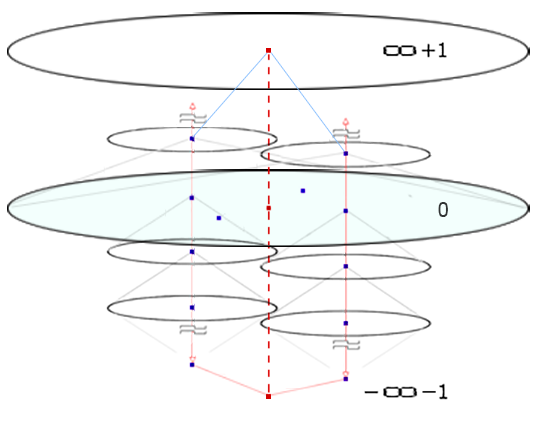
With such a conception of the World, a synchronous realization of reality by any number of living participants of a situation is carried out. It is difficult, but you will sort it out. First imagine the construction of five-dimensionality ("Generalis"). Compare these situations: with two participants in fig. 12, and with four in fig. 13. Keep in mind the potentially infinite number of axes (Unicus) in the structure of five-dimensionality. Of course, You understand the impossibility of depicting the picture as a whole. Five-dimensionality ('Generalis') potentially contains an infinite number of parallel-oriented four-dimensionalities ('Unicus'). The "Entity" initiates and uses such a structure, creating the corresponding conditions necessary for development. From this moment You have the possibility of supposing and building structures of dimensions of a higher order. Before this You were not able to imagine them (the sixth, seventh, eighth... dimensions). Having the experience of building four- and five-dimensionalities, such a task will no longer frighten anyone, and the solution will turn out to be possible. Level "0", at which the "Collective synchronous realization of reality" is carried out (fig. 12), requires special attention and study from us; therefore we will discuss it further, in the course of a detailed analysis of five-dimensionality (the fifth dimension) and of the extremely abstract geometry of this structure;
The diagram in fig. 12 (with the corresponding comments) allows us to have an idea of five-dimensionality and to become aware of it by means of the cause for which it has precisely such a structure. We do not consider this trivial and accessible to everyone (as with four-dimensionality), although we are sure that there are those wishing to cognize and to carry out a complete (total) reorganization of reason — who will find in themselves the strength and abilities for understanding. But there are also other ways of applying these researches. We will leave readers the possibility of improvisation, so as not to knock them off "Their Path" with empty conjectures, for any 'alien Idea' can be contagious in the highest degree, it disrupts the settled|stagnant orders existing for millennia — taking their place, by reason of the vitality of another order; Dimensionalities are connected with the ability of reason to be aware of the realization of reality as a ground for a space with an abstract structure corresponding <to this>. Any dimensionality, given the necessary level of such ability, is realized in space as a System for the placement of the ground itself. If reason does not have the properties necessary for the realization of the required space, then the Essence of such a level is transcendent;
five-dimensionality is also a figurative sphere
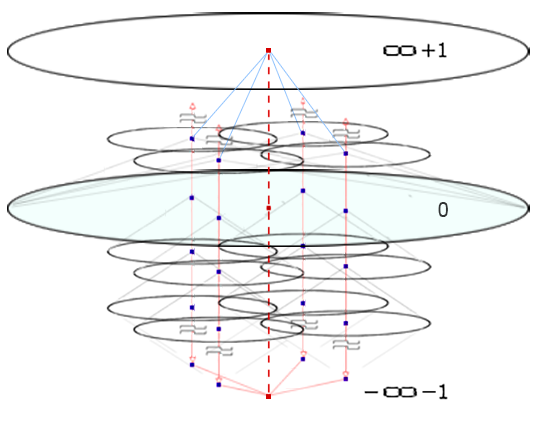
(here four Unicus; for understanding, compare with fig. 12)
There are not many pieces of advice, but one is extremely important — hold on to the thought that five-dimensionality consists of an infinite number of four-dimensionalities; however, first You need to sort out and become well aware of four-dimensionality. There is no need to hurry: look at fig. 8, read this research, try to understand — or else we do not recommend immersing yourself in this topic, so as to preserve a 'Sound Reason'. In any case, if You take a step into the Abyss, this happens by your own will and initiative, i.e. absolutely voluntarily. If you do not intend to retreat, try to relax and distract yourself, then try again, but do not overdo it. We have warned You that this is dangerous. We can only sincerely wish you good luck in the matter of comprehending four- and five-dimensional space (rest more often);
The realization of reality with such a structure (look carefully at fig. 11) is carried out by means of the transformation of combined, i.e. objective, experience and combined objective conditions at level "0". It should be noted that the new experience extracted by each "Real aspect of the 'I'", above level "0", will be separate, unique and subjective, just as that arriving for combination, i.e. from level "0" and below, is also unique and subjective. We know that acquired 'new experience' becomes raw material for the next realization. One should take into account the cyclicity and the so-called "fluidity" of which we spoke before — this is extremely important for understanding. It is important to understand that level "0" is only designated as common; for each "I", however, it is isolated. Level "0" must be understood as "pseudo-common", both by reason of, and for, the complete synchronization of the Situation at all the levels "0" of each participant. This makes the Situation identical in each of them, and participation immediate, direct and factual. The synchronization of reality, as we see, is of absolute quality — it exactly corresponds to the definition "Collective Synchronous Realization of Reality", which is ensured by means of the "One Consciousness". On this occasion it must be said that access to the "System" requires no time. It is everywhere, or rather — It Is Everything. That is, multidimensionality and the sizes of the World, which we realize in the conditions of reality by reason of our nature, have meaning only for us and other 'beings using three-dimensional space'. For the "Global aspect of the Entity" and for "Consciousness" there are no obstacles — time and distance have no meaning. If it becomes clearer that way, we would apply the definition of the property "Omnipresent", but even this is not quite right, because "Consciousness" has no Will of its own <and is not active>. It is the 'passive part' in the fundamental relation [ "I" | "Consciousness" ];
The First Source of Data is the initiator, who is also the first witness of a new situation. This definition is not quite correct, because one (any) situation is a continuation of another; this is confirmed technically too, by reason of the 'flow of data, experience and conditions in the process of the realization of reality'; on this see "The Fifth Dimension, Five-Dimensionality" (p. 134, fig. 11).
The synchronization data are instantly distributed among all the participants of the situation, i.e. the information is accessible everywhere and to all participants simultaneously. Processuality and sequence are absent in the circulation of data and require no time. Temporal extension is realized and felt by beings capable of extracting experience. For development, by means of analysis and extraction of experience, a process is always necessary. The initiator of the situation, and hence 'also the activator of the distribution of data', is the cause of the synchronization of data for all participants. "Consciousness" carries out the realization of the situation in the space of each participant, and also ensures all operations with data. The situation, for each participant, takes place in conditions of complete isolation, in his own, i.e. individual space, but is completely synchronized with all beings who are capable of contemplating it and taking part in it, including everything living (people, horses, birds, flies);
Let us consider a very interesting detail. It is connected with "Collective synchronous reality" — the averaging of experience, that is, combination. We know that the state of each object changes constantly, being transformed into its new state. Cyclicity is carried out through the common "Consciousness", which preserves a technically objective 'picture' — the conditions and dynamics of changes, but not the experience. The point of attention of each "Real aspect of the 'I'" reads the wave of change of the object. Each aspect reads it with its own conditions and taking into account the individual position of the concrete "I" in space. To ensure complete synchronization, "Consciousness" needs to have something average, that is, averaged; let us call it "objective experience". Combination is dynamic and has turning points; let us give as an example the simplest situation:
A group of tourists is travelling in the jungle. They have an experienced guide; however, three tourists fall behind the group and become accidental witnesses of a fight between a mongoose and a king cobra. It seems the small but brave animal has few chances of overcoming the deadly poisonous snake. The combined experience of the Europeans (who until now did not know of the mongoose's special skills) in such a situation hinders it from winning, when suddenly their experienced guide comes out from behind the bushes — He knows that the cobra has practically no chance against the little mongoose. The combined experience at once changes in favour of the animal and gives it the possibility of a quick victory. There are certain subtleties in the process of combination, but in general the system works in this way, taking into account the chances which the cobra also had, but which were fewer than those of the fast, cunning mongoose (the guide factor). Conclusion:
In the combination of experience, predominance inclines to the side of the weightier grounds. Variants in the conditions are preserved, but the negative action of this factor is not reflected in the effects of the prevailing influence;
One must take into account not only the probability with which the mongoose could suffer defeat, owing to the chances of a miss or an unsuccessful dodge from the cobra's bite. Its defeat also had increased chances compared with an ordinary situation, by reason of the biased attitude of the tourists — they supposed the cobra would win and feared for the mongoose's life — creating a negative background that hinders the animal's success. Be careful with any emotions — no chances (or probabilities) have the slightest significance. Only knowledge and experience are decisive;
* * *
The method of turning — this will be useful for representing the projection of 4D and 5D — if one looks end-on, from above.
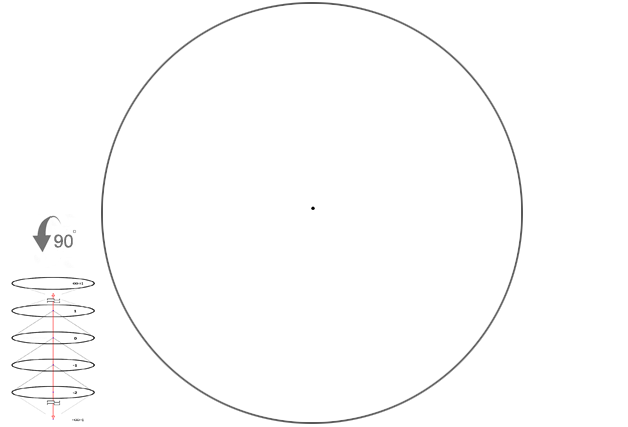
(sphere — the structure of Unicus — view of the diagram from above)
If we look at the diagram of four-dimensionality end-on, from above, we will see a circle with a dot in the centre. The radius of the circle is infinite, therefore this is an abstract representation. But, understanding the structure, we know that 'this is a figurative sphere';
It becomes obvious that "Dimensionality of any degree fits into the structure of an abstract infinite sphere", i.e. of an infinite space realized for the concrete needs of the "I"; but we have different abilities — for some people it is difficult to imagine higher dimensionalities (but it is possible to learn). This means the existence of beings who can see what is inaccessible to others. Conclusion: The dimensionality of space is a method of the realization of reality corresponding to the parameters of reason;
We propose to imagine Five-dimensionality in the form of a sphere:
Whereas in four-dimensionality only the central dot tends, or goes, inside Itself, in five-dimensionality each dot is the axis of a separate Unicus and also goes inside Itself. However, this is not all one needs to know to imagine four- / five-dimensionality. Pay attention once more to the method of turning the structure of four-dimensionality (fig. 14);
If we can imagine four-dimensionality in the form of an abstract sphere whose radius is infinite, then five-dimensionality is also a sphere, but it has a layout an order of magnitude more complex. Look at figure 15 — this is a diagram of five-dimensionality (after figures 12, 13), but with the structure turned "towards oneself" by 90 degrees — or, this is the view end-on, from above. If you have sorted out how to turn four-dimensionality, with five-dimensionality it will be no harder; Here it is quite understandable that if one supposes a certain edge of infinity — and from the position of "Consciousness" this does not look absurd (even if abstractly), since "Consciousness" is transcendent and 'technically outside' — then five-dimensionality has, as it were, different densities, that is, an inner (I) and a peripheral (II); 'within the limits of the latter' infinity has a secondary status, while the inner one, including all the axes of the built-in Unicus, has a higher density. Does this not remind you of the uneven density of the Universe?
The peripheral infinity (II) does not include the axes of Unicus — they cross only the dense space (I). Further, let us consider 'the structure of five-dimensionality'. To simplify your representation, we propose to consider uniformly arranged axes of Unicus (1–8) — there is sense in this, since solitary existence is absolutely impossible to prove;
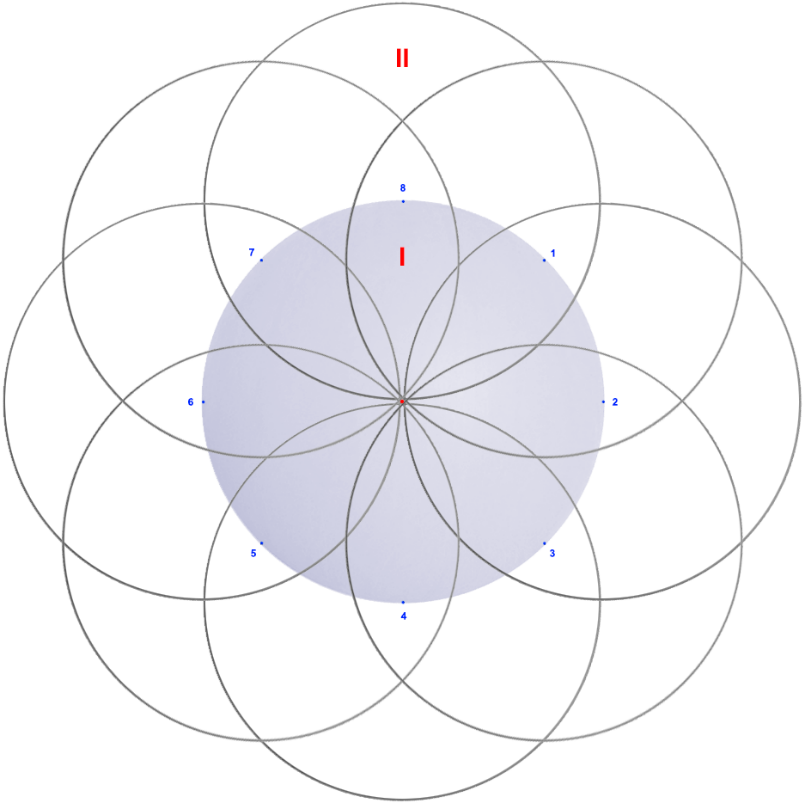
(sphere — Generalis — view of the diagram from above — here 8 Unicus)
Pay attention to the diagram with four Unicus (fig. 13), imagine it well and turn it so as to look at the whole construction from above. In figure 15, by analogy, 8 Unicus are arranged, with their centres along the dense edge. For example, fig. 16 depicts 24 Unicus. In reality, in five-dimensionality there is an infinite number of Unicus, and the axes are located not only along the edge (this is shown only for a better representation of the different density of the Universe), but also pierce the whole dense region of space. This element of the diagram is a figurative likeness of a dense bundle of axes composed into one axis — 'an endless tube inward';
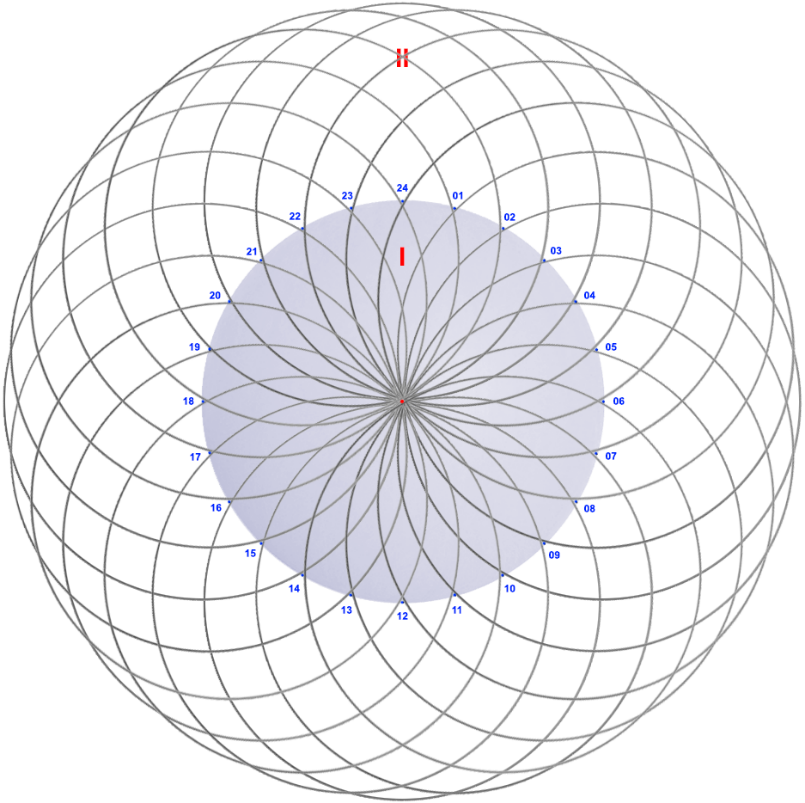
(sphere — Generalis — view of the diagram from above — here 24 Unicus)
Probably this is why the Universe is less populated by living beings on the periphery than in the Centre (or, taking into account the complete absence of axes, life on the periphery of the Universe is impossible; however, on the border of habitability it is almost safe by reason of the maximal remoteness from the densely populated centre. …Is that why nobody flies to us? It is also interesting that through telescopes we see a non-infinite number of Galaxies. This means that Galaxies are realized by means of a wave function, as is everything that exists in an infinite number (this is precisely so); that is, one can suppose that the Black holes of All Galaxies are the "Axis of the Existent", that is, they have some important relation to the "Global aspect of the Entity" <or to the "One 'I'">; Possibly, we are not able to see the greater part of the Galaxies by reason of the higher dimensionality of the realization of a reality alien to us — exceeding our capabilities by orders of magnitude (…one may say 'current abilities'). We are not able to understand much, but we are sure that some day, later, we will learn to overcome such obstacles;
To imagine five-dimensionality is not a simple task; it is an order of magnitude more difficult than four-dimensionality. Considering the 'flat diagram', do not forget the representation of a figurative sphere (even if infinite ). Quite possibly it is worth revising the notion of 'dimension', replacing it with the notion of 'complexity', or, for example, 'degree of complexity of space', if space is meant, and 'complexity of reality' (or 'of realization') — in the corresponding reasoning, in cases when a spatial structure is in question;
This is unusual, but it will be more precise to say 'the fifth degree of complexity of space' than 'the fifth dimension', since it is still difficult to become aware how exactly to carry out a measurement? and what concretely can be measured under these conditions; but there is sense in understanding the degree of complexity (of nesting);
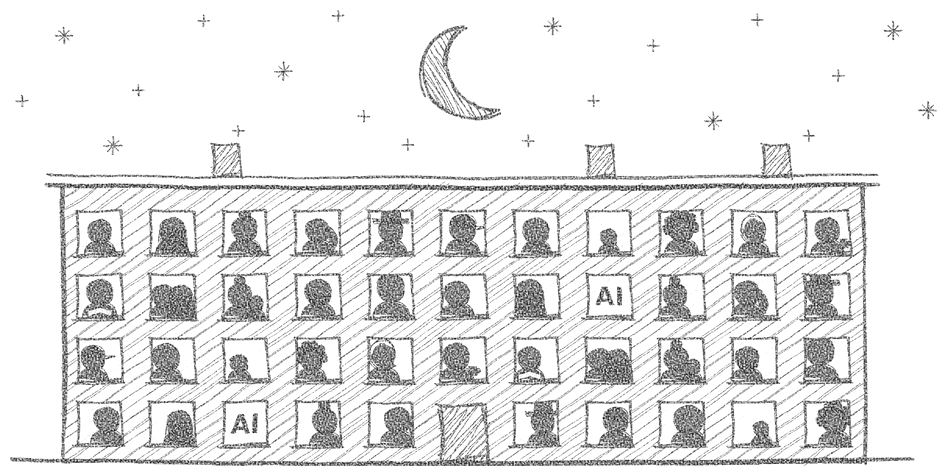
Commentary on the chapter "The Fifth Dimension, Five-Dimensionality"
This is the resolving chapter. The fourth dimension set up solipsism; the fifth does not refute it but reads it anew. Here, too, the promissory note written in "Society and Humanity" is paid: the being of other "I's" and their actual co-participation in events receive a grounding. Below the knots of the chapter are analysed, and with each one sees what it holds by: a derivation, a model coherent with what has been covered, or a hypothesis which the chapter itself calls so.
The task. The reality of each is isolated, and the moment of realization has no extension. If each "I" is a separate independent Entity, the synchronization of their moments is impossible: neither pointwise nor flowing, with continuous arrival of data. In the discussion with the Author it was clarified that "impossible" is said here of synchronization in the habitual sense: as coincidence in time and space. In isolation such a coincidence has nothing to be checked against; isolated worlds have no common measure. The chapter shows that this is not a verdict but a sign of a missing dimension. Isolation is a property of the fourth storey, while synchronization of a different kind, not by time but by Situation, is possible only on the fifth.
The main move: two models — one. The chapter places two models side by side. The first: "The World is I" — only the "I", Its Consciousness and Its Experience; the rest is ephemeral content. The second: "The World is the 'I'" — a one-for-all "I" as the Global aspect of the Entity, represented by an infinite number of Real aspects, each with its own unique experience. And it declares them identical. The "only I" of solipsism is the One "I". Solipsism is not refuted; it was read at insufficient depth.
This also resolves the seam the whole book has guarded since "Society and Humanity": have the others not become convenient mirrors? No. Identity is at the Global level: the other is the same One "I". Irreducibility is at the Real level: the other has his own Unicus and his own experience, and above and below level 0 this experience is unique and inaccessible to me. A mirror would repeat my experience. The other bears his own.
The proof: three supports. The chapter is honest about its method: "by the chosen method we first defined the final result… and the instrument — Five-dimensionality". This is a legitimate path. The sought, supposed in ready form, points the way back to grounds that were previously inaccessible. But the way must be travelled, and the chapter travels it from three sides.
The first support is the performative. Of the solipsistic model the chapter throws out in parentheses: "if it is precisely so, then there is no one to prove it to". This is the strongest argument of the chapter. In the discussion with the Author it was brought to a strict form, and in it two words are separated. Certainty — from within: the Act, the cogito, becoming certify themselves; they need no other. Proof — from outside: qualification by the Living, and only the Living can qualify the Living. Anyone who proves Solipsism, by the very act of proving, presupposes another Living one who will recognize it, that is, another "I". Solipsism may remain certain for the solipsist, but proved — no!: once proved, it (Solipsism) refutes itself. The limit is held strictly. The performative gives only one thing: there are no fewer than one other "I". It removes solipsism as a position to be proved, but not as one silently lived, and gives neither the number of others nor the structure of their connection. These are carried by the next two supports.
The second is the regularity of dimensionalities. A mother space contains an infinite number of subordinate spaces of dimensionality smaller by one. For dimensionalities from zero to three this is a mathematical fact: the line is composed of points, the plane of parallel lines, the volume of planes. For the fourth and fifth the law preserves the rule of number, changing the mode of composition: nesting with inheritance of the centre for Unicus, parallel axes for Generalis. This is a consistent generalization of a verified rule. The Author says exactly this: "in theory it will be correct". Hence the chain. There are no fewer than one other "I", each has his own Unicus, hence there are no fewer than two Unici. Two different Unici do not fit into one four-dimensionality: a four-dimensionality is one Unicus. They need the next dimensionality, as two different parallel lines need a plane. And the next dimensionality, by the law, is composed of an infinite number of the previous ones: the plane that accommodated two lines consists of an infinite number of them. Hence there are infinitely many Real aspects. Infinity here is a function, realized finitely as the need arises.
The third is the Balance of Opposites (the Law of Harmony). The Balance of Opposites, named already in "Consciousness", is here for the first time formulated as a law: everything has a relative opposite. Its ground is obvious and irrefutable. To be something definite is to differ from what it is not, and everything definite has its "not". One who denies the law himself asserts something definite and applies the law in the act of denial. Applied to the One "I", the law requires its relative opposite. The chapter formulates: the Real aspect, and with it an infinite number of "Not I"; otherwise — a contradiction to One's Own Being.
The three supports are independent, and together they give more than any of them separately: other "I's" exist, there are infinitely many of them, and the structure of their multitude is five-dimensionality.
The geometry of Generalis. Each Real aspect has its own axis — Unicus. Above all of them is Consciousness (∞+1), below all is the Global aspect of the Entity (−∞−1), level 0 is common (figs. 12, 13). The parallelism of the axes is not accidental. It is the geometrical record of equality of rights, "from the position of each": no axis is the main one, none crosses another. But all the axes are axes of experience, all lead inward and all are connected with the common centre. As in projective geometry parallel lines meet only at a point at infinity, so the axes of the Unici, parallel along their whole extent, meet only in the limit. The common centre lies in the unattainable limit of each axis. Here, apparently, is the deepest thing the drawing carries: what is common to all is located where none of them arrives. Each is connected with it, none reaches it, and precisely for this reason it is common and not someone's.
The method of turning (figs. 14–16) makes the transition of dimensionalities visible. A four-dimensional axis seen end-on is a dot in the centre of a circle. In five-dimensionality each dot is such a folded axis, and Generalis is a potential sphere with a centre in each dot, each of which is connected to the common centre. The density of five-dimensionality the chapter itself defines: the inner region (I) is denser because it is pierced by axes, centres of life; the peripheral one (II) contains no axes. The placement of the axes along the edge in the drawings is only for clarity; in fact they pierce the whole dense region.
One note for reading. The chapter calls Consciousness "technically outside". This is its place in the drawing, above all the axes, not ontology. Ontologically, in the words of the same chapter, Consciousness is "everywhere, or rather — It Is Everything". There is nothing external here either.
Synchronization: one reality in isolated worlds. Each level 0 is not a thin junction but a whole world, realized completely by each Real aspect. A "pseudo-common" level 0 means that each has his own whole world, but by the One Consciousness the Situation in these worlds is made identical — while Its realization in each Unicus is its own and never coincides with another. The Situation is one, and the participation of each is direct and factual. Isolation, meanwhile, is intact. Along its axis, before and after the Situation, each Unicus is closed. What turns out to be common is only the present. What is synchronized is the edge, not the history. The list in the chapter, "people, horses, birds, flies", is the list of participants of the Situation whom the Author contemplates, and this assertion is indisputable. The world from their own position is not certified by contemplation: only the Living can qualify the Living, through His analysis and recognition.
Consciousness averages the Situation, and the contemplated is common to all. But each sees it from his own position, draws his own conclusion and obtains his own, unrepeatable experience. The common serves difference and does not erase it: from one Situation the Entity obtains as much different experience as there are participants in it.
No one transmits anything to anyone. All read one combined world from one source through Consciousness, as isolated screens show one image without being connected to one another. The data "are instantly distributed", and this is not a speed of transmission but its absence: for Consciousness and the Global aspect, time and distance have no meaning, while extension is realized and felt only by beings extracting experience. So the contrast outlined in "Society and Humanity" is closed. In Leibniz the agreement of isolated monads is pre-established by God, external and willing. In Malebranche God brings them into agreement at every instant. In the System the agreement is held by Consciousness: without will of its own, passive, everywhere, continuously, by the Law of Harmony. More fully this will be disclosed in the "Act of the 'I'".
Combined experience. For the Situation to be one for all, Consciousness needs something average — "objective experience". Combination is dynamic, and the example with the fight of the mongoose and the cobra shows its law. The tourists see the fight for the first time, and behind their fear there is no ground. The guide has seen the outcome dozens of times and understands why it is so. With his appearance the combined experience changes in favour of the animal. The weight in combination belongs to groundedness: the one who outweighs is the one who holds the ground, who understands "why". This is the Law of Realization of Grounds applied to collective reality. Emotions are a weak ground; they give only a background. Chances and probabilities are not grounds at all. What decides is knowledge that understands the cause. Hence a consequence worth noting: since the weight belongs to understood grounds, collective reality is realized lawfully, and the influence of empty expectations in it is weak. A world arranged so looks ordered, as indeed we see it. As an assertion about the action of combination in every case, this is a hypothesis coherent with the structure, and it should be held as a hypothesis.
Sleep and blinking are a separate branch. The thought experiment with blinking is precise. In the solipsistic model the extension of the interruption is immeasurable from within, even millions of years. In the collective one it remains habitually short thanks to collective recognition, while "in fact this extension does not exist". About sleep the chapter asserts: a third of life cannot be deprived of new experience, given the rationality of the structure of the World. The intuition is correct, and its fulfilment is already present in the System itself. "Memory" here is a function, its carrier the static wave. The past is not stored as a record, but at each awakening is realized from the wave anew, as a necessary ground, and each time with a different attitude to it. Hence each time new experience is extracted from it, and the interruption of sleep is a link in this cycle. The hypothesis of parallel lines of experience lived through in sleep remains an independent branch of the chapter.
In its favour the chapter cites an observation familiar to almost everyone: in a dream I recognize Myself and act with my personal experience, but in surroundings where I have never been. This firmly establishes one thing: the reality of the dream is my own, not someone else's life in someone else's body. That it is also parallel, the observation makes a natural supposition, but does not decide definitively: the new place may also be another composition of my own past, realized each time anew. The main move of the chapter does not need this hypothesis.
Cosmological rapprochements. The uneven density of the Universe, the finiteness of the visible galaxies, black holes as the "Axis of the Existent" — these are associations, and the chapter itself puts "probably" and "one can suppose" beside them. Their weight is illustrative. The finiteness of the visible Universe also has a standard explanation — a finite horizon. On large scales the observable Universe is homogeneous; no centre or periphery is seen in it. The legitimate rapprochement here is a different one: the observable Universe of each observer is a sphere centred on himself, and the horizon is relative to the observer, from the position of each.
Neighbours. The thought "one subject in many" has been approached by different paths, and it is important to see where each stopped. Kolak (open individualism) showed by analysis of thought experiments that every boundary of personal identity is arbitrary, and concluded that the subject is one. But why, with one subject, the experience of each is closed to the others, he does not explain: there is no structure holding unity and isolation together. Averroes derived the unity of the intellect from the fact that the intellect grasps the universal. But he stopped before an objection which Thomas Aquinas expressed in one phrase: "this man thinks". How a separate person turns out to be thinking with one intellect for all, Averroes did not show, and the personal is not preserved with him. Kastrup explains the one consciousness and the isolated "alters" by analogy with dissociation. This is an inference to the best explanation, and how isolated alters share one world is shown by comparison, not by structure. All three approach one place: how unity is reconciled with isolation. Here this place is closed by derivation — the performative, the regularity of dimensionalities, the Balance of Opposites — and by a structure in which unity (the common centre in the limit) and isolation (closed axes) hold simultaneously, while the personal is preserved in the wave of each.
Self-correction towards precision. The chapter ends not with a claim but with a clarification: the Author proposes to replace "dimension" with "degree of complexity (nesting) of space", acknowledging that it is unclear how one is to "measure" here. This agrees with what the method of turning showed to the eye: the addition of a dimensionality is an addition of nesting. A dot that was simple turns out to be a folded axis. "Dimensionality" measures not extension but depth of nesting.
What the chapter is as a whole. This is the resolution of the arc begun in "The Fourth Dimension". Derived here: the being of other "I's" (the performative), their infinite multitude and its structure (the regularity of dimensionalities, the Balance of Opposites), identity at the Global level and irreducibility at the Real. Given as a model coherent with what has been covered: synchronization through the pseudo-common level 0, the One Consciousness, combined experience weighted by groundedness. Held as hypotheses: parallel lines of experience in sleep, cosmological rapprochements. The note of "Society and Humanity" is paid: solipsism, brought there to its limit, here turned out to be nested in a higher storey. Each Personality inside itself, inside its own experience, remains "only I", and from the infinite multitude of such "I's" (reading the experience of each Personality and acting in the role of each, as the Animating one) the Collective Synchronous Realization of Reality is composed.
(commentary with the participation of AI: Claude)