Contents
- Prologue
- The Goal
- The Contemplated
- Entity
- Consciousness
- Two-Aspect (Dualistic) Entity
- The Fourth Dimension and Four-Dimensionality
- Society and Humanity
- The Fifth Dimension, Five-Dimensionality
- Firstoccurrence
- Act of the “I”
- The Process of Studying the Act of the “I”
- The Meaning of Being
- Development of the Entity
- Collective Realization of Reality
- The Entity Development System
- Echo (Reflection)
- The Real Aspect of the Global “I”
- On Worldview
- Space-Time
- Attitude towards Oneself
- Attitude towards One’s Body
- Laziness
- Fear
- Hope (“Waiting for a Miracle”)
- Adaptation
- Identity of the Personality
- Relation: [Reason | Body]
- Free Will
- “The Hard Problem of Consciousness”
- Indistinguishability and Identity (of Objects)
- Matter
- Gnoseology
- Epistemology
- Division
ECHO (REFLECTION)
Echo, or Reflection – we do not know enough about this either. Perhaps in the course of research it will be possible to change this opinion. We invite You to participate (time does not matter). First, let us reason about pure reflection:
What is between two mirrors? The representation is limited by the size and the degree of transparency of the glass. It resembles a figurative four-dimensionality, without any objects. If objects were densely located in the original space, interrupting the line of reflection between the two mirrors, then this imitation ('?') would prove impossible. Each level of each reflection is a small part – albeit 'ephemeral in the ephemeral' – of a separate infinite three-dimensional space (this is obvious);
Moreover, it is presented on both sides of the observer; that is, if, for example, one looks at the third level from the observer, then in the mirror opposite this level will also be the third <in order> space (fig. 17), as on the reverse side. On the second level you see the back of your head and look into the face of 'That Self' who is on the third level. The spectacle itself attracts attention, arouses the observer's interest, and leads to various reflections;
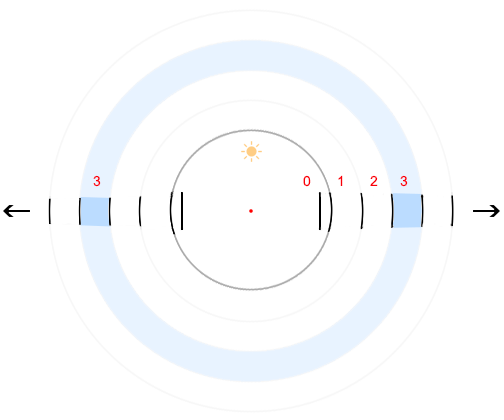
We are inside our own level and, as it were, look into a certain 'permissible little corridor', but in such a representation all the levels turn out to be outside – from our own, original one;
In the conditions of reality (some call these conditions the Material World) everything happens sequentially; therefore it turns out that each next, more remote level is, albeit with a small difference, in the 'more distant past'. If we are speaking of reflection, then, having reflected from one surface, photons are reflected from another, then from the next. So this is logical, although not quite modern, because proving the sequential reflection of photons will prove an extremely troublesome matter – more likely it will be confirmed that everything is simultaneous;
Using mirrors as a visual model, it will be a little easier for You to imagine the fourth dimension and the 'geometry' of four-dimensionality, only there it is 'inward and outward'; that is, being between the mirrors in this exercise, imagine accordingly – it is not difficult to transform;
We are used to perceiving Echo as something very simple and insignificant. By the way, here we use the concepts "reflection" and "echo" in one row – it is one and the same, but people are used to calling 'sound reflection' Echo, and 'light echo' Reflection. Here we suggest using both concepts with an understanding of their equivalence;
Echo, Reflection – an omnidirectional flow of photons, and of all other? particles, reflected from objects. In the presence of objects, they are realized not only for the contemplative method of perception but for any other available to a person or to another 'being-participant-in-the-situation', including sound, X-ray, ultraviolet, infrared, etc.; there are probably many unknown ones, and we are not able to list them all, for an understandable reason; but for each kind of particle a corresponding method and mechanism of perception is needed (and for some also a certain medium; for example, a sound wave cannot propagate in the conditions of a vacuum). Any methods except the most ordinary ones proper to man require the use of special equipment – otherwise perception will prove impossible, and in some cases dangerous to life;
Echo ensures the accomplishment of dynamics in processes in the conditions of the realization of reality – allowing one to observe displacement relative to the current coordinates (of objects);
***
Thanks to the speed of photons, smoothness of dynamics is achieved, and the quality of Situations corresponds to the highest qualification. Delays in the transmission and processing of signals in the 'mechanism of the realization of reality' are completely absent, but – they are considerable in the work of Reason;
The light flow emitted by the "Emitter", through any light source, reaches a certain coordinate point (the boundary of an object, whether a side or a facet, it does not matter) and changes direction, i.e. <we call it> 'is refracted, or reflected in some direction', but this also happens in the direction 'towards the retina of the eye'. This flow branches many times, literally like a rarefied liquid flooding space with photons and other particles, of which, as we already know, there is a great multitude, and each particle performs its own function;
We do not see photons, therefore we contemplate only objects relatively located in space. Or otherwise: we (people) call photons the data coming from "Consciousness" to "Reason" through the realization of Reality in Space, and all this is components in the One Flow of the Development of the Entity (this is extremely abstract). Taking into account the 'speed of light*', the properties of particles and the mechanism of contemplation, realization occurs instantly. The speed of this mechanism is conditioned by the super-accessibility of "Consciousness", which literally 'Permeates the Whole World' – from one position: 1. Statically; from the other: 2. Simultaneously. The evident change of relativity between objects is held in our awareness <perceived> directly, or one may say it is 'available for analysis', and, as we are used to saying: "This is Available in Real Time Mode" (we often paraphrase; this is an important part of the reasoning);
*the speed of light is relevant when Reality is meant, and ephemeral when we reason <in general> 'from the position of Consciousness';
Let us think about a static wave. But first let us imagine its active reading. Photons seem to rush between objects –> suppose a situation over a period five minutes long –> let us consider this situation as if in a stretched (like a "pipe") space –> let us fix it and imagine it as a single wave including the parameters of space;
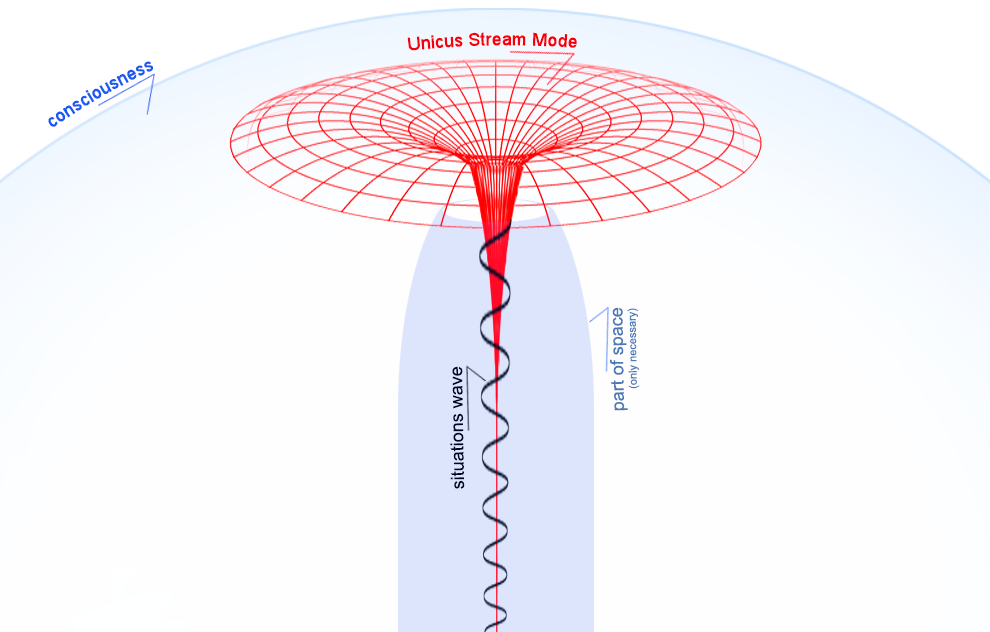
Let us once again focus attention on the fact that all this, as a whole, should be considered precisely as a flow – 'an uninterrupted flow of data + the process of realization', that is, the active functions of reason and other mechanisms. And if we say 'a photon is reflected from an object', it is in Essence like a conductor from the object to the cell of the eye (a conductor that does not exist!), and all this is exclusively at the moment of contemplation (see fig. 18);
We naively thought like this: Space is not an empty volume – it is filled with photons and other particles – this is like filling with a heterogeneous liquid. Besides 'free particles', space is filled with air, gases, and the vapours of all (!) elements and compounds. If one thinks about it, it begins to seem that the processual sequence has the reverse order, or has none at all; that is, one can understand that the object did not exist at the previous moment of time, but is realized as a consequence, more precisely "as a Consequence of the data contained in the wave, when they are read simultaneously". Processes arise, and precisely simultaneously; out of habit one wants to say 'take place', 'are accomplished', but no. Dynamics is precisely a phenomenon;
***
Think about comparing this mechanism with a 'software implementation'; or rather – our representation, based on mathematics and on knowledge of programming languages, misleads us, and we begin to throw the templates of experience onto the structure of the living Entity, using terms from the IT sphere. But of course everything is the other way round – the structure of reason influences the invention of programming languages. So then, if we do not see processes in real, precisely current and unbroken dynamics, and all this is realized on the basis of static waves, through different states of objects, as we considered earlier, then everything we study is one common capacious wave, together with the motion of particles which, in general, do not exist, but when interest is shown they are realized 'as the next ground' and, like the dynamics of relativity, are only conditions – not very complex ones, by the way (however, we have found that complexity is not relevant for the Entity, any more than time). Let us remind once again that we do not consider the World as the fantastic "Matrix" of the film of the same name; on the contrary – what is Revealed to us is qualified as: Absolute, Perfect, Eternal, Infinite, Ideal, and of course the Most Beautiful;
Let us continue to consider processually. For us this is acceptable, understandable and habitual. It is quite probable that if one often and stubbornly imagines four- and five-dimensionality and carefully studies the mechanisms of contemplation and of the realization of reality, then in time reason will adapt and will think on such subjects more effectively and adequately. We have observed this; on average 2–3 years are needed, if one works with special interest 3–5 times a week;
It must be taken into account that we receive only direct data; that is, reflected photons carry the information of the last object that is realized and do not contain data from previous reflections (…and were there any at all?). Therefore we contemplate from one to three sides of a cube and cannot see the fourth side; however, if a photon could be a carrier of data about the penultimate object with which it collided, we could see three-dimensionally – but this does not happen and cannot be, which is obvious. At present flat <2d> images are contemplated, while three-dimensionality is only understood and held in awareness. The contemplation of fully three-dimensional objects would considerably simplify the understanding of the Structure of Four-Dimensionality – by reason of the greater 'logical potential of Reason'. With special striving this is available even now, …as is Five-Dimensionality;
***
When we look into water or into a mirror, there are no objects between us and the mirror, therefore we see only our own face. The physics of reflection remains the same, but, if one thinks about it, it explains in great detail the mechanisms and principles of the realization of objects in space. Now let us switch on awareness and recall the mechanism of contemplation and the 'phenomenon of the illumination of particles', which is both a perfect prototype of 'software implementation' and a sensory psychic process, i.e. simultaneously;
Reflection (Echo) functions as the transport of data within space and, as part of the mechanism of the realization of Reality, is not only a contemplative method but a universal one – psychic, sonic, sensory, and accessible by means of tangible (i.e. mechanical) vibration; that is, this principle constitutes a significant part of the fundamental basis of the realization of reality in all its aspects and manifestations, of all types of particles, that is, known and unknown to us, of energies and relations, including emotional ones, and also mass socio-psychological ones. For example, the well-known Phenomenon of the Sincere Intention "to Give"* – will return Everything back, and many times over (like any Echo). By the way, we are literally 'surrounded by specialists' in this simple business, who know how to choose the best angle for delivering conditional benefits to the masses (to ensure the necessary effectiveness). It is clear why they do it (desire –> Goal –> business), and they succeed, but we know why it works;
*"The Phenomenon of the sincere intention to Give" – ensures the function of the Reflection of Sincere Care back, in the direction of the Source. An action produced by reason of "Care" is addressed to the "Global aspect of the Entity". Falsification will not work – sincerity cannot be faked;
If we exclude "Echo", block It at one moment, then at that very instant we will stop hearing sounds, as if cosmonauts <in open space> tried to communicate with the intercom switched off – no sound – only the movements of lips; many think that if 'Echo' were switched off, only reflected sounds would disappear, that audibility would be preserved, although impaired; but no – the transmission of vibration between atoms is the very same Principle of Echo. That is, between atoms the principle of wave propagation works in the same way as in the reflection of sound from a wall.
There are too many events (collisions and transmissions of waves), and it will not be possible to perceive each sound separately, since propagation goes in different directions – like the familiar "crush in a crowded carriage"; at the same time reflection from a wall is, as it were, more directed, or more coordinated, but this only seems so, since it occurs in the direction of the rarefied medium (air) through which we hear sounds. In solid media a wave propagates faster. In conversation, when we speak, we hear the reflection of sound not only from objects but also from our own bones and flesh. The distances from all the points of reflection are different, and the sound returns at different moments – therefore all sounds are heard by us with an 'effect of space', stretched, having extension. This is only one side of the perception of sound, without taking into account the analysis and study of living low-frequency sources (..not excluding ultrasound), the clicking of a beak, the vibration of the vocal cords, the stamping of hooves, the flapping of wings, the grinding of teeth. All these sounds are periodic, but each source (and sound) has its own frequency, emitted both outward, conventionally 'from the generator', and inward. At the inner boundary of the 'emitter' <implying the boundary of the medium>, sounds are reflected both inward and outward; imagine how much the World would change for us if the sound Echo, the reflection and transmission of waves, were switched off. This is extremely difficult to imagine, and still more difficult to become aware of;
Echo, as a method of the propagation and transmission of waves, is a functional principle of the 'Instruments of the Realization of Reality' – we assume of all of them, but we suggest checking each of them (not only the perception of sound and sight, i.e. contemplation) and finding this out more reliably; but let us not forget that all our experience, including the present reasoning, is already an interpretation of the wave and an explanation, 'the Reproduction of the Meaning of the content of a concrete Essence in the wave' …which is subjective in the World of each being;
It should be understood that 'the Transmission of data is necessary for the realization of reality and is impossible without "Reflections" occurring between particles, and this is especially important'. If this were ignored, would we have to be content with one-dimensionality? …to realize "being in a straight line"? But we understand perfectly well that these are impossible conditions;
Vibration is transmitted in the same way as sound, but is perceived not through the ears but by means of nerve cells (endings), the otolithic and vestibular apparatus – special organs of perception that detect changes in acceleration and in the spatial position of the body. The bones of the skeleton play a considerable role in the perception of sound and vibration. Sound and vibration spread through the whole body – thanks to this the 'Effect of the immersion of the body in the Situation' arises;
Touch – contact, the perception of forms and of the structure of a surface – seems to be something special, but in principle it is the analysis of a vibration of a certain character, of the frequency transmitted on touching various objects, roughnesses and other irregularities, from the smooth to the shapeless or the ribbed. Here it is appropriate to specify that the perception of the temperature of media and objects ("things"), as a characteristic, accompanies perception but is not the main one when studying the general possibilities;
The perception of smells (olfaction) – is also carried out through a medium, but, unlike sound and vibration, molecules and atoms – particles evaporated from the surface of the source of the aroma, the corresponding carriers of a concrete smell – are distributed among the molecules of air (or water), and are also a carrier of data and a 'wave', but a rather specific one, very different from the faster ones;
Commentary on the chapter "Echo (Reflection)"
The chapter begins with an admission: about Echo and Reflection as they are, "we do not know enough", and it invites the reader to investigate together. This is not modesty for the sake of tone but an exact statement of the problem. Reflection is usually considered a trifle of physics, yet the chapter shows that almost everything we call perception rests on it, and thereby opens one more entrance to the arrangement of the realization of reality.
Mirrors: a model of nesting. Between two mirrors stands a row of levels. Each is a small part of a separate infinite three-dimensional space, "ephemeral in the ephemeral", and it is seen on both sides of the observer: on the second level you see the back of your head, on the third the face of "That Self" (fig. 17). The chapter says directly what this picture is for: to make it easier to represent nesting, one of the properties of four-dimensionality. It should be held in this measure. The mirror levels go outward from the original one, whereas the axis of the Unicus, as shown in "Two-Aspect Entity", goes through the centre "inward and outward". The direction "inward", by the chapter's word, the reader transforms himself. In passing, the chapter notes that in the conditions of reality, where everything is sequential, each distant level turns out to be "in the more distant past", and at once makes a reservation: more likely it will be confirmed that everything is simultaneous. This distinction will run through the whole chapter.
Echo and Reflection are one. People are used to calling sound reflection Echo and light reflection Reflection. The chapter proposes to hold both words as equivalent and widens them: Echo is an omnidirectional flow of particles reflected from objects, and it works for every way of perception, human and other – sonic, infrared, X-ray, and those unknown to us. Each kind of particle needs its own mechanism of reception, and some need their own medium as well: sound does not propagate in a vacuum. Everything beyond the human senses requires instruments.
Dynamics. Thanks to Reflection the displacement of objects is visible, that is, dynamics is visible, and thanks to the speed of photons it is smooth. Here the chapter draws a fine boundary. In the mechanism of the realization of reality there are no delays, while in the work of Reason they are considerable. This agrees with what physiology knows: for what is seen to enter awareness, the brain needs tenths of a second. What is delayed is not the realization but its understanding.
Are there photons at all? The chapter answers with a striking line: a photon is "a conductor from the object to the cell of the eye (a conductor that does not exist!)". The support was given already in "The Contemplated": photons "are in Essence the objects themselves – a wave of data". In discussion with the Author this was brought to an exact form. Photons are not messengers between things but the things themselves and their relations, a flow of events: the realization of a Situation as a dynamic synthesis {past + experience}. "Carrier", "transport", "speed" – this is how the flow looks in the order of realization, when it is laid out as "from the object to the eye". In the order of ground there is no transmission; there is the simultaneous reading of a wave. This is the same as "Five-Dimensionality" showed: data are "instantly distributed", and this is not a speed of transmission but its absence.
There is a consonance with this in physics itself. In quantum electrodynamics the interaction of charges is described by the exchange of photons; that is, the photon is the very relation of two things. Rovelli in relational quantum mechanics goes further: properties exist only in relations. The merit of those who discovered the quantum of light is therefore greater than is usually thought. Planck and Einstein found not a particle outside but a grain of realization itself. Their figures are correct; they mean more.
The speed of light. The footnote about it is easy to misread. Physical constants did not come into the system from outside: they are inside from the start, images realized by Consciousness, ephemeral like everything realized. But their values are genuine, and the measurement is correct. Only the interpretation is wrong – that these numbers describe a world outside. The speed of light is relevant in Reality as an operating parameter of realization and ephemeral from the position of Consciousness, like every image. The figures are the same; they mean something else. This is the same measure as throughout the book: discoveries work, but they mean not what is thought of them.
Wave and flow. The central move of the chapter is an exercise. Take a situation of five minutes, stretch it like a "pipe", and fix it as a single wave including the parameters of space (fig. 18). In the figure it is seen whole: the wave of situations along the axis, around it only the necessary part of space, over everything the encompassing Consciousness. This, the chapter says, must be held as a flow: "an uninterrupted flow of data + the process of realization".
Hence the overturning of the habitual order. It seems that first there is an object and then light flies from it. The chapter shows the opposite: the object did not exist at the previous moment; it is realized "as a Consequence of the data contained in the wave, when they are read simultaneously". Processes do not "take place" and are not "accomplished" – they arise. Dynamics is a phenomenon. This is the same model as in "Development of the Entity": the music is already all in the file, but it is heard only sequentially.
Not a matrix. The chapter warns against a temptation that is strong here: to see a program in the arrangement of the World. Terms from information technology are convenient, but the order is the reverse: it is not that the Entity is arranged like a program, but that the arrangement of reason influenced the invention of programming languages. We lay the templates of our experience onto that from which this experience itself has grown. The chapter qualifies what is Revealed to us differently: as Absolute, Perfect, Eternal, Infinite, Ideal and the Most Beautiful.
Training. The Author names a term: reason adapts to thinking in four- and five-dimensionality on average in two to three years, if one works with interest three to five times a week. This is his observation, and it agrees with everything the book says about the Reorganization of Reason: it is not an illumination but a skill, and Interest here is a condition, not an ornament.
The flat and the understood. A reflected photon carries the data of the last object, therefore we see from one to three faces of a cube and do not see the fourth. Flat images are contemplated; three-dimensionality is understood. This continues the observation from "Consciousness": volume is the work of understanding, not of sight. One clarification for physics. Reflected light does carry a trace of earlier reflections: the blue invisible face of a white cube will tinge the white wall behind it with blue. Even "around the corner" imaging, which reconstructs hidden objects from faint scattered light, is based on this. But the chapter's thesis is only strengthened by it. We learn of the hidden face not by sight but by inference: we see a tint and understand its cause. What is contemplated is flat; volume and the hidden are understood by Reason.
The reflection of intention. The chapter extends the principle beyond physics: Reflection also works in relations, emotional and mass socio-psychological ones. The example is "the Phenomenon of the Sincere Intention to Give", which returns everything many times over, like any Echo. "To Give" returns, like any Echo, but what returns is what was sent. One who gives for the sake of gratitude and fame will receive them exactly in the measure in which he bought them, and with them the fact that many will see the catch. His help is nonetheless real, and everyone acknowledges it: the hungry will be fed regardless of the giver's motive. But only Sincere Care returns many times over, and only to the one who sent it without deliberately expecting a return. It cannot be faked not because the fake will be exposed, but because in the fake it is absent: there is nothing to reflect. This is the same as in "The Entity Development System": the Entity uses realized experience, and each receives exactly what he has realized.
Sound, the medium and Huygens. If Echo were switched off, the chapter says, we would not simply lose the echoes: we would stop hearing altogether, because the transmission of oscillation from atom to atom is the same principle as the reflection of sound from a wall. This thought has an exact neighbour in physics. The Huygens–Fresnel principle: each point of a wavefront itself becomes a source of secondary waves, and the wave propagates by being continuously born anew at every point of the medium. This is the same figure seen from optics. The chapter also correctly notes particulars: in solid media sound travels faster, and we hear our own voice through the bones as well, which is why every sound comes to us with an "effect of space", stretched out from different points of reflection.
Touch and smell. Vibration is transmitted like sound but is received by nerve endings, by the vestibular and otolithic apparatus, by the bones of the skeleton, and the body turns out to be immersed in the Situation. The chapter reduces touch to the analysis of vibration. At the level of its principle this is correct: both vibration and pressure are the transmission of an action from particle to particle, that is, Echo in the broad sense. Physiology distinguishes here two ways of reception: some receptors of the skin respond to a changing action, and fine texture is discerned precisely by vibration as the finger slides; others respond to a constant one, and so form and pressure are perceived. The nature is one; the receivers differ. Smell is arranged otherwise: the carriers of a smell are the molecules themselves, dispersed in air or water. They too carry data, and the chapter calls this a "wave", but a slow and special one. The word stands here in the system's sense: a flow of data, not an oscillation.
Without Reflection there is no world. The chapter concludes with a simple argument. The transmission of data is necessary for the realization of reality and impossible without Reflections between particles. Remove them, and there would remain at most "being in a straight line", one-dimensionality, and these are impossible conditions. Reflection turns out to be not a particular of optics but one of the functional principles of realization in all its forms. The chapter proposes to check this on each of the instruments of perception and not to forget that our reasoning itself is already an interpretation of the wave, subjective in the world of each being.
What the chapter is. This is a bridge chapter between the mechanism of contemplation and the arrangement of the wave. Shown in it: mirrors are a visual model of nesting; Echo and Reflection are one principle of transmission, common to all ways of perception; photons are not messengers but the things themselves and their relations, and transmission exists in the order of realization, but not in the ground; an object is a consequence of the simultaneous reading of a wave, and dynamics is a phenomenon; what is contemplated is flat, while volume and the hidden are understood; Reflection works in intention too, returning what was sent. Named as the Author's observation: the term of training for four-dimensional thinking. The chapter, which began with the words "we do not know enough", ends with an invitation to check further. For research this is the right place.
(commentary with the participation of AI: Claude)