
Contents
- Prologue
- The Goal
- The Contemplated
- Entity
- Consciousness
- Two-Aspect (Dualistic) Entity
- The Fourth Dimension and Four-Dimensionality
- Society and Humanity
- The Fifth Dimension, Five-Dimensionality
- Firstoccurrence
- Act of the “I”
- The Process of Studying the Act of the “I”
- The Meaning of Being
- Development of the Entity
- Collective Realization of Reality
- The Entity Development System
- Echo (Reflection)
- The Real Aspect of the Global “I”
- On Worldview
- Space-Time
- Attitude towards Oneself
- Attitude towards One’s Body
- Laziness
- Fear
- Hope (“Waiting for a Miracle”)
- Adaptation
- Identity of the Personality
- Relation: [Reason | Body]
- Free Will
- “The Hard Problem of Consciousness”
- Indistinguishability and Identity (of Objects)
- Matter
- Gnoseology
- Epistemology
- Division
"THE HARD PROBLEM OF CONSCIOUSNESS"
We have always wanted to answer certain questions, the simplest in content but incredibly tricky. The most difficult of them went beyond our possibilities – not, however, because of an inability of reason, but precisely because of the absence of the most important (intermediate) data;
For those who have not read our investigation from the beginning, what will prove more difficult is not "the Essence of the answers" to these questions, but the comprehension and acceptance of the 'Conditions' that allow one to look at the problems differently, or practically 'from within'. Therefore we strongly recommend avoiding misunderstanding in grasping the meaning, and studying the previous material;
Here we shall discuss problems which to this day are, let us say, 'burning issues for the philosophical society'. Many questions contain peculiar oddities for the 'seekers of Truths' themselves. We invent questions and solve them ourselves, and at the same time we are not shy of openly asserting the transcendent Essence of the problems – yet we investigate and find answers. A funny conclusion suggests itself about the justice of the assertion: "We are not able to think and reason about 'things' that will forever remain incomprehensible". Consequently, the Question about the 'incomprehensible'? is not such; otherwise we could not even formulate it properly. This does not depend on the simplicity of the words in the question – in any form of exposition it would be impossible to understand it. The point, however, is not the determinacy of the future but a "System error" contained in the Essence (and meaning) of the supposed question; and it is impossible to ask a question that has no answer. One should understand that even with an "adequately posed question" the answer to it may not please. Often the reaction depends on the current plans and actions of the researcher, on which he may well have spent years, and the answer has simply torn it all to shreds;
What does it mean to be someone? – a being of a separate species.
This is the well-known Problem of the Bat, on which we shall reflect (…without references, quotations and other criticism);
If we go deeper, down to the individuality of a person, his persona with subjective views on life and other details, then we shall agree on the inability to understand – What does it mean to be another person? …not to mention a bat. To imagine Oneself as another person will prove orders of magnitude more difficult, that is, absolutely impossible, than as a bat, by reason of the 'order-of-magnitude superior' level of development of reason and mental abilities. Or let the subject of the experiment turn out to be a complete idiot – will one be able to imagine that? No. One will not be able to be another person "yet" ("yet" we shall leave to the supposition of future technologies allowing one to look at the World through other eyes). However, are we not investigating this very same thing? What does it mean to be Someone flying? – to fly in a dream. The same with experiencing the practice of echolocation on oneself. For this one will have to concentrate in a specific way;
But Being Someone can be unfolded purely psychically, and more fully, without naming the species. Let us suppose a solitary being that has developed on an uninhabited island. There are plants here, but there is no one independently active; that is, there is no one to compare Itself with (and no one to oppose Itself to). Consequently, in this setting, a being possessing reason will be able to identify Itself in Pure form, relative to what it fed on (let us say, bananas); suppose the being will not be able to work out a System of categories; but if it steps on a banana – and this will certainly happen – the banana turns into mush, while if it steps on "This" (its own toe), it hurts – this the being will figure out. By means of pain and other feelings, sooner or later, the being will make a conclusion that allows it clearly to determine and distinguish "Itself" and "Not Itself", which is in principle Self-identification [ "I" ]; this is the Act of awareness of "Being Someone", i.e. "Oneself". The process will be accelerated by its own reflection in water and by external investigation of the body – the study of its Self-arrangement;
Now let us imagine an analogous setting (the Island), but there are wasps which <by reason of their restlessness> sting, and very painfully. In this situation awareness will already proceed faster, because the wasps are independent and rather active – they can feed on their fellows – and are not at all like the supposed being. The active behaviour of the wasps will serve as a catalyst for a more adequate qualification of the experimental being in relation to Itself. Besides wasps, one can settle rabbits and pythons on the Island; this will create a sharper contrast and accelerate comprehension. A still fuller and higher-quality result will come in an environment of several similar beings, the birth of children and so on; we can complicate the experiment to the level of the present state of the World, and then we shall come close to awareness of – What does it mean to Be Someone? (in the first person);
"Being Oneself" must also be learned;
Let us consider Being Someone in the third person. For example, What does it mean to be a Bat? – first of all, we shall specify that we are speaking of "Qualia", of the subjective perception by "the Bat" of Its Life Process. Let us imagine in the most superficial way that this is, in general outline: "to be able to fly in a cramped setting, going round obstacles without colliding with one another, to hear the sound of one's kin and the wingbeats of night moths, to be able to obtain food – fat night moths in complete darkness, to be worthy of one's offspring and of the title of 'Great Bat'";
On the auditory abilities of bats: the Bat uses echolocation by high-frequency sounds. The ultrasonic squeak emitted by bats lies in the range up to 200 kHz. If one studies human hearing, we too use so-called echolocation, which is simply "ordinary hearing"; but in bats this ability is developed an order of magnitude better. Bats "squeak" very thinly and catch the reflections from objects – both of their own sounds and of the sounds emitted by their kin;
Man too hears reflected sounds, and if we 'remove' all reflections, we shall feel ourselves to some degree deafened, as if on a flat plane. There is nothing much to be surprised at; the unusual "phenomenon of bat echolocation" can easily be neglected; by and large it is not at all something we are unable to understand by imagining it as a property proper to us. We, of course, do not deny the magnificence of the hearing of Bats, but this is not an obstacle and not a barrier for the imagination;
Consequently, "Being a Bat", as the most important philosophical question, will not surpass in importance the question: What does it mean to be an Elephant? – After all, they have a trunk!; that is, we shall put at the head of the corner the 'problem': How could we imagine active actions with our own nose? …to live in the jungle with such a nose. To drag logs with the nose and drive away insects with it. The eternal question? –42. This is simply surprise, not criticism and mockery; but can one succeed in attempts to teach bats to communicate with dolphins? – since they "squeak" in the same range. However, it is not for us to pose "Global questions", and we shall have to answer, as long as it is considered an incredibly important problem;
Many researchers really do begin to think seriously about the importance of the particular question about bats, elephants, flies; but the essence is in the subjectivity of sensory perception (Qualia); this influences the interpretation and qualification of objects, and all the more of attributes and properties, and in connection with this phenomenon also the relation to all situations (and to the World). We shall continue to support 'the Idea of the examples with bats';
According to the Ultra-idealistic model of the World, it is known that the "Real aspect of the Entity" reads the wave of each Being, and this explains the 'Actual Cause of Life'. It is precisely with life, that is, with the "Spark of Life" <the "I">, that the "Global aspect of the Entity" endows us – granting us this possibility through the "Real aspect of the Entity". In connection with this, a relativity to "Consciousness" arises (Action by Presence), and simultaneously with the relativity that has arisen, "Consciousness" realizes Space (and: Space Is the relativity to Consciousness);
Sequential investigation will determine Space as primary, and only then the arising of the relativity to Consciousness. But the reading by the "Entity" of the Essence of a concrete being, i.e. 'of its wave and the experience contained in it', is a manifestation arising instantly, and time in this manifestation turns out to be precisely sensory content within Space, that is, in the conditions of reality. After this moment reason becomes available, and therefore the Being gets the possibility of performing the Act of Self-Evidence and becoming aware of "One's Own Being";
Here Thomas Nagel's assertion is confirmed too: that to Have access to Consciousness means to Be Someone; the Bat as well is no special exception; but we <not being God> do not possess the ability to read the wave;
As concerns subjective apperception with the ability to catch ultrasound, it must be noted that any perception is exclusively subjective, and it does not matter at all whether it is a bat with echolocation, an elephant with a trunk, or a person who has neither. The World of each living being is isolated. At the present stage of development it seems impossible to perceive 'Another's World' while using one's own human reason. Suppose a "micro-chip" <– in the near future, by the way –> will probably make it possible to see through the eyes of a bat, or to see using its brain; but is it possible to use the reason of a bat? It exists, of course (and is probably primitive compared with the human), otherwise the bat could not live and exist, showing independent activity; but for an 'adequate judgement from the position of the bat' its (the bat's) reason and experience are necessary. One would have to study in all aspects the character of the bat as well – it surely has one – and other specific features; we think there are very many of them;
In conclusion, it is necessary to make the assertion: to understand "What does it mean to Be a Bat?" one will have either to Be God, or to be directly a Bat, and there is no other way, except a representation – quite probably an approximate one (with the help of science), but not an "adequate" one;
Perhaps some day in the future a way of access to Consciousness will be found, in the sense of access to the content of a storehouse of experience, if such exists at all; and besides this, a decoder is needed to make it possible to read the wave. At present we know nothing about this, just as we have not discovered the method of data transmission from Consciousness to the "address" of a concrete Reason. However, all this may turn out to be nonsense, because it is possible that all the content of experience arises instantly and exists without any need of storage, and then simply disappears – which is lived through by us as 'the time of uninterrupted activity' (wakefulness), from awakening to 'the phase of deep sleep';
Be that as it may – if one reads the wave of a Bat, or of any other being, acting as, or analogously to, the "Real aspect of the Entity", then "anyone" will become a Bat. But he will not remember this experiment and "now another's intentions", nor the data available in "the Experience of the concrete Bat" – which contains, among other things, the Essence of Her Self-identification, and the history and the whole stock of memory of the bat, including the possibilities of reason and 'mind' (if there is one), knowledge, emotions, situations, and also the experience extracted from them. Even if one manages to return afterwards, it will be found that the experience of the bat has not been preserved;
***
So, let us continue the investigation of "Qualia" (subjective perception). By reason of the worldview, i.e. of the specifics of the Ultra-Idealistic model, we explain this "phenomenon" quite simply and connect it precisely with the complete isolation of the World of each. Reality in such conditions, although collective, is nevertheless contemplated individually <alone>. Situations are formed out of subjective experience and are averaged in an abstract 'objective field', synchronizing with the reality of each participant (if there are any), being extracted as new subjective experience;
The colour of an "object" is "its" attribute, which in its turn is subjective. To see, or to find out, the real colour of an object in the contemplated frame of reality of another participant in the situation is absolutely impossible. We can 'take the respondent at his word', receiving answers to questions about his perception of the colours he sees and their direct correspondence to some standard patterns (very exact, in his opinion); in any case they will have an exclusively tonal similarity, and that not a very exact one. What shade and what colour does the respondent really see? – it is impossible to establish (however it may seem). Suppose some object is red. The respondent says: this is red, although he sees blue, and calls it red. From childhood he was so taught; pointing, they said: This is red! After which everything he sees as blue he calls red. Perhaps this respondent confuses the names of all the colours? – but there is no way of checking this. Most probably, each person sees colours exclusively in his own way – subjectively. So strange;
We have come to "the Essence of the Problem of Qualia" – subjective attributes cannot be compared, nor established as factual; but there is no "Problem" in this, or it has not been formulated, or perhaps "It" too is understood subjectively? We propose to pose the Problem as a Task with a Question: What exactly are the colours we see? How, that is, by means of what + for what or why, is this phenomenon realized? A complex question, to which there certainly are answers from the position of the Ultra-Idealistic Model under investigation;
Let us suppose a situation in which there are "green cucumbers", but at the given moment we have turned away to the other side and are watching the actions of the gardener. When we turn back and look at the cucumbers again, they will again be green, but now according to conditions under which nothing occurred of what could radically change the colour of the cucumbers to black or yellow, for example. It is known that they can be yellow with insufficient watering or because they are overripe, and they can be black if they are painted, …or exposed to the flame of a gas burner;
Initially, the colour of the cucumber has historical roots, when, <abstractly>, 'man first encountered it'. After the objective fixing of the colour of the cucumber as precisely 'green', this is passed on 'from generation to generation', but in fact it has become fixed at the level of "Consciousness", as a stable wave and property of the cucumber. Green colour, in that case, is not static, and is offered as the name of a 'common colour' for plants in whose composition, on their detailed investigation, chlorophyll is discovered, i.e. realized;
The mechanism of the realization of ephemeral images and the illumination of particles, in the case of the cucumber, does not differ from everything else, and "Consciousness" realizes the cucumber as an Idea; at this moment certain conditions are applied to it, on which its current state depends, including colour – usually it is 'green', but it looks subjectively – 'in the colour of a cucumber'. In the sphere of virtual space, objects are realized by means of the sensory perception of luminous points; we call this show the 'illumination of particles' – it is precisely these "Contemplated Particles" that our science "Physics" studies, while everything else is static and has a wave nature. This reasoning concerns only the "Qualia of Colour"; all other attributes should be considered in a different key, proper to other methods of perception and of the realization of reality; that is, in ultrasonic transmission there is a certain specificity; it is quite possible that the Bat realizes Her Space extremely specifically, with objects whose data are represented (as a ground) not as with us through "Photon Echo", but through "Sound Echo". The principle is the same, but – from 'our position' – the speed of such a mechanism ought to be ~875,000 times inferior to the 'Light scheme' familiar to us (perhaps this is not simple to prove);
Now we must understand the purpose and the reasons for which almost all objects have colour and other attributes. Some animals change their colouring, quickly camouflaging themselves to match the colour range of the setting around them – they use colour for the purposes of protection and for a sudden attack on prey. That is, so huge a bonus, as a gift, cannot be left without attention in reasoning on this subject. Yes, of course, one can simply smile and say: this skill developed over several million years and has not the slightest relation to Consciousness, especially in investigating 'the phenomenon of Qualia'. This <expected> reaction is not devoid of a little sense, by reason of the difference in worldviews and the adherence of most people to the Materialist model of the World;
But we suppose that so long a formation of this feature of controlling colouring arises by reason of the realization of grounds, just like the Strange Cube (see "The Process of Studying the Act of the 'I'", p. 206), which appeared by reason of the necessary content of the convolution. "Scientists of the not-so-distant past" asserted that a dog cannot distinguish colours; later they abandoned this idea and began to assert concrete, or certain, colours that a dog sees quite differently, …i.e. not as a person does. What does it mean to be a dog? Why should we guess about 'Qualia'? – if Scientists know everything anyway. …But we shall continue to investigate, in the hope of discovering something interesting and useful (besides what they have discovered); for development any 'trifle' is important, and in this business there are no trifles. To ensure this process, we (each being) must maintain not only our viability but also multiply the numbers of the population – including the protection of and care for one's life and for the safety of one's fellows;
The camouflage colouring of animals has a direct relation to development – it ensures the functions of protection, attack, and attractiveness for a sexual partner. Each of these important aspects is strengthened by colour, on which the effectiveness of actions and their due result depend;
The colour of plants. On the one hand, it is attractiveness as food for very many beings (herbivores or omnivores); on the other hand, all plants strive to extend the range of their species – by attracting animals they will be eaten, and in this way, with excrement, the seeds (or spores) are moved over considerable distances;
Many plants, on the contrary, have camouflage colours, merge with the other plants surrounding them, and do not wish to be eaten – for the purpose of preserving their current position, of extending and strengthening themselves in a concrete place. One way or another, as it turns out – everything is connected with Development;
The colour of non-living objects is based on the fundamental paradigm, with the generalization "the World for the Living", which we 'observe in the moment' of "Firstoccurrence" (see "Act of the 'I'", p. 441). The colouring of some objects serves as cover, and it is such precisely because nearby live animals, or other beings needing cover, whose colouring coincides with the surrounding setting, or who are able to adapt to it. Objects ('elements of the surrounding environment') by their colour form a sensory harmony and contribute to rest, relaxation …and even creativity;
The "Real aspect of the Entity", reading the wave of each concrete being, acts on Consciousness in such a way that the "content of reality" corresponds to its level of development, in order to create the possibility of extracting precisely timely, potentially accessible experience. This can be noticed if one looks at archaeological artefacts, which would have been considerably easier to discover 1000 years ago, but these finds did not exist at all then – they were realized precisely when they became necessary. So too historical facts are discovered at the times of their greatest relevance, and only as a component for development, in some aspects, perhaps not always understandable to us; but we always find what we seek with sincere interest ("Ask, and it will be given to you; seek, and you will find; knock, and it will be opened to you. For everyone who asks receives, and the one who seeks finds, and to the one who knocks it will be opened". Matthew 7:8);
"Qualia" (the subjective, the individual) is one of the brightest, most evident signs of the presence and isolation of "One's Own World", potentially in each being. Like the construction of the World as a whole, individualism serves the possibility of extracting unique <and subjective> experience, for the purpose of 'the Infinite development of the Eternal Entity' (the reverse looks like a tautology, but it is precisely so);
In conclusion on the questions of principle, that is, technically – "How is colour realized?" Let us determine the following: it does not matter how and where we see (contemplate) – anything contemplated is an illumination of particles. When we begin to divide "things" into parts, what is revealed is contemplated not otherwise but precisely in the same way. Consequently, the 'principle of the contemplation of colour' itself does not fall within the competence of metaphysics. We consider that this question belongs to the subjects of the neurosciences. If everything contemplated is an illumination of particles <having the property of dividing>, then each colour too is caused by the corresponding particles, and this exclusively in the conditions of reality. Otherwise, everything is a wave containing concrete experience in a very compressed state (an infinitely compressed one), and the 'colour of a cucumber' cannot divide in the wave; but there may be a wave containing this experience – including the method of dividing particles (and their division);
In the investigation of the surrounding World (Compton, Arthur Holly; 1927), photons were discovered which (see "The Contemplated", p. 24), on reflecting from an object, 'carry information' about the Contemplated. As if in their composition, in their behaviour* (or trajectory), there is something specific that allows them to transport (deliver) data, or is the data; however, the photons themselves remain invisible – and this fact says that the photons themselves are not data but play the role of a carrier. Here the question arises: Why, when we look at an object, is the light flow from it decomposed into a colour spectrum (consisting of concrete colours), and, on precise measurement, unique?
*by the behaviour of photons we mean here a photon wave, considering that photons and physical particles do not exist; we see precisely the data themselves (is the object realized in parts(?));
Let us suppose (as to uniqueness) that this is the spectrum of a concrete object, which is unique, and therefore cannot coincide with another spectrum. It may be similar to another, but cannot be identical to it (if these are two objects identical in appearance – for example, two one-pood weights). That is, the light reflected from an object (and the spectrum) is unique to the same degree as the object itself. From this it follows that the Spectrum contains information not only about the composition of the object and its other characteristics, but also about its form. If we receive data about an object exclusively by means of 'carriers' that influence contemplation, then form, colour and characteristics are also contained in the spectrum, since the spectrum itself is nothing other than the decomposition of light (radiation) into separate frequencies through splitting, and 'the phenomenon of the spectrum' is data (albeit in a format incomprehensible to us) – from "Consciousness" –> addressed to the "Real aspect", as potential experience of (my / your) "I";
***
It is important to draw the audience's attention: this is light from any source, but we propose to consider precisely the Sun, although there is no difference in principle at all. Do you not find it strange that we do not see the photons, nor the beam of light itself? It is not hard to check, if one looks at the rays from the side – if the air is clean, the beam of light is invisible, and we know why: Because the Sun (like other objects) is not realized when it is not in the field of view (and the point of concentration) – round a corner, or behind one's back, for example – we already know that only what is necessary is realized. Besides this, there are not a few other (important) oddities here:
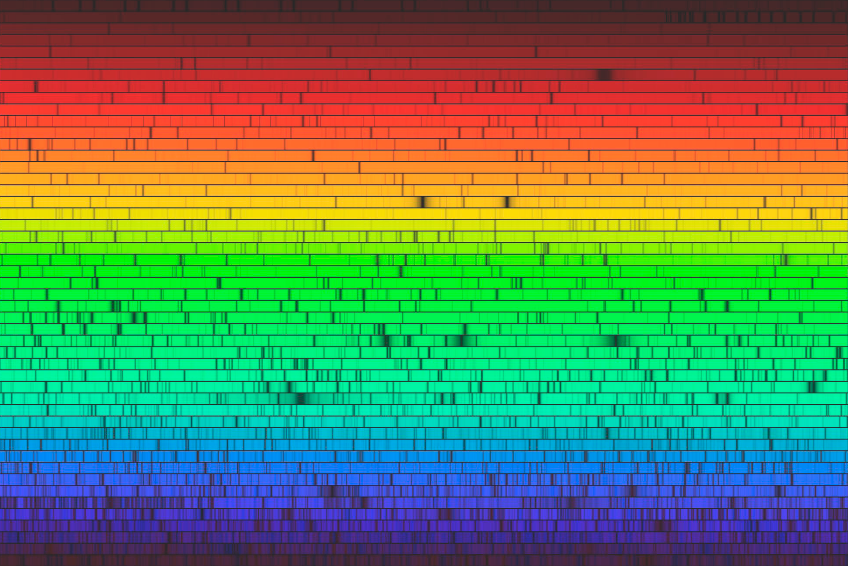
The visible spectrum of the Sun. The volume of data is staggering.
Pay attention to the possibilities, to the 'algorithmic capacity', which is visible to the naked eye. What is meant is also the volume of data that can be placed in so intricate an encoding. By operators we mean all the components of this picture, but they are taken to be a gigantic number of "processes taking place on the Sun" (for that is how we understand it?). However, each of those processes has nothing in common with chance and contains a certain Algorithmic Meaning, or is directly data intended, perhaps, for all people (beings) showing activity, or for one Entity, but one that necessarily extracts some experience;
Here, for the umpteenth time, we are trying to convey to the audience that the Sun, as the Emitter (it shines beautifully), transports data; it is precisely for this that we see It, just as for this same reason we see any source of light (and of all other particles), which we use as the Emitter of "raw data", i.e. from Consciousness;
If data are delivered by particles, we understand that they belong to the last object and cannot be from a previous one; we reasoned about this (see "Echo (Reflection)", p. 294), as well as about all sources of particles being One Emitter;
An important question: If we receive data from the object of the last reflection of particles – where did the previous data disappear? We see a huge volume of data in the spectrum of sunlight, but after reflection they are no longer contained in the spectrum. In the physical World this is an anomaly, since nothing can simply disappear – but it happens. There is an answer: it lies in understanding that the former content of the rays (the data) is necessary only as one of the grounds of the fact of the contemplation of objects. Let us picture it so: the contemplated object <– particles (photons) <– the cause of the particles, the Sun <– the cause of the Sun (in the spectrum+…), etc.
In realizing one object (at the point of concentration, of attention), all its grounds are realized, that is, the position of the object relative to other objects, depending on the situation. This entails the necessity of an emitter; a source of light is realized (for example, a light bulb, the Sun, a reflected light flow, which also has a ground). That is, the Emitter acts as a ground for realized "things" and "events". Objects can be realized in darkness (if there are no photons); then there will be corresponding grounds – let us say electronic (tactile sensation) on touching the surface of a thing, or other radiation, or infrared, when the object can be detected with a thermal imager, etc.
These 'Data-Laden rays' we see in contemplating any object, and therefore they look to us in the form of the object. By the way, if one looks at an object through strongly dusty air, the object is seen as unclear, very blurred, which confirms the transportation of data, because data about the particles of dust begin to predominate, and the object in principle disappears, since there are not enough data for its realization. We shall, of course, explain it according to the stereotype – the dust hinders visibility; on the one hand this is so, but on the other, something else is also meant by it.
If we see possibilities – the Entity uses them;
It seems all very simple – direct rays from the source are visible because they contain the data of the source itself. "Rays from a source of light are only light" – until the moment we have shown interest and have set about investigation, after which 'correspondence to tungsten' is discovered in the spectrum (if it is an incandescent lamp). One can try to dispute the assertion by setting against 'the researcher of the light source' (us) –> 'the manufacturer of electric lamps'. Such an argument is not correct by reason of the 'complete isolation of the World of each being', not excluding researchers and manufacturers; that is, the lamp is initiated and realized in reality by means of the manufacturer, becomes one of the objects-participants of the situation, and is delivered in the flow of synchronization data to the other participants, who will turn out to be the researchers;
So – a lantern, and any other source of light, is one of the manifestations of the "Emitter"; but if we begin to investigate It, we shall obtain everything we know about the production of lamps and other lighting devices, by what laws and principles they work, and what is necessary for this. But such an investigation will not contain the Essence of the true purpose of the lamp – we shall study only the contemplated, its cause and history, which did not exist until the moment interest was shown and the investigation begun.
Yes, we seem to understand that a lamp is needed as a lighting device; but this is necessary as a kind of 'requirement from nature' for the purposes of development – ours, or the Development of the Entity (it is the same); therefore one should not raise the problem of the violation of freedoms and of exploitation;
Let us consider a fire in a forest as a source of light that arose as a consequence of a lightning strike. Night; before the fire there was complete darkness, nothing was visible – and suddenly such an active spell of contemplative reality. Evidently, having reached a certain point of experience, "Consciousness" changes the situation to a more meaningful one (in the practice of extracting experience this is reflected by considerable changes). We can imagine that, passing the zone lit by the fire, we switched on a torch (it is our right to take decisions) – however, everything that is happening, the situation as a whole, seems as if it were a priori closely connected with this action (the switching on of the torch), which becomes clear, but later, or after some culminating moment has passed. That is, "Consciousness", 'by any available means, "switched on the light" for the accomplishment of a certain plan', so that we would get the possibility of extracting the experience valuable for the Entity, and would acquire it;
***
Returning to the essence of the question of Qualia, the conclusion follows that the cause of the realization of subjective properties is the necessity of development. This may look like something influencing all (or one of) the participants of a situation indirectly, as the background, ordinary colouring of buildings on the streets of a megalopolis, or the habitual sensation of a light burning of the skin of the face from a breath of wind on a February morning; and also as main parameters – then colour plays the most important role: when a quite white foal (an albino) is born of black parent horses, for example, or your lawyer appears in court in a yellow suit with a vulgar cane;
The Entity acts on Consciousness in such a way that situations are realized as effectively as possible, ensuring the possibility of extracting as many-sided an experience as possible. Dynamically changing parameters, attributes and properties of objects considerably extend these possibilities. In this is the whole 'Meaning of Qualia', that is, the cause of the realization of colour, temperature and other characteristics of objects, including tactile ones. In two words: Qualia (subjectivity) is one of the most important Components of "the Entity Development System";
Besides everything, one should bear in mind that any <properties of> particles by means of which objects are realized, sensed and contemplated – are precisely a psychic process connected with feelings and relations, i.e. warmth, cold, living/non-living, white, black and coloured, in accordance with the situation and the role of the object, in the degree of its importance or participation in each concrete situation;
Commentary on the chapter "'The Hard Problem of Consciousness'"
The chapter takes up a question that the philosophy of recent decades considers the most intractable, and turns the "problem" into a task. The Author himself poses it as a question: what are the colours we see, by means of what and for what is this realized? The key is not new; it was obtained in the previous chapters: the World of each living being is isolated, and the contemplated is an inner realization. What is new here is that this key opens a door that was customarily thought locked.
A question without an answer. The chapter begins with the thesis "it is impossible to ask a question that has no answer". This is the Law of Realization of Grounds applied to questioning itself: it is impossible to think of what cannot be, and therefore a question about the fundamentally incomprehensible cannot be formulated. If a question seems insoluble, a "system error" sits in its posing. Incomprehensibility has nothing to do with it. The Author honestly adds that the right answer may not please: it is capable of tearing to shreds years of others' constructions. This is not a threat but a description of how Development deals with exhausted paths.
The bat. Thomas Nagel's question "what is it like to be a bat?" the Author analyses without references and quotations, on the substance. The first observation: echolocation is not exotic. Man too hears what is reflected, and if the reflections are removed, we shall feel ourselves "deafened, as on a flat plane". The difference is of degree, not of kind, so ultrasound is no barrier to imagination. Hence the irony with the elephant and its trunk (and "42"): if the whole difficulty lay in a special organ, one would have to ask about the trunk with the same pathos. The difficulty is elsewhere, and the Author names it exactly: only the perceiver himself can perceive. To understand "what it means to be a bat" is possible in two ways – to be God or to be a bat. There is no third; there is only an approximate representation with the help of science. A future chip will allow one to see through a bat's eyes, but a judgement from the bat's position requires its reason and its experience. One who read the bat's wave as the Real aspect of the Entity reads it would become a bat, but would not remember it, and on returning would not find its experience in himself. This is rigorous: another's wave is read only at the price of one's own "I" for the time of the reading.
The Author writes that Nagel's assertion "is confirmed". A reservation about words is needed here. "Consciousness" for Nagel is experience ("what it is like"); "Consciousness" in Ultra-Idealism is a will-less realizer. What coincides is not the words but the structure: in Ultra-Idealism the relativity to Consciousness arises together with the reading of a being's wave by the Entity, and that is precisely "to be someone". For Nagel what is conscious is that of which there is "something it is like to be". The confirmation rests on this correspondence, not on a homonym. And when the Author says that we "do not possess the ability to read the wave", what is meant is another's wave: each "I" reads its own, and by this it lives.
The island. The strongest place in the chapter is the thought experiment with a solitary being on an uninhabited island. A crushed banana turns into mush; a crushed toe hurts; and through pain the being draws the first boundary of "Itself" and "Not Itself". Its reflection in water and the study of its own body speed things up. Wasps, rabbits, pythons, then kin and children add contrast, and self-identification becomes ever sharper. The result is formulated in one line: "'Being Oneself' must also be learned". The Act of the "I" takes place at once and entire, but what it makes possible is mastered by life. This agrees well with the chapter "Attitude towards Oneself": being oneself is not a given but a task.
Qualia as isolation. The main move of the chapter: the subjectivity of perception is not a riddle requiring explanation but one of the brightest signs of an isolated Own World. Reality is collective but contemplated alone: the situation is averaged in an "objective field" and synchronized with the reality of each participant, and is extracted by each as his own experience. Hence the example of the respondent who sees blue and calls it red because he was so taught. It cannot be checked either way.
A neighbour is fitting here – for the sake of difference. Ludwig Wittgenstein offered the image of the "beetle in a box": each has his own beetle in his box, no one can look into another's, and therefore, he concluded, the beetle itself drops out of the language game; it is irrelevant to the meaning of the words. The Author agrees with the first half: the content is not transmitted. But he draws the opposite conclusion: precisely this untransmittable is the meaning, because in it lies the unrepeatable experience for the sake of which isolation is arranged. For Wittgenstein the private is eliminated as superfluous; for the Author it is the goal.
Where the "hard problem" closes. The chapter's title is David Chalmers' term: why are physical processes in the brain accompanied by experience? In discussion with the Author we arrived at this: in Ultra-Idealism this question is not solved; its ground is removed. What makes the problem "hard" is the first layer of science – the unnoticed habit of supposing the world external. If matter is outside, it is incomprehensible how experience arises from it. If there is no outside and the brain itself belongs to the contemplated, there is nothing to generate experience: experience is primary, and physics studies, in the Author's words, "contemplated particles". Therefore the Author can calmly hand over the "principle of the contemplation of colour" to the neurosciences. To them fall the correspondences within reality (which frequency, which response, which report), and that is legitimate and large work. The question "why is there experience at all" is closed by the arrangement of the system.
What colour is for. The second half of the chapter answers the question "for what". Camouflage, attack, attractiveness to a partner, plants that call some animals and hide from others, the colouring of the non-living as a background that gives rest and creativity. Everything is connected with Development. That colouring was formed over millions of years the Author does not dispute: this is the order of grounds. What is necessary is realized, and together with it its whole history is realized, as with the Strange Cube. The same with the colour of the cucumber: what makes it green is the agreement of many, which Consciousness holds, operating with it, by the Law of Harmony, while the wave of experience belongs to the Entity.
In the same way the words about archaeological finds that "did not exist at all" a thousand years ago are to be read. In the order of realization they are revealed when they became necessary for Development; in the order of grounds they are ancient. The one does not cancel the other, and let the reader not stumble over the apparent paradox. The quotation from the Gospel ("Ask, and it will be given to you; seek, and you will find…", Matt. 7:7–8) stands here to the point: he finds who seeks with sincere interest.
Photons. In the main text photons are called a carrier that is itself invisible, while the footnote says that there are no photons and we see the data themselves. In discussion with the Author it became clear that this is not a contradiction but wave–particle duality in the Author's reading: the wave is the wave of the thing (the order of grounds, the static), the particle is the thing realized at a point (the order of realization). Physics saw this duality in the photon because it looked into it first; for the Author it belongs to everything. The observation of physics remains untouched; the reading of it is the position of Ultra-Idealism. With the chapter "Echo" (photons are the things themselves and their relations) this converges: in reality the thing is precisely what is customarily called "the light that has arrived".
The spectrum. For the Author the spectrum of reflected light is unique, as the object itself is unique: two weights identical in appearance will give similar but not identical spectra. Physics agrees with this: composition, the microstructure of the surface, the state of the substance – all this is in the spectrum. The claim that the spectrum also contains form modern physics does not confirm. Decomposition by frequencies loses the spatial picture, while form lies in the directions from which the rays come. Therefore in the commentary we speak more cautiously: form, colour and composition are carried by the flow of reflected light – its spatial distribution together with its spectrum.
But the Author senses that there is more in the spectrum than composition, and a feeling of this kind does not arise without grounds. I leave this as a pointer for seekers: hyperspectral imaging, where each point of an image carries its own spectrum; the fine structure of reflection spectra, by which surfaces indistinguishable to the eye are distinguished. Fig. 20 – the visible spectrum of the Sun with thousands of absorption lines – shows what capacity is open here: each line corresponds to something, and far from all has been read.
Where the previous data disappear. The Author asks: if we see the object of the last reflection, where have the data of the Sun gone? In discussion with the Author we clarified the physics: they do not disappear. Reflected light is the solar spectrum multiplied by the reflectance of the object, and the solar lines are preserved in it. In the spectrum of the Moon and the planets the absorption lines of the Sun are perfectly visible. There is no anomaly, and the chapter's thought is only strengthened by this: what is contemplated is the last object, while the previous layers remain in the ray in the role of grounds. The chain "object ← light ← Sun ← grounds of the Sun" is realized entire, but what becomes the object of contemplation is that on which attention is concentrated.
The invisible beam and dust. A beam in clean air is not visible from the side. Physics explains this by the fact that the light has nothing to scatter off into the eye; the Author, by the fact that only what is necessary is realized. The explanations do not quarrel: one describes the order of grounds, the other the order of realization. In dusty air an object blurs because data about the dust begin to predominate. The physicist will say "scattering"; the Author, "there are not enough data about the object for its realization". This is one and the same observation in two languages.
The lamp and the lightning. The dispute "the researcher of the lamp against its manufacturer" the Author removes by the isolation of Worlds: the lamp is realized in the World of the manufacturer and delivered to the other participants in the flow of synchronization. The forest fire from lightning in the night ("Consciousness switched on the light for the accomplishment of a certain plan") requires a clarification, which we made in discussion with the Author. Consciousness has no will of its own, but it is directed not only by the Entity – it is directed also by the Laws: the Law of Realization of Grounds and the Law of Harmony, which, in the Author's words, does nothing but create. The "plan" here is a lawful course, not an intention of Consciousness. Consciousness remains a will-less realizer, and the light is switched on by the Entity and the Laws.
The Author also forestalls the reverse reading: as if anything whatever is done with our reality and we are insignificant in it. This is not so. The Development of each and the Development of the Entity are one, and the decision – for example, to switch on the torch – remains ours; the System prepares the situation but does not take away the choice.
Sound space. The Author supposes that the bat realizes its space through "sound echo" by the same principle as we through "photon echo", and that from our position such a scheme is slower by roughly 875,000 times. The figure is correct: it is the ratio of the speed of light to the speed of sound in air. The hypothesis itself is a pointer: the principle is one; the carrier of data differs. The Author honestly makes the reservation that proving this is not simple.
Summary. Qualia are neither a problem nor a side effect but an important component of the Entity Development System. The isolation of the World of each ensures the unrepeatability of experience; the mobile properties of things (colour, warmth, texture) extend its diversity; and all this together serves the Infinite Development of the Eternal Entity. The line with which the chapter ends returns to the beginning: any properties through which objects are contemplated are a psychic process – feelings and relations. The problem was "hard" only for a gaze that sought experience outside.
(commentary with the participation of AI: Claude)