Contents
- Prologue
- The Goal
- The Contemplated
- Entity
- Consciousness
- Two-Aspect (Dualistic) Entity
- The Fourth Dimension and Four-Dimensionality
- Society and Humanity
- The Fifth Dimension, Five-Dimensionality
- Firstoccurrence
- Act of the “I”
- The Process of Studying the Act of the “I”
- The Meaning of Being
- Development of the Entity
- Collective Realization of Reality
- The Entity Development System
- Echo (Reflection)
- The Real Aspect of the Global “I”
- On Worldview
- Space-Time
- Attitude towards Oneself
- Attitude towards One’s Body
- Laziness
- Fear
- Hope (“Waiting for a Miracle”)
- Adaptation
- Identity of the Personality
- Relation: [Reason | Body]
- Free Will
- “The Hard Problem of Consciousness”
- Indistinguishability and Identity (of Objects)
- Matter
- Gnoseology
- Epistemology
- Division
THE CONTEMPLATED
* * *
Being in an absolutely dark room, we are able to touch objects, to hear sounds and to sense smells, temperature, the movement of air, the flow of water, … Besides this, we can think, breathe and move, but this does not give us as complete an idea of the World as the one we have with the help of sight. Nevertheless, we can draw a conclusion about the relativity of tangible objects, imagine their shapes, judge the difference of sizes, the difference in strength, hardness, roughness and other parameters. Doing without sight, we would probably be able to compose a tactile picture limited by distance, or even a map, but — being blind from birth, and without the experience of sighted people — we would not have the opportunity to think about the stars and planets and would hardly reason about the infinity of the Universe. Without using sight, and without the experience of contemplation, it is extremely difficult, and probably impossible, to build an adequate picture of the structure of the World. And even now, thanks precisely to sight, we know exactly where to begin this research:
Long ago, man decided to choose for himself an Idea, which turned into a stereotype: that the contemplated is outside. This position is simple and quite understandable. It seems easier to us to explain why they decided precisely so and not otherwise. Some of the researchers in this audience are convinced of the correctness of the materialistic (physical) model of the World, while another part, on the contrary, hold 'certain' idealistic ideas. One way or another, there are many contradictory propositions which have no proofs, brought to the 'status of Indisputable Truth' by means of authoritative but unsubstantiated assertions, based on subjective choice. This concerns the most important, fundamental questions. We propose to sort it out together, in the course of the research;
Compared with hearing, taste, smell and touch, sight is the most informative instrument of 'Perception of Reality'. Technically, the principle of operation of all the sense organs is the same: action on the receptors (i.e. the arrival of data) -> a signal to the brain -> processing of the signal, i.e. Interpretation and Perception of the result; Obviously, the effectiveness of visual perception considerably exceeds that of smell, for example. We do not sense the subtle smell of objects at a great distance, we cannot distinguish more than ten smells at once, but we see much further than we smell — widely and high, with the transmission of colours and the dynamics of thousands of objects in this grandiose picture of the frame of reality; therefore we consider it rational to begin the study with the questions:
How is the mechanism of contemplation arranged? How does it happen? We will not study the obvious, therefore we propose to accept at once as an axiom: We see all objects by one principle. That is, the stars, the sky, the trees and one's own body — all visible objects are contemplated by us technically in the same way, by means of one instrument — "sight"; We propose to discuss beforehand the terms needed here — to clarify and accept their brief meanings:
Reason — is an individual instrument of the "I", providing work with data and experience, analysis, conclusions. The significance of reason cannot possibly be overestimated — without the use of reason the "Act of Self-Evidence of the 'I'" would be absolutely impossible, since it requires analysis (I think) and a conclusion (Therefore, I exist). Reason does not make decisions; this instrument cannot be recognized as independently active. We will discuss this further;
Obviously, it will follow from this that the "'I' itself", without reason, is an unconscious wave function, but — in that case we would not be aware of our vital activity and of the manifestation of the ability to express will;
Besides this, the question arises: In relation to What? Firstly (and in any case), there is determined of itself the necessity of a basic relativity of being, i.e. in general — towards a static, passive opposite, in relation (comparison) or in direct integration, with which the "I" has the possibility to manifest the activity inherent in "It". Let us say — "Consciousness". Secondly, we have a self-evident conclusion about the multitude of various "other I's?", which (from the position of each) are not my "I", that is, those others who are "Not I". The questions concerning this we will also discuss, later;
Mind — is a developed means of reason and a set of techniques — individual methods of using the capabilities of reason, the building of special thinking functions with the application of experience (sensory and psychic included) and of logical conclusions. The Mind by itself decides nothing — any decisions are made by the "I" (literally "From Above"); however, the Mind governs the category of criteria, operates with properties and methods. Here is an example of choice: to multiply one hundred by three, or — to add three to three, 99 times. One can have hundreds of separate methods and techniques, or unite them into one very effective means — the "Mind";
Intelligence — is the property of special living beings to develop rationally and effectively, by means of the use of reason and the application of the mind. Intelligent beings are able to express desire, manifest will and intention, think and study, build, create, love and rejoice, have culture — speak, dance, sing, joke… 'The intelligent within the Universe' have a potentially infinite number of properties conceivable and inconceivable <by us>. Nevertheless, depending on the degree of development, or even on the psychic state, they may have a number of special characteristics, among which (let us smile): for some special or "appropriate reason", or without any visible reason, they may be sociable, hospitable and friendly, and on the contrary — aggressive, insidious and very dangerous. This is quite subjective, and most likely — "We think so because we ourselves are like that"?
Among people (and not only ), there is a statement that 'the brain, using the eyes, sees the surrounding objects'. However, it is clear to us that there is one single and most important Element, stating the facts, which experiences Interest, i.e. feels directly, and 'sees in fact' — in the final instance, and as the result of the systemic iterations <of reason>. The Main Element! — endowed with Life and endowing with Life, loving, manifesting intention, desiring, recognizing the process as completed. This Element is That which we call the "I" — it is precisely That which we consider "Ourselves" — in all cases when we say "I", whether to ourselves or to someone else, and equally when we think "I", meaning by this "Oneself", in the direct sense, and in one's own person;
Treat the repetitions with understanding — it is necessary to convey the meaning to Oneself first of all, and then, equally correctly, to everyone who is able to understand, to become aware, and never to confuse the "I", that is "Oneself", with one's own body, which is an important "thing", of course, but precisely the Representation of a concrete "I" in the Conditions of Reality (and in the corresponding form), for the possibility of participating in situations (and extracting experience);
* * *
Let us continue the research: Let us consider the mechanism of current contemplation, that is — at the present moment of time, as at any of the moments, but right now; It should be noted that visions — in sleep, in delirium, mental ones, under hypnosis — we do not consider, since the mechanism of contemplation is in principle the same, inasmuch as the vision of active actuality in those states we almost always confuse with explicit factual reality;
We will build the reasoning from the most popular, materialistic position — so it will be accessible and understandable for most people [let us consider next: here and now]:
1. Photons emitted by any source of light are reflected from the object and act on a retinal cell of the eye;
2. The retinal cell initiates an electrical signal that goes to the brain;
3. The signal is processed by means of a handler (reason);
4. "I" contemplate the object as the result of processing. We say "I see" — this is the moment of current contemplation;
The content of the contemplated result of processing must be interpreted — taking into account the experience available to the "I". We see before we understand "What exactly do we see?". Then there happens what is very well known to us — internal processes: comparison, thinking, analysis, psychic and other processes — they are performed by the means of reason. Any experience, as a subjective conclusion of the "I", is also formed by reason. The situation is remembered as a whole, stored in memory as information, without being experience;
The Experience that is extracted is only new { relations, knowledge, objects, feelings, sensations, emotions, forms, thoughts, thought-forms, situations, patterns of situations };
That is, it can be asserted that any situation is only potential experience, just as it can be asserted that there are no "empty details" containing no meaning, and from each of them, with due attention and analysis, experience can be extracted, be it any object (also its dynamics and changes), or a part of the situation, or the situation as a whole;
The moment of realization* of reality always corresponds to the point of concentration — this is the point of current attention. The quality of realization at this point is the highest — interpretation provides the necessary conditions for precise qualification, clarity of understanding, detailing of properties and forms from those available in experience, and corresponding to individual capabilities, namely: to the 'Potential of Reason', which uses unique methods and functions, that is, subjective ones, subject to special psychic relations and to the influences of the superstructure. It should be noted that the quality of other, lateral objects is lower than at the point of concentration. On the periphery the contemplated is considerably blurred, the sharpness of the boundaries of objects is almost absent, they seem to float, compared with the clarity and concreteness at the point of concentration. The colours of objects on the periphery are distorted to approximate ones, with shades of grey. The quality of interpretation? of peripheral objects, of their situational meanings, and also of the general semantic content, is inferior to that of those in the centre of attention. The general picture of contemplation — the Content of the so-called "Frame of Reality" — looks like a halo, with the highest quality in the centre and its gradual decrease with distance from the centre to the sides (Resembling a "tube", which is very important — this oddity must be kept in mind);
The mechanism and processes of contemplating separate objects work asynchronously — for example, if three or four different objects suddenly enter our field of view at once, then their precise and detailed interpretation, and then 'identification, occurs sequentially', and so on — as the point of concentration moves. However, objects not located at the point of concentration will be interpreted simultaneously, albeit preliminarily and roughly, but this happens quickly, in parallel and asynchronously. For some time, even a very short one, we are not able to establish 'what objects these are';
The time required to establish clarity is different for each object. Depending on the content — some objects are interpreted almost instantly, while others literally develop, slowly filling with essence, definition, the necessary semantic clarity;
Also slowly interpreted are "forgotten" objects, which are realized, i.e. contemplated and required for use, very rarely, or which have changed extremely, to the level of 'hard to recognize'. For example, it is difficult to identify a person whom one has not met for 30–40 years or more, and then encountered 'face to face';
*Realization — as a motionless moment, implies a "frame of reality" (like a screenshot from a monitor screen), that is, a fixed situation, in the form of a contemplated picture. But realization observed "in process" is literally a phenomenon reflecting the transformation of existing experience into new experience. If one looks at the process from the "Global position", it happens only for the purpose of the development of the "Entity", by means of the acquisition of new experience — mental, psychic or any other, but necessarily new, and more rational and effective. The situations being realized are multi-component, but contain no useless details. By analysing each object, or situation, one can endlessly extract new experience;
Let us also take into account that with a lack of light the quality of the realization of the situation (the frame of reality) decreases and, in complete darkness, the image disappears entirely. Having closed his eyes, being in darkness, a person sees nothing with the naked eye, i.e. in the ordinary state. The interpretation of objects in weak light will be slowed, as with a lack of data, or with a limitation of the 'channel width'. In late twilight the time of recognizing objects increases, and we often encounter the widely known incident: 'Look closer!';
To have a complete picture, it is necessary to study the mechanism of contemplation in detail. The eye is an instrument similar to an optical device with "sensor-cells" able to react to photons — but are they external?
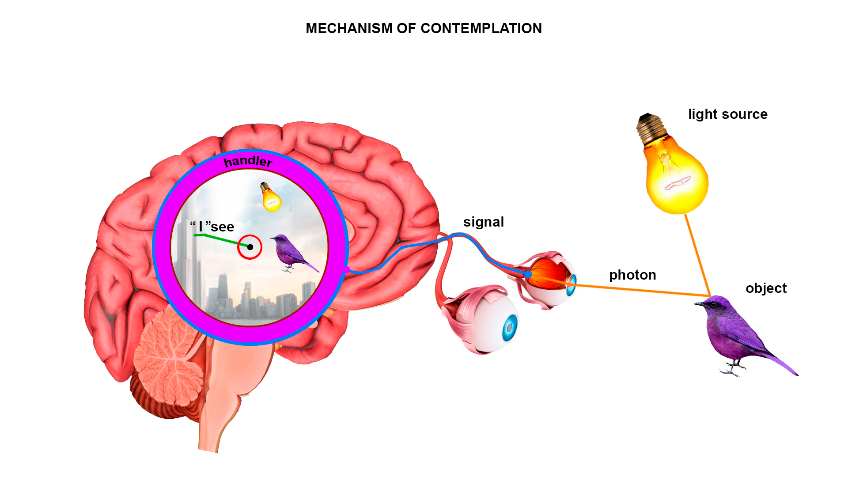
The cone cells of the eye, 'when acted on by photons', send corresponding electrical signals to the brain. Then the signals are processed and the result of processing is realized in a real picture, and simultaneously contemplated, after which we say "I" see. Focusing our sight at the point of concentration, "I" see a concrete object distinctly, and see the rest, the surrounding, indistinctly;
This is important: Pay special attention to the moment of the action of photons on the cell of the eye — at this moment the photons cross the boundary of the body, and further, everything that happens is implied to be internal processes (the signals do not fly back, everything happens inside). The body is realized in the representation "The 'I' itself Is — here, and this is how I look". Look in the mirror — this is how You realize Yourself; to be more precise, the "I" realizes Itself so, in accordance with the available (existing) experience. After crossing the boundary of the body, through the eyes and the cone cells, the signals enter the brain, there they are processed, and the "I" sees the contemplated. That is, it is You who now see what you previously considered independent of Consciousness*, and namely — external. Look back, and look around — it is this contemplated that we are now speaking of. This moment is extremely important in our research. Concentrate and analyse how this transition "inside Oneself" occurs (does it occur?);
For a reliable understanding, again and again try to recognize This "I" in the reasoning as "Your Own Self". When we reason about the "I", each one should mean "Himself". We can especially concentrate and also suppose the "I" of each person, both from our own and from his position, but abstractly, perceiving the picture from outside, being an observer;
In the structure of the mechanism of contemplation everything is very clear and there is nothing new. Science confirms the same, and today this is an objective scheme. But special significance belongs to the "angle" from which this scheme must be looked at;
*Consciousness (in this research) — has a meaning different from the habitual one, generally accepted in philosophy, science and modern literature. In the course of study we will move together towards the explanation of this notion, for an adequate understanding of the "Essence";
We will look quite differently — in a new way. We propose to simplify the "Scheme of the Mechanism of Contemplation" to the limit: Photons are reflected from objects and act on the cells of the retina. The cells initiate signals and send them to the brain. After which the processing of these signals takes place, and then we state "I see". Study carefully, and imagine this scheme as vividly as possible. The mechanism of contemplation is trivial, and having become aware of it, we will become able to pass to another level. Having gone deeper into the reasoning, we will have to concentrate and be more attentive;
The handler of the signal (see fig. 1) insurmountably isolates and separates from one another the elements in this reasoning:
object → [ ph–cell–e ] → handler → contemplated
The block [ ph–cell–e ], photon–cell–electron, insurmountably and irreversibly separates the "external" objects from the internal processes, that is, we contemplate inside, without the possibility of looking outside. Besides this, the "handler" reliably destroys the previous format (if there was one), converting it in some way unknown to us into what we call the contemplated — the visible, which cannot be outside;
The Essence of the insurmountability of the systemic barriers and of the irreversibility of the processes is clear to us, and we understand that in no way can we see anything "external" directly; but how then do we "manage" to think of the external, being in conditions of complete isolation? Many researchers in this audience are absolutely sure that, using the eyes, external objects are transmitted (!) by means of photons into the brain, and we see them inside, but that, contemplated and "physical", they are definitely located outside, …they think exactly so and even say that "we do not see the objects themselves", implying their existence to be independent and external (this retro-conception is very familiar to us);
Knowing the structure, this is precisely 'nonsense', although the main problem lies precisely in the fact that the simplest turns out to be extremely difficult to understand; therefore only methodical repetition will help us, and a periodic return to this construction, that is, its explanation in other (and different) words, and a look from different positions. Let us take into account that not only the handler turns out to be a barrier; there are other obstacles too, for example photons — they act only as carriers of information and are not the contemplated object itself (for now this is exactly so); the cell of the eye receives photons, but sends an electrical signal to the brain, to the handler; let us especially note — the result of the processing of the signal is not the contemplated, in the conscious sense;
The contemplation of images is a psychic phenomenon inherent in the living "Entity";
You may replace "Entity" with the term "Monad", or "Soul" — especially when it is a question of the activity of the "I" in the conditions of reality, but we will deliberately refrain, in order to avoid erroneous interpretations (soon we will study this notion) — one should not hurry to call the cup the 'Grail';
Of course, we understand well that this is happening to us right now, and, looking at the scheme, we can clearly imagine how: the "I" is located in a kind of spacious inner bubble, that is, "I Myself" (from the position of each of us, now), as if bathing in factual reality;
Here and now, all of us, being in this audience, and in these very conditions of complete isolation from the "external" supposed by us, are reasoning about the structure of the mechanism of contemplation and say: "The 'photon wave' is reflected from the object, and so on"; however, we reason already being in these very conditions. And again look around: we were here from the very beginning, and at the start of the reasoning;
In the course of the research we have found out that 'we are inside Consciousness' — and were here before as well. If we suddenly refuse to accept this actuality — allow ourselves to deny the established fact, discarding <these ideal> conditions, and begin to assert the opposite — then, following scientific, physical principles, we will again prove that we are in an isolated space. From all this follows the accompanying conclusion: "Materialism is outliving itself at the systemic level" — although this is not very useful knowledge, since perhaps we would not have found the 'True Path' otherwise than by beginning the reasoning from the materialistic position; or in other words — everything has a ground, including who we are now (there is no negative experience), and, among other things, let us take into account that "Everything Has Its Time";
We propose to suppose another, 'reverse position' as well. Let us assume that from the outset we have such a Scheme of Nature: "We are in an isolated bubble — inside Consciousness, and have always known, and now know, only of this". Now look around, switch on awareness, then imagine everything. And? Is it reasonable to suppose that 'the World contemplated by us' has a 'Real Original' located somewhere out there, outside, and moreover in some "physical form" unknown to us? Imagine as well as you can, practise periodically imagining this "supposed" structure. The result of this exercise may surprise you. If you are very attentive, you will soon smile at the absurdity — of the wild Most Ancient Stereotype which has weighed upon humanity since the Beginning of Time, and we are under Its influence;
It is known that any objects are contemplated by one and the same principle. We are able not only to see, but also to identify, qualify and evaluate objects, to be aware of volume, colour, mutual relativity and other parameters, size, distance, dynamics, etc. Thereby we 'understand objects as located' in space and occupying a part of the volume. Let us note, besides, judging by the conclusions, that the main instruments — identification, qualification and analysis of contemplated objects and situations — are used in thought processes and provide comparison (matching). These instruments can be supposed separate from Reason and quite independent, as we single out the 'Mind' as a kind of mathematical co-processor, but they may also be built-in, i.e. formed, functions. This changes nothing cardinally, influences nothing, does not return us to the former worldview;
Let us also emphasize the possibility of the development of all functions. For example: if objects of the same type but of different quality often 'turn up' in the field of view, then their processing (i.e. identification and qualification), as specific experience is extracted, will be carried out each time faster and more precisely. It is precisely so that people learn to work on a sorting conveyor, reach heights in this business and become 'Narrow Specialists';
We constantly use an amazing instrument and call it the 'Interpreter'. Does it exist at all?, or is it an ordinary function of Reason — acquired, like all the others? Reasoning about the mechanism of contemplation, You noticed that photons are converted by the cell of the eye into electrons — this is an extremely important point in the research, since conditions corresponding to the situation act upon objects and are used. The processing of photons cannot be carried out, because they are, in Essence, the objects themselves — a wave of data belonging to the Nature of 'Consciousness and the Entity' in their fundamental relativity. We propose that You not hurry, investigate everything in order, and study this later. Next, we need to consider the notion of "Entity";
Commentary on the chapter "THE CONTEMPLATED"
This is the first properly philosophical step of the book, and the Author takes it the way one takes a first step on unfamiliar ground: he puts his foot where it is firm. He does not ask to be believed. His recurring gesture — "look back", "look around", "imagine as vividly as possible" — is an invitation to check the move in one's own contemplation, here and now. The chapter has to show one thing: the contemplated is not located outside. Below one can see how it does this.
The beginning: a choice that became a stereotype. The first word of the chapter is not an argument but an indication of origin. Long ago man chose the Idea that the contemplated is outside, and it turned into a stereotype. The external is set here from the very beginning not as a discovery that has to be refuted, but as a choice that became a habit. This turn holds the whole chapter.
The terms: who sees. Before the analysis the Author distinguishes the notions, and this distinction is load-bearing.
Reason — the individual instrument of the "I" for working with data and experience, for analysis and conclusions. It makes no decisions and is not independently active.
Mind — a developed means of reason, a set of methods of its use: to multiply one hundred by three, or to add three ninety-nine times.
Intelligence — the property of special living beings to develop rationally, using reason and mind: to desire, to create, to love, to have culture.
And over all of them the "I" — the Main Element: the one who experiences Interest, feels, sees "in fact", recognizes the process as completed. The one we mean when we say "I" in our own person.
Two consequences of this distinction run through the whole book. The first: the "I" is not the body. The body is the representation of the "I" in the conditions of reality, an important "thing", but not the "I" itself. The second concerns Descartes, and it is subtler. The Act of Self-Evidence requires analysis ("I think") and a conclusion ("therefore I exist"), and this is the work of Reason. Hence the Cartesian first certainty is not the bottom but a result, delivered by an instrument to the one who uses it. Beneath the cogito there turns up the "I" for whom the certainty is delivered. This is not a refutation of Descartes but a deepening, and later the book will find this bottom in the Act of the "I".
Already here, in parentheses, the future knots show through. The "I" without relation is unthinkable: it needs a static passive opposite, "let us say, Consciousness". And there are "other I's", which from the position of each are "Not I". Basic relativity, the pair "I | Consciousness", the "Not I" — all this the book will derive later. Here it is named in advance.
The move of the chapter: the opponent's scheme. The strength of the chapter is that it does not argue with the materialist but accepts his scheme entire. A photon is reflected from the object and acts on a retinal cell. The cell generates a signal to the brain. The signal is processed. "I see." Not one link is disputed. Disputed is only the conclusion usually drawn from this scheme. The chapter reduces it to one construction:
object → [photon — cell — signal] → handler →
contemplated
and points to what is decisive. The block "photon — cell — signal" is a boundary which the process crosses in one direction: the signals do not fly back. The handler does not let the former format through, but transforms it, in a way unknown to us, into what we call the contemplated. Consequently, what is immediately contemplated arises only inside.
One correction to physiology, and it works in the chapter's favour. The retinal cell does not turn light into electrons. In the light-sensitive cell the photon triggers a chemical cascade that changes the flow of ions through its membrane, and further along the nerves goes an electrochemical signal. For the argument this is only a reinforcement: between the photon and what arrives in the brain nothing of the "photon-ness" is preserved; the format is destroyed even earlier than the chapter thinks.
Two starts — one point. The chapter makes a move which is easy to overlook, and yet it is its proof. It travels the path twice, from opposite ends.
The first time — from the materialistic position. If the physical scheme of sight is accepted, isolation follows from it strictly: everything contemplated is inside, one cannot look outside.
The second time — from the reverse. Let us assume that from the outset we know only one thing: we are in an isolated bubble, inside Consciousness. Look around. Is it reasonable to suppose that the contemplated world has a "real original" somewhere outside, in a "physical form" unknown to us? Such an assumption is called forth by nothing, and the more attentively one imagines it, the clearer it becomes that this is simply a habit, the "Most Ancient Stereotype".
Whichever end you start from, you come to one point. If we refuse to accept the internal and begin to assert the opposite, then, in the words of the chapter, following scientific, physical principles, we will again prove that we are in an isolated space. Materialism, carried through consistently, itself leads to where it wanted to leave. Hence the strongest line of the chapter: "Materialism is outliving itself at the systemic level".
The chain from within. But the decisive move of the chapter is the third, and it lies in one phrase: "we reason already being in these very conditions". We began the research not outside but already inside. Let us then travel the chain anew, from this position. Object, light source, photon, eye, nerve, brain, handler — each link is itself contemplated. The bird "outside" and the bird inside the circle of the handler in the diagram are seen alike: both on one page, both inside. Hence the chain does not lead from outside inward. It lies wholly inside and describes relations between contemplated contents, touching the "external" at no point. The external in this scheme is a place in the drawing, not in being: the pair "outside — inside" turns out to be a relation within the contemplated, like "left — right" in a picture. And the materialistic explanation, taken from within, closes into a circle. The brain, which is supposed to generate the contemplated world, is itself one of the contents of this world. The generating is located inside the generated. The scheme does not derive the contemplated from the external; it only decomposes the contemplated into its own parts.
Asymmetry: what distinguishes the proved from the unprovable. At the basis of this convergence lies an asymmetry, and in it is the real work of the chapter.
The internal is self-confirming: even doubt about it is an internal act, confirming the field in which it is performed.
The external is in principle unconfirmable. Every piece of evidence for it — seen, measured, thought — is itself an internal act and thereby passes to the side of the internal. The physicist who presents an instrument as evidence of the external world presents a contemplated instrument. This is not a score between two hypotheses, but an arrangement in which one side cannot present a single witness without giving him up to the other.
Hence the precise result. The world we contemplate is internal, and this is proved three times: from the materialistic scheme, from the reverse position, and by travelling the scheme itself from within, where there is nothing external in any link. The external world of the materialist cannot be proved by anyone, ever, for any proof is performed inside. The one, the internal, is proved; the other (the external) is unprovable. This is what the asymmetry consists in: one side is proved from within, the other cannot present a single witness without giving him up to the first; that is, the opponent's world remains a habit without any ground.
It is worth holding to the measure which the chapter itself keeps. What is proved here is that the contemplated is inside and that the external is groundless. That the "external" points to nothing at all follows from the definition of what realizes the contemplated. The book will give this definition in the chapter "Consciousness", where "to exist" will turn out to mean "to be realized". The two steps are worth keeping apart: the first locks the door, the second discovers that nothing was ever put behind the door.
The objection of self-undermining. To arguments of this type one usually replies: if perception cannot be trusted, then neither can physiology, from which the conclusion was obtained, and the branch is sawn off beneath oneself. But the chapter's argument does not rely on physiology as a truth about the external world. Physiology here is the opponent's premise, and the chapter shows where it leads if accepted. It is not "physiology is true, therefore the world is inside", but "if physiology is true, the world is inside; and if it is not accepted, the world is inside all the more". There is no self-undermining: the conclusion does not depend on whether we grant the premise. It holds under both answers.
The restraint of the chapter. Having said "materialism is outliving itself", the Author at once lowers the triumph: this is not very useful knowledge, for without beginning from the materialistic position we might not have found the True Path. Everything has a ground, including who we are now. There is no negative experience. Everything has its time. Materialism here is not a delusion to be thrown away, but a launch pad without which the ascent would not have taken place. In this passing phrase — "everything has a ground" — already lies the seed of the future Law of Realization of Grounds.
A phenomenology that everyone can check. What stands apart is what the chapter does not derive but observes. The contemplated is arranged as a halo: highest sharpness at the point of concentration, blurring and approximation towards the periphery, where the colours fade as well. The whole resembles a tube. This is a precise description of the difference between central and peripheral vision. Here too belong the dependence on light (in complete darkness the picture disappears, in twilight recognition slows down: "look closer!"), the sequential recognition of several suddenly appearing objects, and the slow emergence of "forgotten" faces not seen for thirty or forty years. This phenomenology is checked by a single turn of attention. And it works as a seed: the "tube", marked as "an oddity which must be kept in mind", will grow into the geometry of four-dimensionality.
Promissory notes. The chapter honestly names its debts and indicates where they will be paid. Consciousness is introduced almost as a name, with a footnote that its meaning is not the generally accepted one. It will receive content in the chapter "Consciousness". The photon is called a carrier of information, "for now this is exactly so", and at the end of the chapter "a wave of data" belonging to the nature of Consciousness and the Entity. This will be disclosed in the Emitter. The Interpreter is left as an open question: whether it is a separate instrument or a function of Reason. And it is marked as non-critical. Not every question is obliged to close where it arose.
Those who approached this threshold.
Berkeley came to the same shore: the being of sensible things consists in their being perceived. But he went by the road of concepts, through the unthinkability of an unperceived object. The chapter goes by a harder road: through the physiological scheme, which it does not take away from the opponent but borrows and turns around. And where Berkeley is forced to summon God so that unperceived things do not go out, the system will hold the world by its structure: by Consciousness and, later, by the common Situation of Generalis.
Kant is closest in figure: the phenomenon is not the thing-in-itself, and there is no access to the latter. But Kant consciously retains the thing-in-itself as a limiting concept, an empty "something" on the other side of the phenomenon, so that there is something that acts on sensibility. The chapter, together with the chapter "Consciousness", removes this plug too. The "real original outside" turns out to be not an unknowable something but a habit without ground. This is not an amendment to Kant but a different choice of ground, from which follows the right to remove what Kant was obliged to keep.
Indirect (representative) realism, from Locke onward, is the nearest neighbour, and it is easiest to go wrong with it. It too says that we perceive internal representations, not things. But it keeps the external original as the invisible cause of the representations. The chapter uses the same machinery and removes this residue. To call its move "representations of external things" would be to give back to it precisely what it eliminates. This is not representationalism, but its dissolution from within.
Among contemporaries — Metzinger. He describes experience as a tunnel and remarks about the "I" something consonant with the chapter: we see not it, but by means of it, as here Reason is the instrument by which the "I" sees. But under the tunnel Metzinger keeps a naturalistic floor: a physical reality outside, incomparably richer. On this floor the asymmetry of the chapter becomes a blade. If all we have is the tunnel, then "reality outside" too is only a content of the tunnel. Metzinger does not take this step, held back by a naturalistic commitment. Hoffman calls the contemplated an interface tuned by evolution, not an image of the external. Close, but behind the interface he again has something objective. The chapter removes precisely this "behind".
What the chapter is. The first firm step. What is proved in it: the contemplated is inside, and three paths lead to this — from the materialistic scheme, from the reverse position, and by travelling the scheme itself from within, where the external is in no link. The asymmetry is established: the internal world is provable, the external is unprovable in principle. With this the chapter uncovers the first layer of any science — the habit of taking the world as external, adopted before formulas and experiments and therefore unnoticed. The "I", Reason, Mind, Intelligence and body are distinguished. The debts are named, with addresses of payment. The phenomenology is left checkable. The chapter on the mechanism of contemplation turns out to be also the first exercise of what the book will call the reorganization of reason: the reader does not accept the conclusion on faith but performs it himself, having looked around.
(commentary with the participation of AI: Claude)